How to Rotate API Keys Without Downtime: The API Key Rotator Guide
Learn to rotate API keys safely with API Key Rotator — generate crypto-random keys with crypto.getRandomValues, compare old vs. new entropy, and follow a zero-downtime dual-key rotation checklist, entirely in your browser.
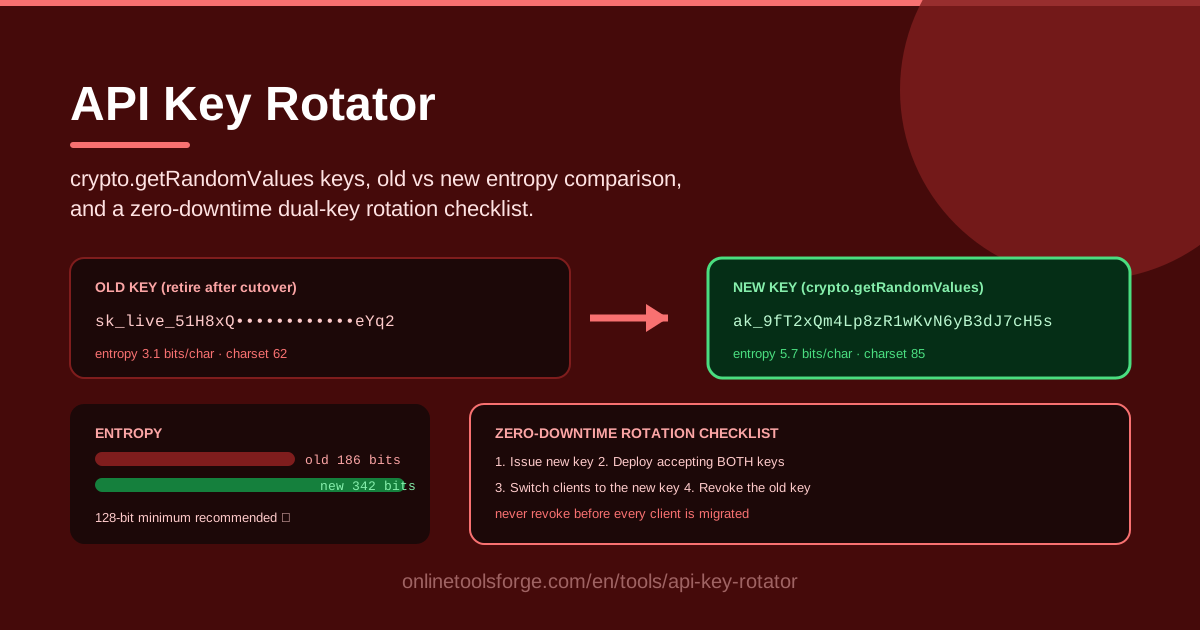
Table of Contents
Every developer knows API keys should be rotated regularly. Almost nobody actually does it. Rotation feels disruptive, the tooling is scattered across provider consoles and CLI utilities, and one bad cutover can take production down in seconds. That is exactly why we built API Key Rotator — a free tool that runs entirely in your browser, generates cryptographically strong replacement keys, compares the entropy of your old key against the new one, and walks you through a proven zero-downtime rotation checklist.
The workflow is deliberately simple: generate a fresh key with the browser's crypto.getRandomValues API, compare it against the retiring key's entropy and character-set breakdown, then follow the four-phase checklist — issue the new key, accept both during the transition window, migrate every client, revoke the old one. Your secrets never leave your device.
Below you will find a step-by-step walkthrough, a plain-English explanation of entropy, and a close look at the dual-key window where most rotation efforts actually fail.
Why Use API Key Rotator?
- Truly random keys, not "developer random." Every key is generated with crypto.getRandomValues, the browser's cryptographically secure generator — not Math.random, which is predictable and unsafe for secrets.
- Entropy you can see. Paste your old key and the tool estimates its entropy in bits with a full character-set breakdown, so you can prove the replacement is materially stronger.
- A checklist that prevents outages. The built-in dual-key plan — issue, accept both, migrate, revoke — is sequenced so no client ever hits a 401 mid-transition.
- Zero-downtime by design. Keeping the old key valid until every client has switched decouples security hygiene from deployment risk.
- Completely client-side. Generation and comparison happen in your browser; nothing is transmitted or logged elsewhere, which matters when live production secrets are involved.
- Free and instant. No signup, no rate limits — open the page, rotate, close the tab.
Key Features
| Feature | What it does |
|---|---|
| Crypto-random key generator | Creates new API keys using crypto.getRandomValues for uniform, unpredictable output |
| Entropy comparison | Estimates your old and new keys' entropy in bits |
| Character-set breakdown | Shows the mix of uppercase, lowercase, digit, and symbol characters in each key |
| Zero-downtime checklist | Guides the four phases: issue, accept both, migrate clients, revoke the old key |
| Client-side only | Runs entirely in the browser — key material never leaves your device |
- The entropy comparison turns a vague claim ("this key is stronger") into a concrete number you can cite in a change ticket or incident report.
- The checklist is ordered deliberately: revocation comes last, only after you confirm traffic on the old key has dropped to zero.
How to Use API Key Rotator
- Generate the new key. Open API Key Rotator and create a fresh key with one click. Every character comes from a cryptographically secure source, and longer is always safer.
- Compare entropy with the old key. Paste the key you are retiring. The tool shows both keys' estimated entropy in bits plus a character-set breakdown — and the gap is usually dramatic if the old key was made casually.
- Issue the new key on your platform. Register it with your API provider or provisioning system so old and new keys are valid simultaneously. This starts the dual-key window.
- Migrate clients while both keys work. Update applications, scripts, CI/CD pipelines, and third-party integrations. A missed client will not cause an outage; it simply keeps appearing as traffic on the old key.
- Revoke the old key. Once logs confirm no requests arrive with the old key, revoke it. The dual-key window closes with only the new key remaining valid.
Why Rotation Keeps Getting Skipped
If rotation matters this much, why does everyone defer it? Usually a mix of fuzzy risk intuition and fear of breaking production. Let's unpack both.
What entropy means in bits. Entropy measures how unpredictable a secret is. Each bit doubles the search space an attacker must cover, so a 40-bit key is roughly a million times easier to brute-force than a 60-bit one. A lowercase-only key carries about 4.7 bits of entropy per character, while a mix of uppercase, digits, and symbols approaches 6.5. A 20-character mixed-set key lands around 130 bits — comfortably above modern security guidance.
Why 128 bits is a floor, not a target. Exhausting a 128-bit keyspace is physically implausible with any foreseeable hardware. Below that threshold, every bit you remove exponentially cheapens an attacker's effort. The tool's entropy readout exists so you can confirm the new key clears the bar with margin to spare.
crypto.getRandomValues vs. Math.random. Math.random is built for simulations, games, and UI jitter. Its output is deterministic given its internal state, and that state can often be reconstructed from a handful of observed values. crypto.getRandomValues draws from the operating system's cryptographically secure entropy pool. For anything that authenticates, only the latter qualifies.
The dual-key window. The most common rotation failure is the hard cutover: revoke the old key at the same instant the new one activates, and every forgotten client — a cron job on an abandoned server, a partner's webhook — starts failing immediately. The dual-key window inverts this. Both keys stay valid during migration, so mistakes surface as log entries instead of incidents. Keep the window long enough to cover every deploy cycle, and short enough that two live keys stay a bounded risk.
Why revoking too early causes outages. Revocation is the step teams rush. Revoke before every client has migrated and you have converted a security improvement into a self-inflicted outage. The discipline is simple: watch authentication logs during the window, chase down each straggler, and revoke only once old-key traffic has been zero for a comfortable stretch.
Client-side generation safety. Many rotation tools are web services that ask you to paste secrets into a form, trusting a remote server with live production keys. This tool does none of that. Generation and comparison run on standard Web Crypto APIs inside your browser, and no key material is ever transmitted. You can even go offline after the page loads and everything keeps working.
Practical Use Cases
Quarterly secret hygiene
Treat key rotation like patching: schedule it. Once a quarter, list every key your team holds, generate replacements, and run a dual-key migration per service. The entropy comparison gives you a before-and-after number for your records, and the checklist keeps each rotation identical and boring — which is exactly what good security operations look like.
Responding to a leaked key incident
A key has surfaced in a public repository or a log dump. Speed matters now, but so does sequencing. Generate the replacement immediately, issue it, and open the dual-key window so legitimate clients keep working while you hunt down the leaked key's users. If you confirm the leak is being exploited, shorten the window and revoke at once — an outage is cheaper than a breach.
Onboarding a new service
Every new integration deserves a strong key on day one. Rather than accepting whatever string a provider's console hands you, generate your own, verify it clears 128 bits of entropy, and store it in your secrets manager before the first deploy.
Team offboarding
When a developer leaves, their laptop, scripts, and personal automation may all hold copies of shared keys. Instead of auditing every device, rotate the keys they could have touched. The dual-key window lets the team migrate calmly while the departing employee's access closes on schedule.
Best Practices
- Rotate on a schedule, not on a feeling. Quarterly is a common baseline for production keys; high-value secrets may warrant monthly rotation.
- Monitor for old-key use after cutover. Any 401s referencing the retired key in the days after revocation reveal a client you missed.
- Store keys in a secrets manager. A strong key pasted into a shared document undoes all the entropy math.
- Scope keys to least privilege. A leaked read-only key is an annoyance; a leaked admin key is a catastrophe, so issue narrow scopes per service.
- Never reuse keys across services. Per-integration keys stop a single leak from cascading.
- Document each rotation. Record dates, entropy figures, and revocation timestamps for auditors and incident responders.
Open API Key Rotator, generate a cryptographically strong key in one click, compare it against the key you are retiring, and work the dual-key checklist until the old key is safely revoked. It is free, entirely client-side, and turns the chore everyone defers into a ten-minute routine.
Related Tools You Might Like:
- Password Generator — build strong passwords and passphrases with the same crypto-grade randomness.
- Hash Generator — compute SHA-256 and other hashes to verify integrity at a glance.
- API Endpoint Tester — confirm your new key authenticates correctly before revoking the old one.
Stay safe out there!
Frequently Asked Questions
Q: Is my API key sent to a server when I use API Key Rotator? A: No. The tool runs entirely in your browser. Generation uses crypto.getRandomValues locally, and nothing you paste or generate is transmitted, logged, or stored anywhere else.
Q: How much entropy should a good API key have? A: Aim for at least 128 bits. With a mixed character set of uppercase, lowercase, digits, and symbols, that is roughly 20 or more characters. The tool shows estimated entropy for both keys so you can verify the margin.
Q: Why not just revoke the old key immediately? A: Any client you have not yet migrated fails the moment the old key stops working. The dual-key window keeps both keys valid during migration, so forgotten clients show up in logs instead of causing outages.
Q: Is crypto.getRandomValues really safer than Math.random? A: Yes, for secrets. Math.random is predictable — its internal state can be reconstructed from observed outputs — while crypto.getRandomValues draws from the operating system's cryptographically secure entropy pool.