APY Calculator: Convert Nominal Rates Into True Annual Yield
Learn how APY works and how to use the APY Calculator to turn any nominal rate and compounding frequency into a true effective annual yield, with an instant comparison table.
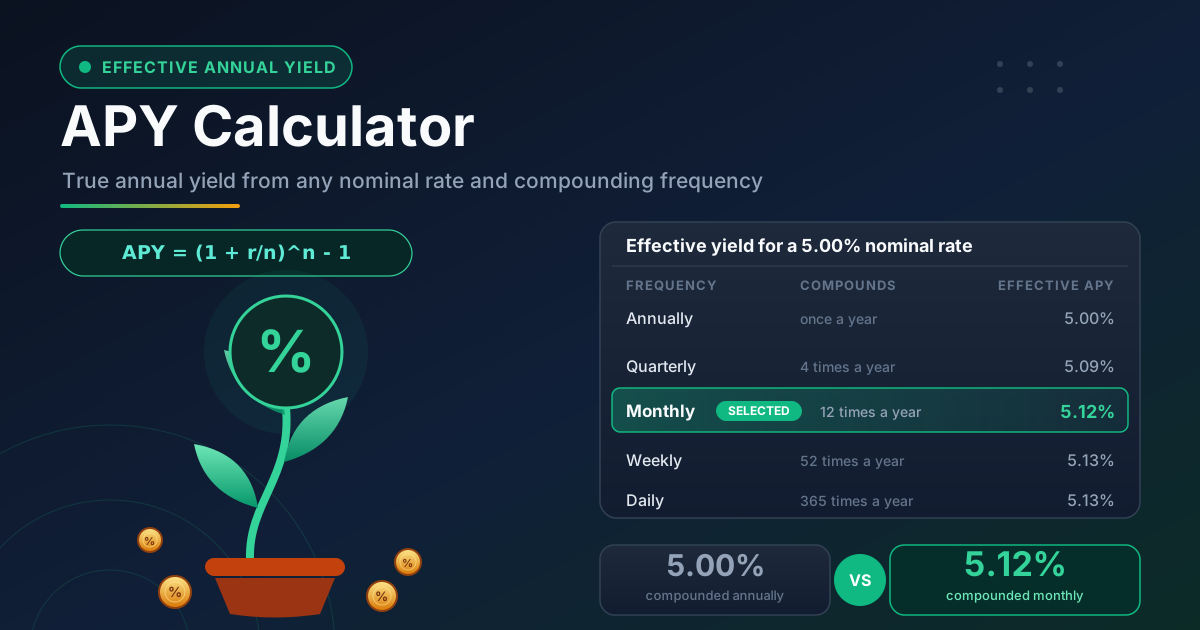
Table of Contents
APY Calculator: Convert Nominal Rates Into True Annual Yield
When a bank advertises a savings account at "5 percent," that figure rarely tells the whole story — what you earn depends on how often interest compounds, and two offers with identical headline rates can pay noticeably different amounts. The annual percentage yield, or APY, settles the question: it folds nominal rate and compounding frequency into one comparable figure.
Our free APY Calculator makes that conversion instant. Enter a nominal rate (5% by default), pick a compounding frequency — monthly by default, with quarterly, biweekly, weekly, and daily available — and it computes the true effective yield on the spot, alongside a table comparing every frequency, your selection highlighted. All math runs 100% in your browser; nothing is uploaded anywhere.
In this guide we explain what APY really measures, walk through the calculator step by step, and unpack the math that separates a 5.00% nominal rate from a 5.12% effective yield.
Why Use the APY Calculator?
Here is what the tool brings:
- Compare offers on equal footing — Comparing APYs means comparing what you truly earn.
- See what compounding frequency is worth — Quantify how much monthly adds over annual, and where gains flatten.
- Decode marketing claims — Advertisers quote whichever number looks best; converting to APY reveals the real ranking.
- Get an instant frequency comparison — The table shows annual through daily in one view, with your selection highlighted.
- Keep your data private — The calculator is 100% client-side: your figures never leave your device.
Key Features
The APY Calculator keeps it focused: two inputs, one output, and a comparison table.
| Feature | What It Does | Example |
|---|---|---|
| Nominal rate input | Advertised annual rate | 5% (default) |
| Compounding frequency | Annual, quarterly, monthly, biweekly (26), weekly (52), daily | Monthly (default) |
| APY result | Effective annual yield from the formula | 5.12% |
| Comparison table | Ranks every frequency, highlights yours | 5.00% to 5.13% |
| Client-side math | Runs entirely in your browser | Instant results |
- Live updates — Every change recalculates the APY and the table, so experimenting takes seconds.
- Payroll-friendly options — Biweekly (26 periods) matches how many people are paid.
How to Use the APY Calculator
- Enter the nominal rate — Type the advertised annual rate, such as 5 for 5%; the field starts at 5%.
- Choose the compounding frequency — Monthly is the default; switch to quarterly, biweekly, weekly, or daily to match your account.
- Read the APY — The effective annual yield updates instantly; this is the number to compare across offers.
- Scan the comparison table — See the effective rate for every frequency at once, with your row highlighted.
- Apply it to your decision — Compare savings accounts, deposits, or staking offers on the same basis and pick the better deal.
APY vs Nominal Rate: What the Difference Really Means
The formula in plain words
The calculator is built on one formula:
APY = (1 + r/n)^n - 1

r = nominal annual rate (as a decimal, so 5% = 0.05)
n = number of compounding periods per year
In words: divide the annual rate by the number of periods, then let that small per-period rate compound against itself n times — each period's interest joins the balance, so later periods earn interest on interest. APY is that total growth after one year.
Why 5% monthly beats 5% annually
Nominal rate (r):  5% = 0.05
Compounding (n):   monthly = 12

APY = (1 + 0.05/12)^12 - 1
    = (1.0041667)^12 - 1
    = 1.05116 - 1
    = 5.116%
Compounded annually, 5% pays exactly 5.00%. Compounded monthly, the same nominal rate pays 5.116% — about 5.12% — because each month's interest earns its own interest before the year ends. On $10,000 that is $511.60 instead of $500.00.
The diminishing returns of compounding more often
Frequency helps, but increments shrink fast at 5% nominal: annual 5.00%, quarterly 5.09%, monthly 5.12%, weekly 5.13%, daily 5.13%. Annual to monthly is worth 0.12 points; monthly to daily barely 0.01. As n grows, APY approaches a ceiling of e^r - 1, about 5.127% here — rarely worth a fee or a worse account.
APR vs APY: savers versus borrowers
APR is nominal — it ignores intra-year compounding; APY includes it. US deposits must disclose APY, so savers see true earnings. Loans quote APR, which flatters the lender: a card at 20% APR compounded daily charges more than 20% a year. So compare APYs when saving, APRs when borrowing — and ask how often interest capitalizes.
Think in real returns
A 5.12% APY only builds wealth if it outruns inflation. Against 3% inflation your real return is about 2.1%; at 6% you lose purchasing power despite the positive statement. Check any yield against the Inflation Calculator before calling it good.
Practical Use Cases
Comparing savings accounts and fixed deposits
Bank A offers 4.95% compounded daily; Bank B advertises 5.05% annually. B's headline looks better, but the APY Calculator shows A yields about 5.07% against B's 5.05% — the "smaller" rate wins. Rank accounts by APY, not the poster number.
Reading promo-rate fine print
Promotions like "6% for your first three months" are quoted nominally and cover a slice of the year. Convert the rate and compounding to APY to see what the bonus is worth, then compare it with accounts paying a solid rate year-round.
Sanity-checking crypto staking claims
Staking platforms love enormous "APY" figures. Enter the advertised rate with the payout frequency — daily payouts you restake behave like daily compounding — and see what the schedule implies. A claimed 120% APY is easy to verify; the absurdity shows where risk hides.
Comparing bond coupons
A bond paying a 5% coupon semiannually is not the same as a deposit compounding monthly at 5%. Coupons are nominal payments whose effective annual value depends on timing and reinvestment. Converting both to an APY-equivalent basis puts them in the same race.
Best Practices
- Compare APY to APY, never APY to nominal — Mixing them favors whoever quoted the bigger number.
- Confirm the compounding basis — Check how often interest is applied before trusting any headline rate.
- Weigh frequency against everything else — Daily over monthly is tiny; fees, withdrawal rules, and deposit insurance matter more.
- Assume reinvestment — APY assumes interest stays in the account; withdrawing it drops you back to simple interest.
- Adjust for inflation — Evaluate every yield against rising prices to know real return.
- Re-run the numbers when rates change — APY is only as current as the rate you enter.
See Your True Yield Today
Headline rates are marketing; APY is math. Two minutes with the free APY Calculator shows what any nominal rate and compounding schedule really pays over a year — no sign-up, no spreadsheets, nothing leaves your browser. Try your own bank's numbers and see what the fine print hides.
Related Tools You Might Like:
- Compound Interest Calculator — Project savings growth year by year with contributions and compounding.
- Savings Goal Calculator — Work backward from a target to the plan that gets you there.
- Inflation Calculator — Convert nominal gains into real purchasing power.
Happy calculating!
Frequently Asked Questions
Q: What is the difference between APY and the nominal rate?
A: The nominal rate is the advertised annual rate before compounding. APY applies the compounding frequency and states your actual one-year growth: 5% nominal compounded monthly is really a 5.116% APY.
Q: Does daily compounding meaningfully beat monthly?
A: Rarely. At 5% nominal, monthly yields 5.116% and daily about 5.127% — hundredths of a point. Fees and account features usually matter far more.
Q: Which compounding frequency should I choose in the calculator?
A: The one your account actually uses, per its terms. If you cannot find it, monthly is the most common default and a reasonable estimate.
Q: Is the APY Calculator accurate for any currency or amount?
A: Yes. APY depends only on the rate and frequency, not the currency. Calculations run client-side in your browser, so any currency or balance works identically, and inputs never leave your device.