Auto Loan Calculator: Know Your Car Payment Before the Dealership
Compute monthly car-loan payments and total interest from price, down payment, trade-in, APR, and term, with a loan amount and total paid summary. Free in your browser.
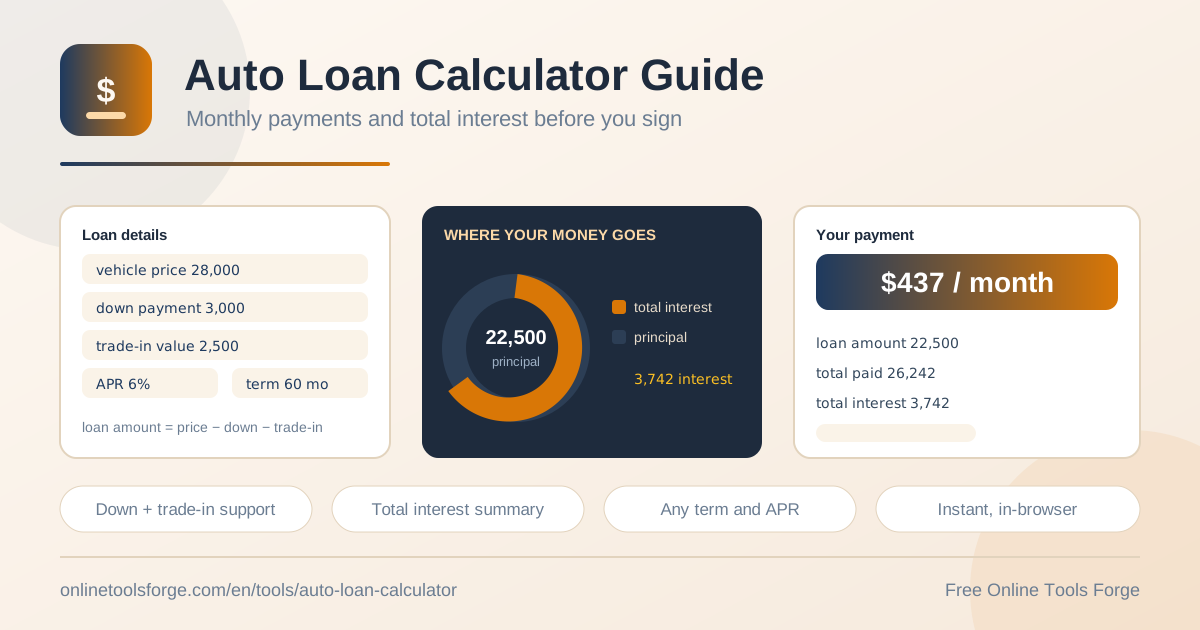
Table of Contents
A new car is one of the largest purchases most people ever finance, yet the monthly payment is often the last thing negotiated and the first thing forgotten. The free auto loan calculator flips that order: enter the vehicle price, down payment, trade-in value, APR, and term, and you instantly see your monthly car payment, the loan amount, total interest, and total paid. Everything runs in your browser, with no signup and no data sent anywhere.
That matters because car financing is full of moving parts. Dealers often quote a monthly figure without showing how it was built, and a payment that looks affordable can hide thousands in interest. When you can compute the number yourself in seconds, you negotiate from data instead of guesswork.
Why Use the Auto Loan Calculator?
- Instant answers: Results update as you type, so you can test a dozen scenarios in under a minute.
- Complete picture: You see the loan amount, monthly payment, total interest, and total paid together, not just one number.
- Trade-in aware: The tool subtracts your trade-in value from the price automatically, matching how dealers actually build the deal.
- APR and term tradeoffs: Compare a 48-month loan at a higher rate against a 72-month loan at a lower one without doing mental math.
- Private and free: The calculator runs entirely in your browser. No account, no email, no stored data.
- Works anywhere: Open it on your phone while sitting across the desk from a salesperson and test a counteroffer on the spot.
Key Features
| Feature | What it does |
|---|---|
| Vehicle price | Sets the starting point for the purchase. |
| Down payment | Cash you pay upfront, subtracted from the price. |
| Trade-in value | Credit from your old car, also subtracted from the price. |
| APR | Annual interest rate used to compute the monthly rate. |
| Term in months | How long you take to repay, typically 36 to 84 months. |
| Summary panel | Shows loan amount, monthly payment, total interest, and total paid. |
- The loan amount is derived as price minus down payment minus trade-in, so it always matches your real out-of-pocket financing need.
- The monthly payment uses standard amortization, the same formula banks apply.
- Results are instant; there is no submit button to hunt for.
How to Calculate a Car Payment
- Enter the vehicle price, including any options and fees you plan to finance.
- Add your down payment. This is cash paid upfront; more down means a smaller loan.
- Enter your trade-in value if you have one. It reduces the amount you need to borrow, just like cash.
- Type the APR from your lender or financing offer. If you are shopping, try two or three rates to see the spread.
- Set the term in months. The summary panel instantly shows the loan amount, monthly payment, total interest, and total paid.
How Car Loan Amortization Works
Every car loan starts with a simple derivation. The amount you finance is not the sticker price; it is the vehicle price minus your down payment minus your trade-in value. That figure, not the price on the window, is what interest accrues against for the life of the loan.
Amortization means each equal monthly payment splits between interest and principal. The interest portion is the remaining balance times the monthly rate (APR divided by 12). Early in the loan the balance is large, so most of each payment is interest. As the balance falls, the interest slice shrinks and more of every payment attacks the principal, which is why extra payments made early save the most interest.
APR and term pull in opposite directions. A longer term lowers the monthly payment but stretches the balance over more months of interest, so total interest climbs. A 60-month loan at 6 percent on 22,000 dollars costs about 3,519 in interest; stretch it to 72 months and interest grows past 4,200 even though each payment drops. A bigger down payment or a better trade-in shrinks the loan amount itself, lowering both the payment and the interest in one move.
Price 30,000 - down 5,000 - trade-in 3,000 = 22,000 loan
22,000 at 6% APR over 60 months = 425.32 per month
Total paid = 60 x 425.32 = 25,519.20
Total interest = 25,519.20 - 22,000 = 3,519.20
Run the same inputs through the auto loan calculator and you will see these exact figures, updated the moment any input changes.
Practical Use Cases
Negotiating at the Dealership
Walk in with two numbers: the maximum monthly payment you accept and the maximum total interest. When the salesperson presents a payment, ask for price, down payment, trade-in offer, APR, and term, then rebuild the deal in the calculator. If the payment only works because the term stretched to 84 months, you will see it immediately.
Comparing Bank and Dealer Financing
Get preapproved at your bank or credit union, then let the dealer try to beat it. Enter the bank offer first and note the total interest. Switch to the dealer APR and compare. If the dealer rate is higher but includes a rebate, add the rebate as extra down payment and see which deal truly costs less. A 1 percent APR gap is sometimes worth less than a 1,500 dollar rebate; the summary panel settles it in seconds.
Choosing the Right Term Length
Try 48, 60, 72, and 84 months on the same loan amount and watch two numbers move in opposite directions: the payment falls as the term grows while total interest rises. Pick the shortest term whose payment fits your budget with room to spare, since cars depreciate faster than long loans are paid down.
Sizing a Down Payment
Start at 20 percent of the vehicle price and adjust. Each extra 1,000 of down payment reduces the loan by 1,000 and typically saves several hundred more in interest over the term. If cash is tight, test whether a shorter term serves you better than a bigger check. The calculator makes the comparison concrete instead of theoretical.
Best Practices
- Negotiate price first, financing second. A great APR cannot rescue an overpriced car.
- Ask for the APR in writing. The monthly payment can be massaged many ways; the rate is harder to hide behind.
- Include fees in the price field if you plan to finance them, or your real payment will run higher than the estimate.
- Check the trade-in separately. Confirm the trade-in value against private-party prices so a low trade figure is not subsidizing a discount elsewhere.
- Compare total paid, not just the payment. Two deals with identical monthly payments can differ by thousands in total interest.
- Recheck before signing. Numbers on the contract occasionally drift from the numbers you agreed to; rerun the final terms in the calculator.
Run the Numbers Before You Sign
The difference between a good deal and an expensive one is usually just information. Open the auto loan calculator, enter the numbers from the offer on the table, and see the monthly payment, loan amount, total interest, and total paid instantly. It is free, private, and takes less time than a test drive.
Related Tools You Might Like:
Financing questions rarely stop at the car loan. These companion calculators cover the rest of the borrowing picture:
- Loan Calculator — a general-purpose amortizing loan calculator for any borrowed amount.
- Mortgage Calculator — monthly payments and total interest for home loans.
- Car Lease Calculator — compare leasing against buying before you commit.
Happy driving!
Frequently Asked Questions
Q: How is the monthly car payment calculated?
A: The payment uses the standard amortization formula: loan amount times the monthly rate, spread evenly across the term. The loan amount is the vehicle price minus down payment and trade-in, and the monthly rate is APR divided by 12.
Q: Does a bigger down payment really save that much?
A: Yes, and it compounds. Every dollar of down payment removes a dollar of principal plus all the interest that dollar would have generated. On a 22,000 dollar loan at 6 percent for 60 months, an extra 2,000 down cuts total interest by roughly 320 while lowering the payment.
Q: Should I choose a shorter term or a lower APR?
A: Compare total interest, not the monthly payment. A shorter term usually beats a slightly lower rate because it removes months of interest entirely. Enter both scenarios and let the total paid figure decide; if the shorter payment fits your budget, it is usually the stronger deal.
Q: Does the calculator store my financial data?
A: No. The tool runs entirely in your browser with no signup, and nothing you type is transmitted or saved. Close the tab and your figures are gone.