BLAKE Hash Generator: Create BLAKE2b, BLAKE2s and BLAKE3 Hashes Online
Generate BLAKE2b, BLAKE2s and BLAKE3 digests for any text or file with the free BLAKE Hash Generator — everything is computed locally in your browser, with keyed hashing and selectable digest lengths.
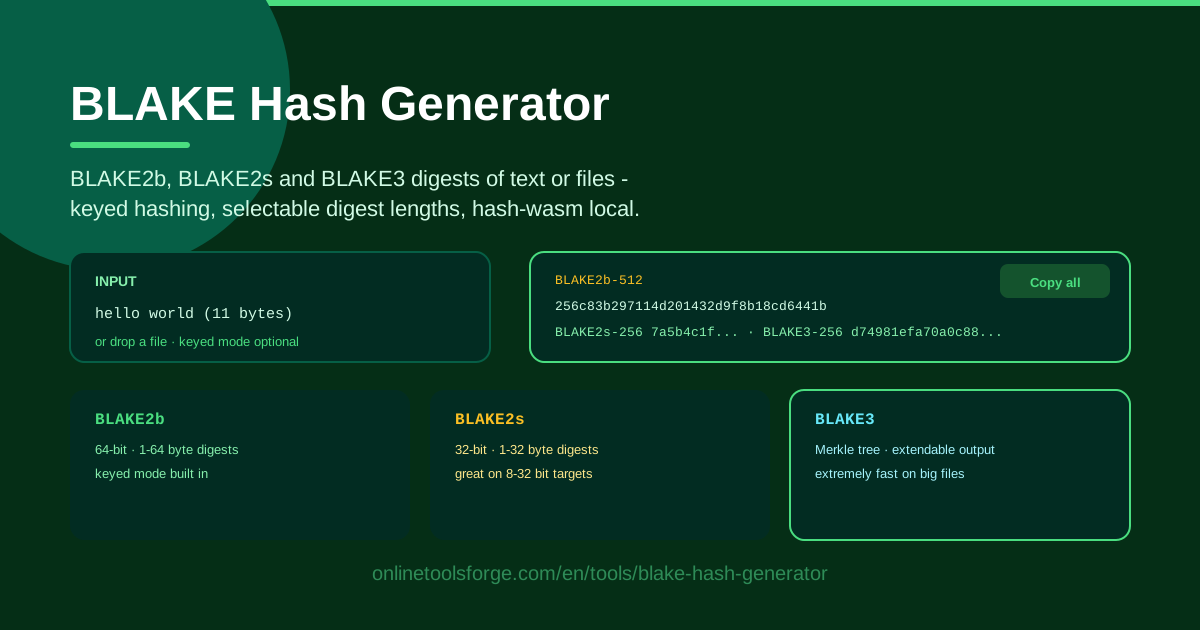
Table of Contents
When you need a cryptographic hash that is both modern and extremely fast, the BLAKE family is hard to beat. The free BLAKE Hash Generator lets you produce BLAKE2b, BLAKE2s and BLAKE3 digests for any text or file in seconds. Everything runs locally in your browser through hash-wasm, a WebAssembly implementation of these algorithms, so the content you hash never leaves your device.
BLAKE2 and BLAKE3 descend from the original BLAKE algorithm, a finalist in the NIST competition that produced SHA-3. They were engineered to outperform MD5 and SHA-1 with far stronger security, and BLAKE3's throughput makes hashing very large files practical even in a browser tab. This guide shows how the tool works and when each variant fits.
Why Use BLAKE Hash Generator?
- Hash private files locally. Text and files are processed entirely inside your browser with WebAssembly. Nothing is uploaded, so you can safely hash confidential documents or source code.
- Three BLAKE variants in one place. Switch between BLAKE2b, BLAKE2s and BLAKE3 instantly instead of juggling separate utilities or command-line flags.
- Optional keyed hashing. Supply a secret key and the tool produces MAC-style digests that only key holders can reproduce.
- Selectable digest lengths. BLAKE2b supports 1–64 byte outputs and BLAKE2s supports 1–32 bytes, letting you trade collision resistance for shorter identifiers when the task allows.
- Very fast on large files. BLAKE3's parallel design keeps hashing quick even on multi-gigabyte archives, directly in the browser.
- No installation or account. Open the page, paste or drop your input, and copy the digest in any modern browser.
Key Features
Here is what the generator offers at a glance:
| Feature | What it does |
|---|---|
| Text and file input | Hash pasted text or a dropped file, entirely in the browser |
| BLAKE2b | 1–64 byte digests on 64-bit words; the natural choice for file checksums |
| BLAKE2s | 1–32 byte digests on 32-bit words; compact and friendly to constrained environments |
| BLAKE3 | Extremely fast, with extendable output for large files and custom digest lengths |
| Keyed mode | Adds a secret key to produce MAC-style digests for authentication |
| Digest length selector | Choose the exact output size for BLAKE2b and BLAKE2s |
| hash-wasm engine | Runs the algorithms as WebAssembly locally — no uploads, no server round-trips |
Details worth knowing:
- Results come from hash-wasm and match the official BLAKE test vectors, so digests are identical to those from OpenSSL, b2sum or any standard library.
- Digests are displayed in hexadecimal, the format used by most checksum lists, package managers and storage systems.
How to Use BLAKE Hash Generator
- Provide your input. Paste text into the input box or drop a file onto the drop zone. No need to split large files — the browser reads and hashes the bytes directly.
- Choose a variant and digest length. Pick BLAKE2b, BLAKE2s or BLAKE3 and select the output size. The defaults — 64 bytes for BLAKE2b, 32 for BLAKE2s — are the standard choices.
- Optionally set a key. To authenticate digests, enter a secret key and share it only with the parties that need to verify the values.
- Generate the digest. Click the generate button and the result appears immediately. Re-run it whenever you change the input, variant, length or key.
- Copy the digest. Use the copy button to grab the hexadecimal value for your checksum list, deployment note or ticket.
The BLAKE Family Explained
BLAKE was designed by Jean-Philippe Aumasson, Luca Henzen, Willi Meier and Raphael C.-W. Phan as a candidate in the NIST SHA-3 competition. It reached the final round thanks to strong security analysis and impressive speed. Although Keccak became SHA-3, the BLAKE line lived on: BLAKE2 was tuned until it ran faster than MD5 while keeping the original security margins, and BLAKE3 rebuilt the design around modern parallel hardware.
BLAKE2b and BLAKE2s differ mainly in word size. BLAKE2b operates on 64-bit words and produces digests of 1 to 64 bytes, the go-to for desktop and server workloads such as file verification. BLAKE2s uses 32-bit words with digests of 1 to 32 bytes, suiting 32-bit platforms and shorter outputs. Despite the shared lineage, their digests are not interchangeable — the same input hashed with each variant produces different results.
BLAKE3 takes a different route: it organizes input in a Merkle tree so hashing can spread across CPU cores, which is why it stays very fast on large files. It also offers extendable output — rather than one fixed length, BLAKE3 can emit digests of arbitrary length, useful for long pseudorandom values or shorter fingerprints from the same computation. Its default output is 32 bytes.
Keyed hashing deserves special attention. Hash with a secret key and the digest can be reproduced only by someone holding that key, turning the hash into a fast message authentication code. For service-to-service checks it is a lightweight alternative to heavier signature schemes — exactly what the tool's keyed mode demonstrates.
Compared with MD5 and SHA-1, BLAKE2 and BLAKE3 are simply better: both legacy functions have known collision attacks, while BLAKE2 and BLAKE3 remain unbroken and run faster in software. The exception is compatibility — if you must match digests from a system that only understands SHA-256, use SHA-256 there.
Practical Use Cases
Verifying File Integrity After a Download
Download a Linux ISO, a firmware image or an installer and hash it with BLAKE2b. If the publisher lists a BLAKE2 checksum, place your digest beside theirs — matching strings byte for byte means the file arrived intact. Large files are handled locally, so verifying a multi-gigabyte archive needs no extra software.
Building Content-Addressed Storage Keys
Object stores, build caches and IPFS-style networks identify blobs by their hash. BLAKE3's speed makes it popular here: hash each object once, use the digest — or its first 16 bytes — as the storage key, and retrieval becomes a simple lookup. Prototype these keys in the generator before wiring them into code.
Fast Keyed Authentication Between Services
When two internal services exchange webhooks or job payloads, a keyed BLAKE2b digest acts as a shared-secret MAC. The sender hashes the payload with the key; the receiver repeats the operation and compares digests. Anything altered in transit — or sent without the key — fails the check.
Detecting Duplicate Files with Fingerprints
Before a backup or migration, hash candidate files with BLAKE3 and compare fingerprints. Identical digests mean identical content, so you can skip duplicates, merge directories or build a deduplicated archive — all in the browser, even where installing utilities is impractical.
Best Practices
- Use keyed mode when authenticity matters. A plain digest proves integrity only if received through a trusted channel. When the digest itself could be tampered with, add a key.
- Keep the digest length adequate. Short digests collide sooner. Stay at 32 bytes or more for security-relevant uses, and reserve short outputs for non-adversarial jobs like cache keys.
- Verify with a second tool. For high-stakes files, recompute the digest with b2sum, OpenSSL or our Hash Generator. Matching output across independent implementations rules out tool bugs.
- Do not use it for password hashing. BLAKE2 and BLAKE3 are general-purpose hashes, not password schemes. For stored passwords use Argon2, bcrypt or scrypt, which are deliberately slow and salted.
- Record your parameters. Note the variant, key and digest length used — a checksum nobody can reproduce later has little value.
- Treat keys like passwords. Store keyed-mode secrets in a secrets manager, not in scripts or repositories, and rotate them if they may have leaked.
Ready to try it? Open the BLAKE Hash Generator, paste a line of text or drop any file, and watch BLAKE2b, BLAKE2s and BLAKE3 digests appear instantly — computed privately in your own browser.
Related Tools You Might Like:
- Hash Generator — MD5, SHA and more in the same browser-based interface
- HMAC Generator — keyed HMAC-SHA digests for the classic MAC construction
- Hash Type Identifier — recognize which algorithm produced an unknown digest
Happy hashing!
Frequently Asked Questions
Q: Is the BLAKE Hash Generator free to use? A: Yes. The tool is completely free, requires no registration, and you can hash as many texts and files as you need.
Q: Are my files uploaded anywhere when I hash them? A: No. All hashing runs locally in your browser through the hash-wasm engine, so your text and file contents never leave your device.
Q: Which BLAKE variant should I choose? A: Use BLAKE2b for general file checksums, BLAKE2s when you need shorter digests or 32-bit compatibility, and BLAKE3 when speed on large files or extendable output matters most.
Q: Can two different inputs produce the same digest? A: In theory yes — hash functions map unlimited inputs to fixed-size outputs — but with a full-length BLAKE digest a collision is so improbable it is not a practical concern. Risk only becomes real when you deliberately shorten digests.