Capital Gains Tax Estimator: Know Your Tax Before You Sell
Estimate short and long-term capital gains tax from cost basis, proceeds, and holding period, with 0/15/20 percent bracket stacking and a custom-rate mode. Free in-browser.
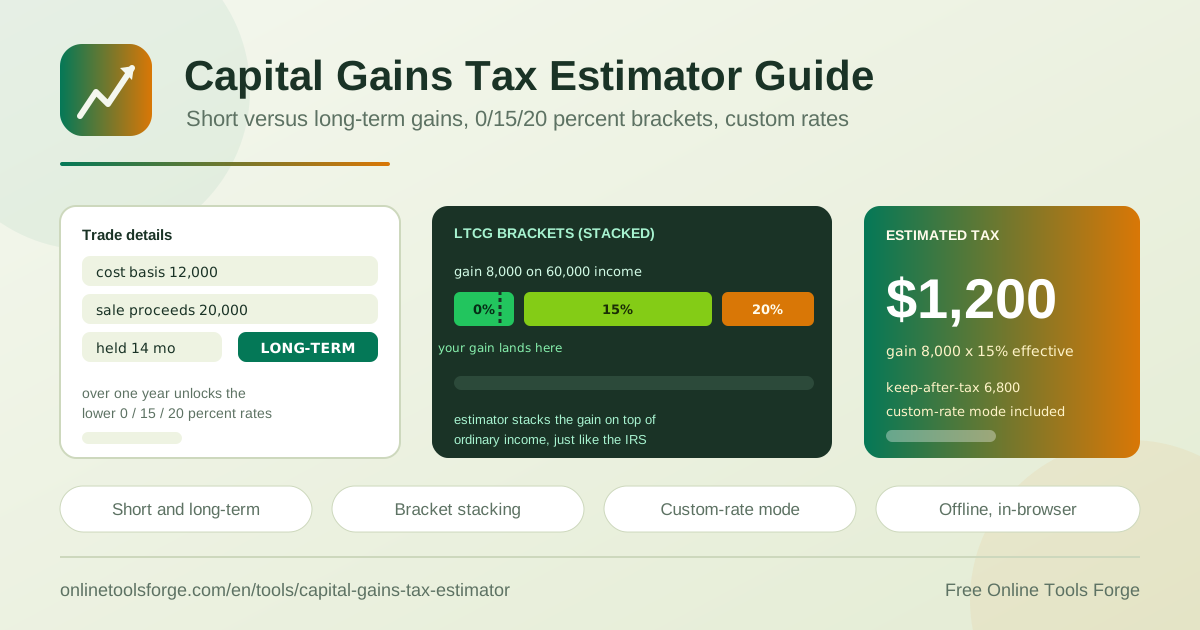
Table of Contents
Selling an asset you have held for a while — shares, a crypto position, a fund — feels simple until you remember the tax bill waiting on the other side. The Capital Gains Tax Estimator lets you see that bill before you commit, using nothing more than your browser.
Enter your cost basis, sale proceeds, holding period, and ordinary income, and the tool classifies the gain as short-term or long-term, applies the matching bracket logic, and returns three numbers that matter: the gain, the estimated tax, and what you keep after tax. Everything runs locally — no accounts, no uploads, no waiting.
This guide explains how the estimator works, why holding periods move your rate so much, and how to use it for timing decisions and harvest planning. Results are informational estimates, not tax advice.
Why Use the Capital Gains Tax Estimator?
- See the tax before the trade. Mental math hides bracket effects; the estimator shows the real estimated tax and after-tax keep for your exact numbers.
- Understand the one-year cliff. Holding period moves a gain from ordinary rates to preferential 0, 15, and 20 percent long-term rates — adjust the field and see both outcomes.
- Account for your income. Long-term rates depend on where the gain stacks relative to your ordinary income; the tool models that stacking rather than assuming a flat rate.
- Spot threshold crossings. A sale can push part of a gain into the next tier; the estimator reveals how much lands in each band.
- Handle non-US situations. Custom-rate mode accepts your own flat percentage for other countries or special levies.
- Stay private. Every calculation runs offline in your browser; your basis and income never leave your device.
Key Features
| Feature | What it does |
|---|---|
| Cost basis and proceeds | Enter what you paid and what you sold for; the gain computes instantly. |
| Holding period classification | Gains held one year or less are short-term; longer holdings become long-term. |
| Ordinary income input | Sets the income floor that long-term gains stack on top of. |
| 0 / 15 / 20 percent long-term brackets | The gain fills the preferential tiers based on total income. |
| Short-term ordinary brackets | Gains held briefly are bundled into the standard 10 to 37 percent federal brackets. |
| Custom-rate mode | Override defaults with one flat rate of your choice. |
| Clear results | Shows gain, estimated tax, and after-tax keep together. |
- The stacking model mirrors real bracket logic: a long-term gain is not taxed at one flat rate — the slice inside the 0 percent band is free, and only the remainder reaches 15 or 20 percent.
- Because everything computes in the browser, the tool works with no internet connection, keeping financial data on your machine.
How to Estimate Your Capital Gains Tax
- Enter your cost basis — what you paid for the asset, including fees.
- Enter your sale proceeds — the amount you expect to receive.
- Set the holding period — this single field decides short-term versus long-term treatment.
- Enter your ordinary income — salary and wages, so the gain can be stacked on top and placed in the right brackets.
- Read the results — the estimator shows the gain, the estimated tax, and your after-tax keep; switch to custom-rate mode if your situation calls for a flat rate.
Short-Term Versus Long-Term Rates
The dividing line is one year. Sell an asset held one year or less and the entire gain is short-term, taxed at your ordinary federal rates — the same 10 through 37 percent brackets that apply to salary. Hold a day past one year and the gain becomes long-term, unlocking the preferential 0, 15, and 20 percent schedule.
A common misconception is that long-term gains are taxed at a flat rate. In practice they stack on top of your ordinary income, and the brackets fill in order. If your ordinary income sits below the top of the 0 percent band, the first slice of the gain is taxed at nothing. As the stack crosses into the next range, that portion moves to 15 percent, and only amounts above the final threshold reach 20 percent. The estimator performs this slice-by-slice calculation using your income plus the gain, so the result reflects where you actually fall rather than a blunt average.
Outside the United States, or where a flat national levy applies, custom-rate mode taxes the entire gain at one percentage you choose, keeping the tool useful for international planning.
Because the rate difference can be large, the weeks around the one-year mark are a natural planning checkpoint. Run the numbers both ways — sell now at ordinary rates versus wait for long-term treatment — and turn an instinct into a decision you can quantify.
cost basis 8,000 - proceeds 10,000 - held 14 months
gain 2,000 (long-term) - ordinary income 45,000
gain stacks above income into the 15 percent band
estimated tax 300 - after-tax keep 1,700
Practical Use Cases
Timing a Stock Sale Around the One-Year Line
You bought shares eleven months ago and need cash. Selling today makes the gain short-term; waiting a month converts it to long-term. Enter both scenarios with your ordinary income and compare the after-tax keep — often the wait is worth more than the market risk, and now you can put a number on it.
Estimating Crypto Gains Without Spreadsheets
Every crypto sale is a taxable event, and active traders often hold lots with different purchase dates. Run each lot through the estimator with its own basis and holding period to see which sales trigger ordinary rates and which enjoy long-term treatment, then sell the cheapest lots first.
Planning Tax-Loss Harvesting Pairs
If one position shows a gain and another shows a loss, estimate the tax on the winner, then consider selling the loser in the same window to offset it. The estimator quantifies the tax you would owe without the offset — exactly the figure a harvest saves.
Comparing Which Lot to Sell
Two lots of the same fund, different purchase dates: one is deep in long-term territory at a low tier, the other barely past one year. Estimating each lot separately shows which sale keeps more after tax — sometimes the higher-priced lot still wins, sometimes not.
Best Practices
- Use an accurate cost basis, including fees; small errors compound into misleading estimates.
- Model both holding scenarios — today, one day later, and next tax year — to see the full range of outcomes.
- Re-check near year-end, since thresholds and your income can shift between January and December.
- Remember that many states tax gains separately; the federal model or your custom rate is only part of the bill.
- Keep records of basis, dates, and proceeds — exactly what a preparer will ask for later.
- Treat every result as an informational estimate, not tax advice; confirm decisions with a qualified tax professional who knows your full situation.
Try the Capital Gains Tax Estimator Today
Whether you are days from the one-year mark, holding a large crypto position, or simply curious what a sale would really net, the fastest move is to run your own numbers. Open the Capital Gains Tax Estimator, enter four values, and see your estimated tax and after-tax keep in seconds — free, private, and entirely in your browser.
Related Tools You Might Like:
- Investment ROI Calculator — measure the total return on any investment.
- Inflation Calculator — see what your gains are worth in real terms.
- Tax Calculator — estimate broader income tax scenarios.
Happy investing!
Frequently Asked Questions
Q: Is the capital gains tax estimator free?
A: Yes. It is completely free, requires no sign-up, and runs entirely in your browser — even offline.
Q: How does the tool decide whether a gain is short-term or long-term?
A: It compares your holding period against the one-year threshold. One year or less produces a short-term gain taxed at ordinary rates; more than one year produces a long-term gain that uses the 0, 15, and 20 percent tiers.
Q: What does bracket stacking mean for long-term gains?
A: Your long-term gain is added on top of your ordinary income, and the combined total decides how much of the gain falls into each 0, 15, and 20 percent tier — part of a gain can sit at 0 percent while the rest lands at 15 or 20.
Q: Can I use this outside the United States?
A: Yes. Custom-rate mode accepts any flat percentage, which suits countries that tax gains at a single national rate.
Q: Does this replace advice from an accountant?
A: No. The estimates are informational planning aids, not tax advice. Basis rules, offsets, and state taxes vary, so consult a qualified professional before acting.