Car Lease Calculator: Decode Your Monthly Lease Payment
Estimate monthly lease payments from MSRP, cap cost, residual value, and money factor, with a full breakdown of depreciation, rent charge, and total lease cost. Free in-browser.
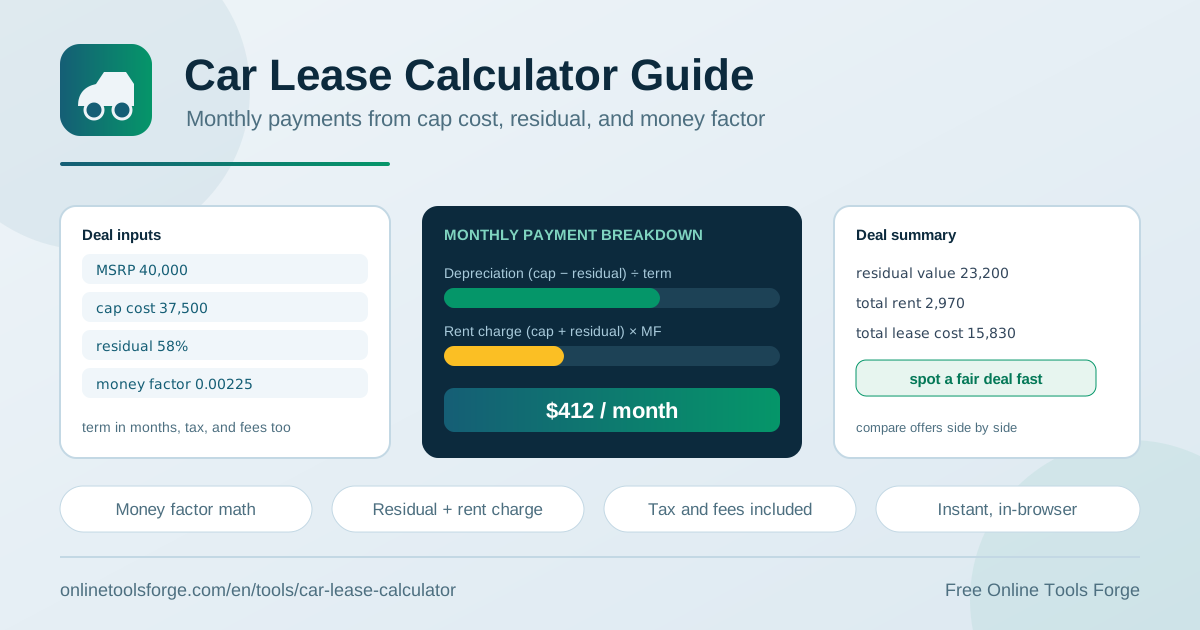
Table of Contents
Leasing a car should be simple: you pay for the portion of the vehicle you use, plus a financing charge. In practice, the paperwork hides behind jargon — capitalized cost, residual value, money factor, acquisition fees — and most shoppers sign without ever seeing how the monthly number was built. The free car lease calculator fixes that. Enter the MSRP, negotiated price, residual percentage, money factor, term, and taxes or fees, and it instantly shows the monthly payment with a complete breakdown.
Everything runs 100% in your browser with no signup and no data leaving your device. Model a deal at the dealership desk, compare offers from your couch, or double-check a contract before signing. The result is not just a payment estimate — it is a transparent picture of depreciation, rent charge, total rent, and total lease cost.
Why Use the Car Lease Calculator?
- See the real math, not just the payment. The tool splits the monthly figure into its depreciation portion and rent charge portion, so you know what you are actually paying for.
- Translate the money factor. Multiply the money factor by 2400 to get the approximate APR, and you can immediately judge whether the quoted rate is fair.
- Compare offers on equal footing. Two deals with identical payments can hide very different cap costs, residuals, or rates; running each through the calculator exposes the genuinely cheaper one.
- Spot inflated payments. If the dealer number exceeds what the inputs justify, padding, add-ons, or a marked-up rate is costing you money.
- Plan the total commitment. Total rent charge and total lease cost appear alongside the payment, so you can budget for the whole term.
- Zero friction. Free, instant, and in-browser — adjust a number and results update immediately, ideal for live negotiations.
Key Features
| Feature | What it does |
|---|---|
| MSRP and cap cost | Captures sticker price and your negotiated price after discounts and down payment |
| Residual percentage | Converts the predicted end-of-lease worth into a dollar residual value |
| Money factor field | Accepts the lease rate directly, or works back from APR by dividing by 2400 |
| Term in months | Supports common 24, 36, and 39-month leases or any custom length |
| Tax and fees | Folds sales tax and fees into a realistic monthly figure |
| Full breakdown | Reports depreciation, rent charge, residual value, total rent charge, and total lease cost |
Worth highlighting:
- Instant results. Every input change recalculates immediately — no submit button, no waiting.
- Dealer-quote friendly. Each field maps to a line on a real lease worksheet, so you can copy numbers straight from the contract.
How to Calculate a Lease Payment
- Enter the MSRP. This anchors the residual value, which is usually expressed as a percentage of sticker price.
- Enter your negotiated price. This is the capitalized cost — the amount effectively financed after discounts, rebates, and any capitalized down payment.
- Set the residual percentage. A quoted residual of 58 percent becomes a dollar figure once multiplied by MSRP.
- Add the money factor, term, tax, and fees. For reference, 0.00250 converts to about 6 percent APR; 36 months is the most common term.
- Read the breakdown. The payment appears instantly, split into depreciation and rent charge, with residual value, total rent charge, and total lease cost shown underneath.
The Lease Math Explained
Every lease payment is built from the same few ingredients, and understanding them is your best defense against a bad deal.
Capitalized cost (cap cost) is the negotiated price plus fees rolled into the lease, minus any down payment or rebate. It is the lease equivalent of a purchase price: every dollar you shave off lowers the payment directly.
Residual value is the leasing company estimate of what the car will be worth at lease end, expressed as a percentage of MSRP. A 36-month lease with a 60 percent residual on a $40,000 MSRP carries a $24,000 residual. Higher residuals mean lower payments, because you finance only the gap between cap cost and residual.
Money factor is the finance charge written as a small decimal. Multiply it by 2400 for the approximate APR — a money factor of 0.00250 equals roughly 6 percent. Dealers sometimes mark up this rate above the manufacturer buy rate, and the conversion makes the markup obvious.
The payment itself has two halves:
Depreciation = (Cap Cost - Residual) / Term
Rent Charge = (Cap Cost + Residual) x Money Factor
Monthly = Depreciation + Rent Charge + Tax
With a $34,000 cap cost, $24,000 residual, and 36-month term, depreciation runs about $278 per month. The rent charge applies the money factor to the average of cap cost and residual: (34,000 + 24,000) x 0.00250 equals $145 per month. Add the two for roughly $423 before tax.
Taxes and fees vary by state: sales tax may hit the monthly payment, the full price, or be collected upfront, while acquisition, disposition, and registration fees often ride along. Including them keeps the estimate honest.
Practical Use Cases
Comparing Dealer Offers
Collect quotes for the same car, enter each set of inputs, and compare total lease cost rather than monthly payment. The lower payment may simply come from a longer term or an inflated residual. The full breakdown reveals which deal is genuinely cheaper.
Deciding Lease vs Buy
Leasing suits drivers who want lower payments, warranty coverage, and a fresh car every few years; buying suits high-mileage drivers who keep vehicles for a decade. Run the lease here, then price the purchase alternative with the auto loan calculator to turn an emotional decision into an arithmetic one.
Negotiating the Cap Cost
Depreciation is driven by cap cost, so every $1,000 negotiated off the price cuts roughly $28 from a 36-month payment. Arrive with a target cap cost, verify the quoted payment against the calculator before signing, and negotiate from data instead of hope.
Checking Residual and Rate Claims
Ask for the residual percentage and money factor in writing, then plug them in. An implausibly high residual or a money factor converting well above prevailing APRs is leverage. A markup from 0.00200 to 0.00275 on a $58,000 combined value costs about $43 every month for nothing.
Best Practices
- Get residual and money factor in writing before discussing payments; these two numbers determine most of the deal.
- Convert money factor to APR by multiplying by 2400 — anything above roughly 0.00300 deserves scrutiny.
- Negotiate price first, payment last. A low payment achieved through a long term or inflated residual is not a discount.
- Keep the down payment small. A large capitalized cost reduction is money at risk if the car is totaled early.
- Match mileage allowances to real driving. Excess mileage penalties at lease end routinely exceed the cost of a higher allowance upfront.
- Re-run the numbers before signing. Contract figures drift from the worksheet, and a final check catches surprises.
Ready to Decode Your Next Lease?
Open the free car lease calculator, enter the numbers from the quote in front of you, and see the full breakdown in seconds. It runs entirely in your browser with no signup, so you can test a dozen scenarios before committing to one. Bring the math with you — it is the strongest negotiating tool there is.
Related Tools You Might Like:
- Loan Calculator — model general-purpose loans and amortization.
- Auto Loan Calculator — price the buy-versus-lease alternative with full loan terms.
- Fuel Cost Calculator — estimate what your driving habits cost in fuel.
Happy driving!
Frequently Asked Questions
Q: What is a money factor and how do I convert it to an interest rate?
A: The money factor is the financing charge on a lease expressed as a small decimal. Multiply it by 2400 to get the approximate annual percentage rate — 0.00250 equals roughly 6 percent APR — and you can quickly judge whether the quoted rate is competitive.
Q: What is residual value in a car lease?
A: Residual value is the predicted worth of the vehicle at lease end, usually a percentage of MSRP. It sets the purchase option price and shapes your payment: a higher residual means less depreciation to finance and a lower monthly cost.
Q: Why is my dealer payment higher than the calculator estimate?
A: Common causes include a marked-up money factor, a lower residual than advertised, fees rolled into capitalized cost, add-on products, or different tax treatment. Compare each input against your written quote to find the differing line item.
Q: Is leasing cheaper than buying?
A: Monthly payments are usually lower because you pay only for depreciation plus rent charge, not the full vehicle price. Over the long run, buying and keeping a car typically costs less. Model both scenarios and compare total cost against how long you keep vehicles.