CLV Calculator: Measure What a Customer Is Really Worth
Calculate Customer Lifetime Value from average order value, purchase frequency, and lifespan, with margin-adjusted CLV, the CLV:CAC ratio, and CAC payback in orders. Free and 100% in-browser.
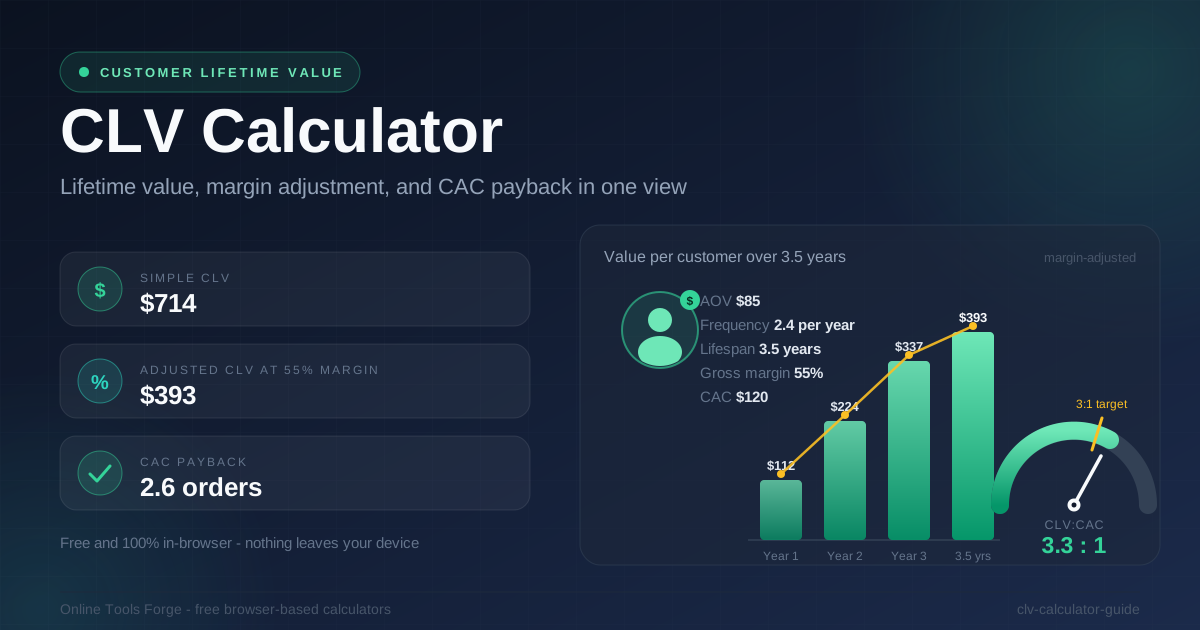
Table of Contents
CLV Calculator: Measure What a Customer Is Really Worth
Most marketing dashboards obsess over the first sale: cost per click, conversion rate, day-one revenue. But a business is built on repeat sales. A customer who buys four times a year for three years is worth far more than a one-time bargain hunter, and nearly every decision you make should trace back to that difference. The metric that captures it is Customer Lifetime Value, or CLV.
Our free CLV Calculator turns four inputs into the full picture: average order value, purchase frequency, and customer lifespan produce a simple CLV, adjusted for gross margin to show the profit you keep. Add your acquisition cost and it also computes the CLV:CAC ratio and CAC payback — the orders needed to repay what you spent to win the customer. Everything runs 100% in your browser — no sign-up, no data leaving your device.
This guide unpacks what each output means, works through a realistic e-commerce example, and shows how teams use these numbers to set ad budgets, price subscriptions, and judge loyalty programs.
Why Use the CLV Calculator?
CLV is often called the most important metric in e-commerce, yet it gets ignored as too abstract. Putting a concrete number on it changes how you operate:
- It shows what a customer is really worth. Margin-adjusted CLV reveals the profit a relationship generates — the only number that can responsibly fund acquisition.
- It sets a defensible ceiling on ad budgets. Once you know profit per customer, you know exactly what you can pay to acquire one and can bid with confidence instead of gut feel.
- It exposes unprofitable growth. A store can double sales and still be dying if each customer costs more than they will ever return. The CLV:CAC ratio surfaces that in one glance.
- It shifts focus to retention. One extra year of lifespan often lifts CLV more than any discount campaign would.
- It makes channels comparable. Email, search, and social buyers convert and spend differently; CLV gives them a common currency.
- It takes seconds and stays private. Four inputs, instant results, and all math happens locally in your browser.
Key Features
| Feature | What It Does |
|---|---|
| Simple CLV | Average order value multiplied by purchase frequency and lifespan |
| Margin-adjusted CLV | Applies your gross margin to show the profit you actually keep |
| CLV:CAC ratio | Compares lifetime profit to acquisition cost against the 3:1 benchmark |
| CAC payback in orders | Shows how many orders repay the cost of acquiring the customer |
| Annual value and lifetime orders | Breaks CLV into yearly spend and total expected transactions |
| Real-time recalculation | Every output updates instantly as you edit any input |
| Copy-to-clipboard summary | Exports a clean text summary for reports or docs |
| 100% client-side | All math runs in your browser — nothing is ever transmitted |
Two details deserve emphasis. The margin adjustment is where honest math happens — a "$714 customer" is less impressive once only a fraction of revenue is yours to keep. And the CLV:CAC ratio is the fastest health check in marketing.
How to Use
- Enter your average order value (AOV). Take it from your store dashboard: total revenue divided by orders. We will use $85 below.
- Enter purchase frequency per year. Orders per customer per year; the default of 4 suits habit-driven categories, furniture stores might see 1 or 2.
- Enter customer lifespan in years. How long a typical customer keeps buying; the default of 3 is a common planning assumption.
- Set gross margin and CAC. Margin defaults to 60% — enter your true blended figure. Then add acquisition cost: marketing spend divided by new customers.
- Read the results panel. You get simple CLV, margin-adjusted CLV, annual value, lifetime orders, the CLV:CAC ratio, and CAC payback — then copy the summary.
The CLV Formula and What It Tells You
The calculator builds its answer in layers, each answering a different question.
Simple CLV = Average Order Value × Purchase Frequency × Lifespan
With an AOV of $85, a frequency of 2.4 orders per year, and a 3.5-year lifespan, a customer generates 85 × 2.4 × 3.5 = $714 of revenue — 8.4 lifetime orders and $204 of annual value. Useful, but flawed: it treats every revenue dollar as profit.
That is why the margin-adjusted figure is the number that matters. At a 55% gross margin, the same customer is worth 714 × 0.55 = $392.70 in gross profit. Ad budgets, discounts, and payroll are all paid from margin, not revenue, so decisions should reference this adjusted figure. The same $714 customer yields $143 of profit at a 20% margin, but $500 at 70%.
Now add acquisition cost — say $120 per customer. The ratio is 392.70 ÷ 120 = 3.27:1. The classic rule of thumb says a healthy CLV:CAC ratio is 3:1 or better: below 3:1 you are overpaying to grow, below 1:1 you lose money on every customer. Persistently above 5:1 can even signal underinvestment.
CAC payback converts the same numbers into effort. Each order contributes 85 × 0.55 = $46.75 of gross profit, so repaying $120 takes 120 ÷ 46.75 ≈ 2.6 orders. The customer turns profitable on their third purchase — comfortably inside a 3.5-year lifespan.
Practical Use Cases
Setting an Ad Budget Ceiling
If margin-adjusted CLV is $392.70 and you target 3:1, your maximum sustainable CAC is about $131 — your bidding ceiling everywhere. When click costs push acquisition past it, fix conversion rate, raise order value, or walk away before spending.
Pricing Subscription Tiers
Subscriptions live or die on how fast a subscriber repays acquisition cost. Model an 18-month lifespan and known margin per subscriber to test whether a discount breaks even, or how many months a free trial costs. If payback passes half the expected lifespan, reprice the plan.
Judging Loyalty Program ROI
A points program that lifts frequency from 2.0 to 2.4 looks like pure cost on a monthly P&L. Run both scenarios: at a $85 AOV over 3.5 years, that bump adds about $119 of revenue and $65 of margin per customer. If the program costs under $65 per member per year, it is profitable.
Comparing Cohorts Over Time
Social buyers may convert cheaply but churn after one order, while email subscribers buy less often yet stay for years. Computing CLV per cohort reveals which channel deserves budget, and recomputing quarterly shows whether last year's retention work moved lifespan.
Best Practices
- Always use margin, not revenue. The margin-adjusted CLV is the decision number; the simple figure only starts the math.
- Segment by cohort before averaging. A blended CLV hides the channel that funds the business and the one quietly burning it.
- Revisit inputs quarterly. AOV, frequency, margin, and CAC all drift; last year's CLV is history, not planning.
- Beware survivorship bias in lifespan. Measuring only still-active customers overstates it; track full cohorts, including those who left.
- Treat 3:1 as a floor, not a trophy. Strong businesses keep improving payback so cash returns faster and growth funds itself.
- Test scenario ranges. If a decision only works with optimistic inputs, it is a hope, not a plan.
Ready to Find Out What a Customer Is Worth?
Stop budgeting on instinct. Open the free CLV Calculator, enter your AOV, frequency, lifespan, margin, and CAC, and in seconds you will know your true profit per customer, your acquisition ceiling, and your break-even order count — entirely in your browser, nothing tracked or stored.
Related Tools You Might Like:
- ROAS Calculator — measure return on ad spend to see which campaigns deserve more budget.
- CPC Calculator — work out cost per click and what you can afford to pay for traffic.
- CTR Calculator — check click-through rates to spot ads that need new creative.
Here is to customers who come back!
Frequently Asked Questions
Q: What is a good CLV:CAC ratio to aim for?
A: The common rule of thumb is 3:1 — lifetime profit at least three times acquisition cost. Below 3:1 you overpay for growth; below 1:1 every customer loses money. Above 5:1, you may afford to invest more aggressively.
Q: Should I use simple CLV or margin-adjusted CLV for decisions?
A: Use margin-adjusted CLV. Simple CLV counts revenue, but ads, discounts, and payroll come out of gross margin. Two customers with identical revenue can differ enormously in profit once margin differs.
Q: How do I find purchase frequency and customer lifespan?
A: Frequency is orders divided by unique customers, annualized. Lifespan is best estimated from cohorts: track customers acquired in a given month and see how long they keep ordering. Without data, start from the defaults and refine later.
Q: What does CAC payback in orders tell me?
A: It converts acquisition cost into effort: the orders needed before accumulated margin repays your acquisition spend. Two to three orders is comfortable for e-commerce; payback near your total lifetime orders signals trouble.
Q: Is my data safe when using the calculator?
A: Yes. All calculations run entirely in your browser — nothing is transmitted, stored, or logged. There is no sign-up, and the copy summary is generated locally.