Ethereum Unit Converter: Convert Wei, Gwei, and ETH With Exact Precision
Learn how to convert between Wei, Gwei, and ETH with the free Ethereum Unit Converter. Exact BigInt math, a live all-units table, and why floating point is dangerous for crypto amounts.
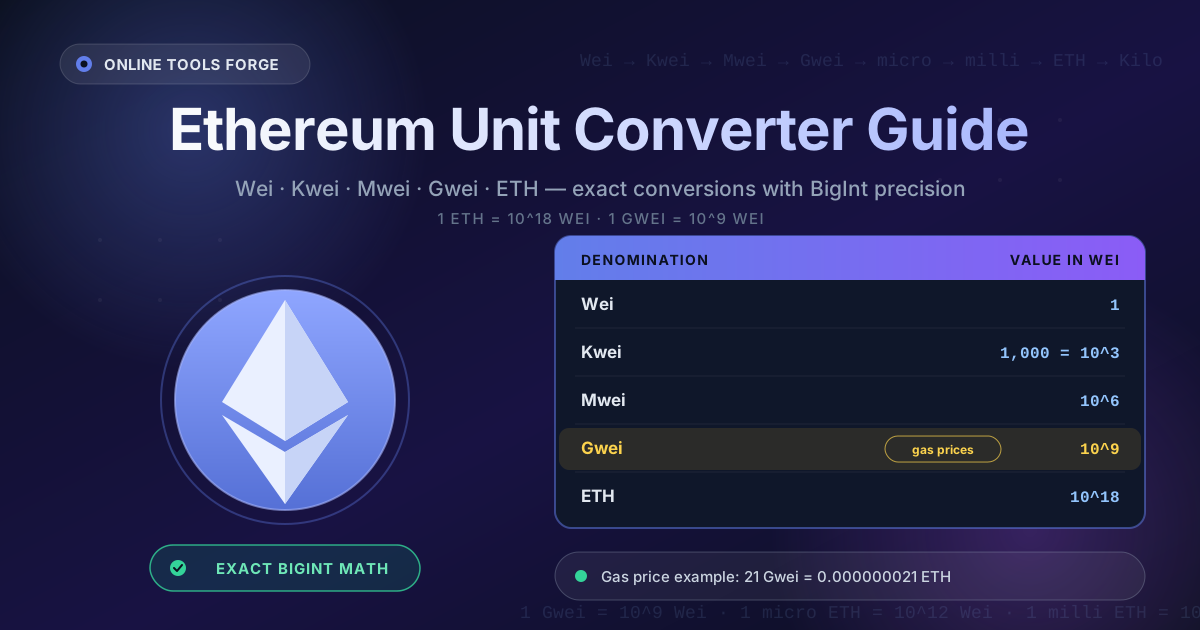
Table of Contents
Ethereum Unit Converter: Convert Wei, Gwei, and ETH With Exact Precision
Ethereum speaks three languages for the same coin: gas prices are quoted in Gwei, balances are recorded on-chain in Wei, and wallet apps display ETH. Shuttle between them by hand across eighteen decimal places, and an expensive mistake is only a matter of time.
The free Ethereum Unit Converter removes the risk. Type any amount in any unit — from Wei to Kiloether — and it instantly shows the equivalent in every other denomination. Under the hood, exact BigInt integer arithmetic replaces floating-point math, so the result you read is the result the blockchain would record. Everything runs 100% in your browser; nothing you type ever leaves your device.
This guide covers why Ethereum needs so many units, how to use the converter, and the floating-point trap that makes naive money math dangerous.
Why Use Ethereum Unit Converter?
The details matter more here than in most conversions. Here is what the tool brings:
- BigInt precision — floats corrupt Wei. JavaScript's Number type cannot even represent 1 ETH in Wei exactly, because 10^18 exceeds the largest safe integer (about 9 × 10^15). The converter parses input into an exact integer count of Wei first, so rounding is impossible.
- Every unit on one screen. A live all-units table updates as you type, showing every denomination simultaneously.
- Correct by construction. Denomination conversion is pure exponent shifting, eliminating order-of-magnitude errors from moving a decimal point by memory.
- 100% client-side privacy. Nothing is uploaded or stored — safe for production wallet and contract values.
- Copy-ready output. Copy any value with one click, ready for a script or report.
Key Features
The Ethereum Unit Converter is deliberately focused: one input, one selector, one complete answer table.
| Feature | What It Does |
|---|---|
| Any-unit input | Enter your amount as Wei, Kwei, Mwei, Gwei, microether, milliether, ETH, or more. |
| Live all-units table | Every other denomination updates instantly as you type, in one view. |
| Exact BigInt math | Integer-only arithmetic guarantees results with zero floating-point rounding. |
| 100% client-side | All computation happens in your browser; nothing is transmitted anywhere. |
- Sub-Wei precision is rejected, not rounded. More than 18 fractional digits is flagged rather than silently guessed at.
- Trailing zeros are trimmed for display only. The internal value stays a full-precision integer; only the display shortens.
How to Use the Ethereum Unit Converter
- Open the tool. Navigate to the Ethereum Unit Converter page.
- Enter your amount. Type the number you have — 0.00042, 420000, or a full 18-digit Wei value. Commas are fine.
- Choose the input unit. Pick the denomination your number is in — Gwei for gas quotes, Wei for raw chain data, ETH for wallet amounts.
- Read the all-units table. Every other unit updates live; take the value from the row you need.
- Copy the result. Click copy on that row and paste it wherever required.
Wei, Gwei, and the Floating-Point Trap
The denomination ladder
Ethereum's smallest unit is the Wei; every other denomination is a power of ten of it. One ETH is 10^18 Wei, and the ladder climbs in thousand-fold steps: 1 Kwei = 10^3 Wei, 1 Mwei = 10^6 Wei, 1 Gwei = 10^9 Wei, then microether (10^12), milliether (10^15), and ETH. Gwei became the standard gas unit because a typical price in Wei is an unwieldy twenty billion, while "20 Gwei" is easy to compare.
Why gas is priced in Gwei but paid in Wei
Gas is Ethereum's metering system: every computational step costs a fixed number of gas units, priced per unit in Gwei. But the protocol never moves Gwei — it is a display convention, not a currency unit. The chain multiplies gas used by gas price and settles the product in Wei, so a Gwei quote becomes a Wei debit before it leaves your balance.
The floating-point trap: 0.1 + 0.2
Ask JavaScript to compute 0.1 + 0.2 and it answers 0.30000000000000004. That is IEEE 754 floating-point math — harmless for graphics, unacceptable for money. Worse, integers beyond 2^53 (about 9 × 10^15) cannot be represented exactly at all, and 1 ETH is 10^18 Wei, more than a hundred times that limit. That is why the converter is built on BigInt: it parses your decimal string into an exact integer count of Wei and does all arithmetic there, so what you copy matches the chain bit-for-bit.
A worked gas-fee example
Say a simple ETH transfer consumes 21,000 gas at 20 Gwei per gas:
21,000 gas × 20 Gwei/gas        = 420,000 Gwei
420,000 Gwei × 10^9             = 420,000,000,000,000 Wei
420,000,000,000,000 Wei ÷ 10^18 = 0.00042 ETH
At 3,000 dollars per ETH that is about 1.26 dollars; enter 420000 with Gwei selected and the converter reproduces all three lines instantly.
Practical Use Cases
Estimating transaction fees
Multiply expected gas by the current Gwei price before submitting, then convert the product into an ETH figure to compare against your balance — or turn a budget of "0.005 ETH" into the maximum affordable Gwei price.
Checking contract values and allowances
Token approvals and contract parameters are specified in base units — the 18-decimal integers visible in raw transaction data. Paste that integer in to see the amount you are really approving and catch requests asking for more than they should.
Verifying wallet balances
Explorers and APIs often return balances in raw Wei while wallets display rounded ETH. Converting both and comparing confirms the display matches the chain and that a deposit arrived in full.
Reading block explorers
Explorer pages mix units freely: transaction values in ETH, gas prices in Gwei, internal transfers in Wei. Keeping the converter open makes the mixed notation immediately comparable.
Best Practices
- Always compute in Wei, format only for display. Treat the integer Wei value as the source of truth and derive ETH strings only at display time.
- Never route money math through floats. parseFloat and toFixed suit charts and labels, never amounts that will be signed or settled.
- Double-check decimals per token. 18 is ETH's convention, but ERC-20 tokens vary — USDC uses 6, others differ again. Confirm a token's decimals value first.
- Quote gas in Gwei, settle in Wei. Keep the units straight: prices in Gwei, debits in Wei.
- Prefer exact strings over scientific notation. Values like 4.2e14 are easy to mistype; copy the full string the tool provides.
- Re-verify before signing. A two-second check is cheap insurance against order-of-magnitude errors no dialog will catch.
Start Converting With Confidence
Wei, Gwei, and ETH are one coin seen from three distances, and moving between them should never involve guesswork. The free Ethereum Unit Converter shows every denomination at once, computed with exact integer math that matches the blockchain's own accounting — private, instant, and sign-up free.
Related Tools You Might Like:
- Base Converter — convert between binary, octal, decimal, and hexadecimal when reading hex transaction data.
- Unit Price Calculator — compare per-unit prices; the same denomination logic applied to shopping.
- Hash Generator — compute SHA-256 and other hashes when verifying transactions or data integrity.
Happy converting!
Frequently Asked Questions
Q: How many Wei are in one ETH?
A: Exactly 10^18 Wei — a one followed by eighteen zeros. Working from this exact integer means even a full 18-digit Wei value converts with no precision loss.
Q: Why is my gas fee quoted in Gwei but deducted in Wei?
A: Gwei is a display convention worth 10^9 Wei. The protocol multiplies gas used by gas price and settles the result in Wei, so the Gwei quote is the last step before a Wei debit.
Q: Why can't I just use a regular calculator for these conversions?
A: Ordinary calculators use floating-point numbers, which round and cannot exactly represent integers beyond about 9 × 10^15 — smaller than 1 ETH in Wei. The converter uses BigInt integer math instead, so results match the blockchain exactly.
Q: Does the converter work for ERC-20 tokens?
A: It converts Ethereum's native denominations, which share the 18-decimal scale of many tokens. For tokens with a different decimals value, rescale by that token's own decimal count.