Iframe Embed Generator: Responsive, Lazy-Loaded, and Sandboxed Embeds in Seconds
Free iframe embed code generator. Build responsive 16:9 embeds for YouTube, Vimeo, and Google Maps with lazy loading, sandbox, referrerpolicy, title, and live preview. 100% client-side.
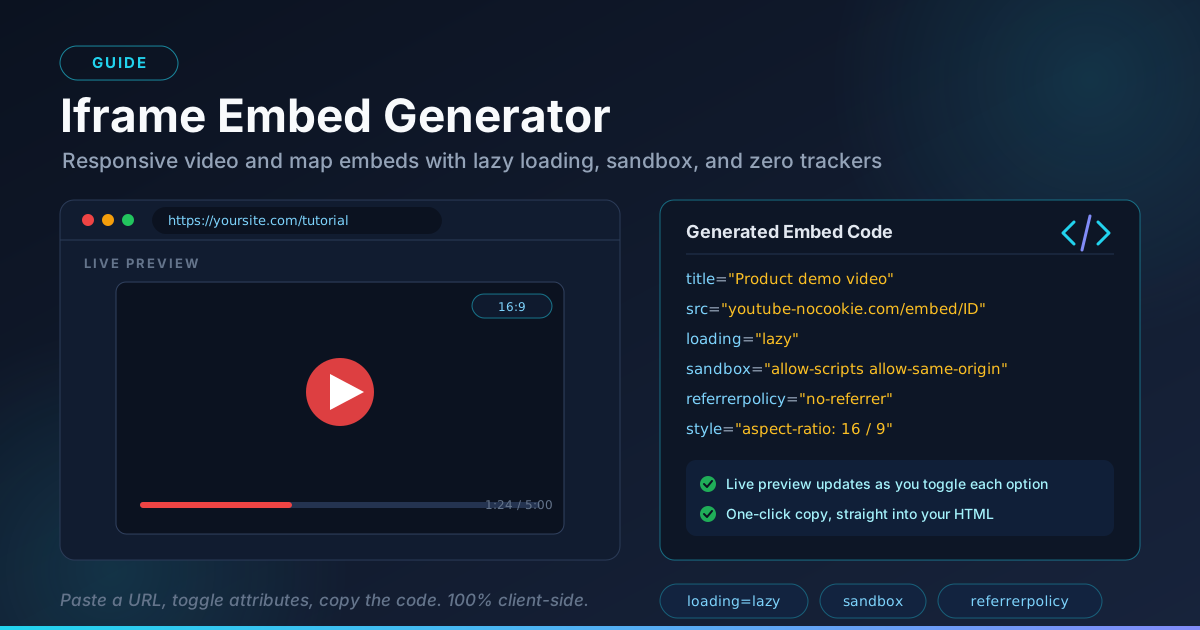
Table of Contents
Iframe Embed Generator: Responsive, Lazy-Loaded, and Sandboxed Embeds in Seconds
Pasting YouTube's default embed code is the fastest way to get a video onto a page — and it quietly ships third-party trackers before anyone presses play, while its hard-coded width and height break mobile layouts with horizontal scrollbars.
The free iframe embed generator fixes both in the time it takes to paste a URL. Pick a preset — YouTube, Vimeo, or Google Maps — or drop in any address. The tool wraps everything in a responsive container, offers toggles for lazy loading, sandbox, referrerpolicy, and title, previews the result live, and hands over clean, copy-paste-ready code. It runs 100% client-side, so your URLs never leave the browser.
This guide walks through the workflow, explains what each attribute really does, and closes with the habits worth keeping.
Why Use Iframe Embed Generator?
- Two defects fixed at once: privacy-enhanced domains keep trackers out, and the responsive wrapper keeps layouts intact down to a 360-pixel phone.
- Presets for the big three: one click configures YouTube, Vimeo, or Google Maps — any other URL works too.
- Attributes as toggles: lazy loading, sandbox, referrerpolicy, and title — no memorizing syntax.
- Live preview before you ship: see what visitors get before the code touches your page.
- Private by design: no account, no upload; safe even for staging or intranet URLs.
- Clean, committable output: readable markup you can merge without embarrassment.
Key Features
| Feature | What It Does |
|---|---|
| Source presets | Ready-made patterns for YouTube, Vimeo, Google Maps |
| Any URL support | Embeds arbitrary pages, dashboards, or players |
| Responsive wrapper | A 16:9 container that scales down to mobile |
| Lazy loading toggle | Adds loading="lazy" — loads only when scrolled near |
| Sandbox toggle | Restricts what embedded content can do |
| Referrerpolicy toggle | Limits referrer data sent to the embedded site |
| Title attribute | Adds the accessible name WCAG requires |
| Live preview and copy | Renders as you toggle, then one-click copies |
Two details matter day to day: the preview updates as fast as you flip a switch, so comparing configurations takes seconds, and 100% client-side means it works offline and never leaks staging or intranet URLs.
How to Use
- Pick your source — the YouTube, Vimeo, or Google Maps preset, or paste any URL.
- Provide the reference — paste the share link or ID; the tool extracts the identifier onto the privacy-friendly domain.
- Toggle attributes — switch on lazy loading, sandbox, referrerpolicy, and title, then edit the title text to describe the content.
- Check the live preview at the size your page will use.
- Copy and paste the snippet into your blog post, documentation, or client site.
The Attributes That Matter
The toggles look small, but each maps to real browser behavior. Knowing them turns a convenience into a decision-making tool.
The responsive 16:9 wrapper
Hard-coded dimensions are the top reason embeds break: YouTube's default 560-pixel player overflows a 375-pixel phone. Since 9 divided by 16 is 0.5625, a wrapper with 56.25% bottom padding keeps perfect 16:9 proportions at any width; modern aspect-ratio: 16 / 9 CSS is cleaner and is what the generated code uses. A small annotated embed:
<!-- Privacy-enhanced domain: no tracking cookies until playback starts -->
<!-- Responsive wrapper: 56.25% padding keeps 16:9 at any width -->
<div style="position: relative; padding-bottom: 56.25%; height: 0; overflow: hidden;">
  <!-- Accessible name: WCAG requires it so screen readers announce the frame -->
  <!-- Deferred download: fetched only when the visitor scrolls near -->
  <iframe
    src="https://www.youtube-nocookie.com/embed/VIDEO_ID"
    title="Product demo walkthrough"
    loading="lazy"
    referrerpolicy="strict-origin-when-cross-origin"
    style="position: absolute; inset: 0; width: 100%; height: 100%; border: 0;"
    allowfullscreen
  ></iframe>
</div>
loading="lazy" saves bandwidth
Eager embeds download the player, thumbnail, and scripts on page load even if nobody scrolls. Three videos can shed over a megabyte with loading="lazy", and because browsers fetch lazy iframes only as they approach the viewport, above-the-fold content paints sooner. Skip it only for an embed at the very top.
sandbox: levels of restriction
The sandbox attribute treats the embedded document as untrusted. Empty, it is strictest — scripts off, forms blocked, popups prevented — which stops modern players from running. Permission tokens relax specific restrictions: sandbox="allow-scripts allow-same-origin allow-presentation" lets a video play while still denying forms, top-level navigation, and popups. Careful: allow-scripts plus allow-same-origin lets the embed remove its own sandbox.
referrerpolicy for privacy
Every embed request sends a Referer header, which historically carried your full URL, query strings included. strict-origin-when-cross-origin sends only your origin; no-referrer sends nothing. For sensitive paths — intranet tools, admin panels, unlaunched products — no-referrer is the conservative choice.
title: an accessibility requirement
WCAG and the HTML spec require a title on every iframe. Screen readers announce frames by that name; without it, visitors hear a bare "frame" — or several anonymous frames per page. Writing "Quarterly results video" takes ten seconds and turns an inaccessible box into a labeled element. The generator makes title a first-class field so it is never forgotten.
Privacy-enhanced mode: youtube-nocookie.com
YouTube's standard embed domain sets cookies before playback, which is why European privacy guidance often flags default embeds. youtube-nocookie.com defers them until the user actually plays — functionally identical, meaningfully more private. The YouTube preset applies it automatically.
Practical Use Cases
Blog post videos
Talks, tutorials, and demos pair well with prose. Each post gets a lazy-loaded, titled, responsive player that loads nothing until scrolled into view.
Documentation and knowledge-base maps
"How to reach our office" becomes genuinely useful beside an embedded Google Map. One responsive snippet serves phones in the field and wide monitors at the desk.
Client site embeds
Agencies paste third-party players into client sites constantly. Delivering titled, sandboxed, privacy-friendly code signals craftsmanship — and answers the compliance auditor six months later.
Privacy-conscious, analytics-free pages
Pages promising "no tracking" cannot quietly ship a default embed. The privacy-enhanced domain plus referrerpolicy="no-referrer" and a sandbox keeps the promise verifiable.
Best Practices
- Lazy-load everything below the fold. Free performance; never download an unseen player.
- Always set the title. Treat a missing iframe title like missing alt text.
- Sandbox third-party embeds when possible. You embedded a video, not an application.
- Grant the fewest tokens that work. Start strict, add permissions until it functions, stop.
- Test on mobile. Only a real device catches proportion and fullscreen surprises.
- Prefer privacy-enhanced domains everywhere. Visitors' cookies are not the price of a video.
Start Generating Your Embeds
Grab a YouTube, Vimeo, or Maps link and run it through the iframe embed generator. Toggle, preview, copy, paste — responsive, lazy-loaded, sandboxed, titled embeds in under a minute, with nothing sent to any server.
Related Tools You Might Like:
- QR Code Generator — turn URLs and text into downloadable QR codes for print and packaging
- URL Parser — split any URL into protocol, host, path, and query parameters
- Graph Paper Generator — print custom grid, dot, and isometric paper as ready-to-print PDFs
Happy embedding!
Frequently Asked Questions
Q: Will lazy loading break my embed or delay playback?
A: No. loading="lazy" defers the initial download until the iframe approaches the viewport; it then loads and plays normally. Skip it only for an embed deliberately placed above the fold.
Q: Why does my sandboxed video refuse to play?
A: The strictest sandbox disables JavaScript, which modern players need. Add tokens — typically allow-scripts, plus allow-same-origin for same-domain assets — until playback works, then stop. Keep the sandbox; it still blocks forms, popups, and top-level navigation.
Q: Do I still need youtube-nocookie.com if I set a referrerpolicy?
A: They solve different problems: the privacy-enhanced domain controls YouTube's cookies on your visitors, while referrerpolicy controls what your page URL leaks. For a genuinely private embed, use both — the preset does.
Q: Does the tool send my URLs anywhere?
A: No. The generator runs 100% client-side in your browser; whatever you paste, including staging or intranet URLs, never leaves your machine — which is also why it works offline.