ISO Country Code Lookup: Alpha-2, Alpha-3 and Numeric Codes Explained
Find any ISO 3166 country code instantly with ISO Country Code Lookup — search by English or Thai name, alpha-2, alpha-3 or numeric code, fully offline, with flag emoji, calling code and currency.
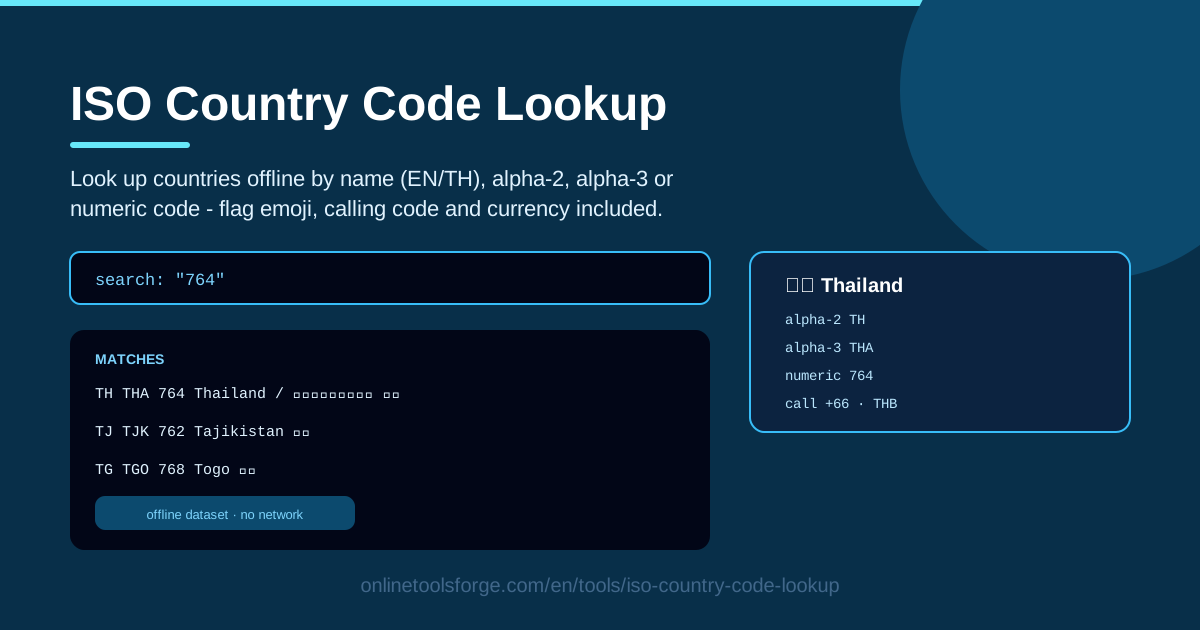
Table of Contents
Country data has a way of turning simple tasks into tedious ones. You are filling in a payment form that wants a two-letter code, staring at a spreadsheet that mixes "Thailand", "TH", "THA" and "+66", or trying to recall Japan's numeric code. Get it wrong and forms get rejected, imports fail, and cleanup eats your afternoon.
ISO Country Code Lookup was built to end that guesswork. Type what you already know — a country name in English or Thai, an alpha-2 code, an alpha-3 code, or a numeric code — and the tool instantly returns the country's full profile: flag emoji, international calling code, and currency. Everything comes from a bundled dataset, so the tool works with no network and runs entirely in your browser.
In this guide you will learn how to use the tool step by step, what each of the three ISO 3166 code systems is actually for, and how developers put country lookups to work every day.
Why Use ISO Country Code Lookup?
- It works completely offline. The dataset is bundled with the tool, so lookups keep working on flights, trains or flaky conference Wi-Fi — and nothing is ever sent to a server.
- You can search in Thai or English. "ประเทศไทย" and "Thailand" both find the same country, a genuine time-saver for Thai-speaking teams handling international data.
- Any input format works. An alpha-2 from a form, an alpha-3 from a passport, a numeric from an old export — one search box handles them all.
- You get more than codes. Every result includes the flag emoji, calling code and currency, so one lookup answers several questions at once.
- Results follow the real standard. The data maps to ISO 3166, the same standard used by payment networks, postal systems and software platforms worldwide.
- No sign-up, no friction. It runs in the browser, loads instantly and is free to use as often as you like.
Key Features
| Feature | What it does |
|---|---|
| Multi-format search | Find countries by English or Thai name, alpha-2, alpha-3 or numeric code. |
| English and Thai names | Every country is indexed in both languages. |
| Flag emoji | Copy the country's flag straight into docs, chats or UI. |
| Calling code | See the dialing prefix, for example +66 for Thailand. |
| Currency | Each card shows the local currency for pricing work. |
| Offline dataset | No network requests — private, fast and always available. |
| Runs in the browser | Nothing to install; works on any modern device. |
- Multi-format search is the anchor. A designer grabbing a flag for a mockup and an analyst resolving numeric codes from a government export can use the same page.
- Offline means private. Lookups never leave your machine, so pasting internal or client data into the search box is safe.
How to Use ISO Country Code Lookup
- Open the tool at ISO Country Code Lookup. It loads immediately; nothing to install or configure.
- Type what you know — "Thailand" or "ประเทศไทย", a two-letter code like "TH", a three-letter code like "THA", or a numeric code like "764".
- Read the matches. Matching countries appear with flag, name and all three codes, so you can confirm the right country at a glance.
- Copy the code you need — alpha-2 for a web form, alpha-3 for a banking document, or numeric for a data pipeline.
- Check the calling code and currency while you are there, especially if your task involves phone validation or pricing.
Most lookups take seconds, and because everything runs locally there is no lag even on a slow connection.
The Three ISO 3166 Codes Explained
Every country in ISO 3166 carries three official codes, and they are not interchangeable. Knowing which one to use where saves real debugging time.
Alpha-2 codes are two letters — TH, JP, DE. This is the most widely used format: it powers country-code top-level domains (.th, .jp, .de), most web form dropdowns, browser locale settings (the TH in th-TH) and countless API parameters. If you are building a typical web application, alpha-2 is almost certainly what your forms expect.
Alpha-3 codes are three letters — THA, JPN, DEU. The extra letter makes them easier for humans to recognize; MMR reads as Myanmar far more clearly than MM, which could be almost anything. You will find alpha-3 in machine-readable passport zones, visa and banking paperwork, customs forms and sports data feeds — anywhere documents are read by people and machines alike.
Numeric codes are three digits — 764 for Thailand, 392 for Japan, 104 for Myanmar. They look awkward but hide a superpower: no dependence on any alphabet. When Burma became Myanmar, BU became MM and BUR became MMR, yet numeric 104 stayed exactly the same. When Zaire became the Democratic Republic of the Congo, ZR and ZAR gave way to CD and COD while numeric 180 carried on unchanged. For long-lived archives and statistical databases, numeric codes are the stable choice.
A few extras are worth knowing too. Flag emoji are built from alpha-2: each letter maps to a Unicode regional indicator symbol, so T and H combine to render Thailand's flag — which is why some platforms show letter pairs instead. Calling codes are a separate system; the +66 in +66 2 123 4567 comes from the E.164 telephone standard, not ISO 3166. And the bundled offline dataset ties it all together: faster results, better privacy, and lookups that cannot fail because an API went down.
Practical Use Cases
Populating Form Dropdowns
Building a country selector? Pull name and alpha-2 pairs for your options and confirm each entry with a quick lookup. The flag emoji makes visual verification easy — especially for confusable pairs like Austria and Australia.
Payment and Checkout Country Fields
Processors are strict: some want alpha-2, others alpha-3, and legacy systems occasionally want numeric. When an integration rejects a country value, look it up, confirm what it decodes to, and supply the exact format demanded. The currency field also helps when setting display currency per market.
Cleaning Messy CSV Country Columns
Real exports mix "Thailand", "THA", "764" and the occasional "Siam". Resolve every variant through the tool, then standardize the column on one code system.
Travel App Data
Travel products use all three code families at once: alpha-2 for locales, alpha-3 for airline references, calling codes for international contact forms. With flags, codes, prefixes and currencies on one card, a destination profile comes together in a single visit.
Best Practices
- Store alpha-2 in your database — it is the de facto interchange standard and what most libraries and APIs expect.
- Never use free-text names as primary keys. Names change and get misspelled; codes do not. Keep names for display, codes for logic.
- Normalize ambiguous input at the boundary. "USA", "US" and "America" should all resolve to US before data enters your system.
- Verify your form's expectations. Check whether the target wants alpha-2, alpha-3 or numeric; the tool gives you all three.
- Prefer numeric codes for archives. They survive renames and script changes that letter codes do not.
- Test flag emoji rendering. Flags vary across operating systems; verify them on every platform you support.
Ready to stop guessing at country codes? Open ISO Country Code Lookup, type a name or a code, and get the answer with its flag, calling code and currency in seconds — no network required.
Related Tools You Might Like:
- Timezone Converter — convert times across the time zones of countries you work with.
- Unit Converter — handle the measurement conversions that come with international data.
- Currency Converter — pair every country's currency with quick conversion math.
Happy looking up!
Frequently Asked Questions
Q: What is the difference between alpha-2, alpha-3 and numeric codes? A: Alpha-2 uses two letters (TH), alpha-3 uses three (THA), and numeric uses three digits (764). All three identify the same country under ISO 3166; web forms usually want alpha-2, documents use alpha-3, and long-lived systems favor numeric because it survives country renames.
Q: Can I search using a Thai country name? A: Yes. Every country is indexed in both English and Thai, so "ประเทศไทย" and "Thailand" return the same result.
Q: Does the tool work without an internet connection? A: Yes. The dataset is bundled and everything runs in your browser, so lookups work fully offline — on flights, in dead zones, or while an external API is down.
Q: Is a calling code the same as an ISO country code? A: No. Calling codes such as +66 come from the E.164 telephone plan, which is separate from ISO 3166. The tool shows both side by side so you never mix them up.