PII Redactor: Strip Personal Data Before You Paste or Share
Detect and redact emails, phone numbers, credit cards, SSNs, IBANs, IP addresses, and API keys in pasted text, with Luhn validation and redact, mask, or hash modes. Runs fully in-browser.
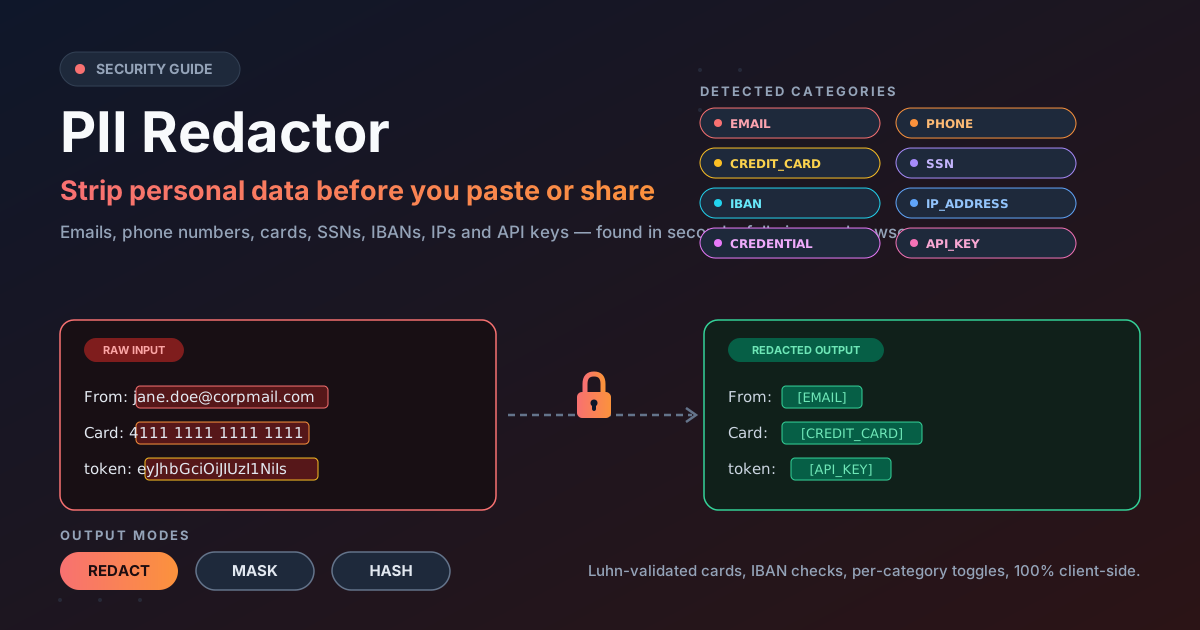
Table of Contents
PII Redactor: Strip Personal Data Before You Paste or Share
Engineers and support agents paste other people's personal information every day: an email in a pasted log, a card number in a stack trace, an API key in a config snippet. The paste takes two seconds; the exposure lasts for years, because tickets, chat archives, and AI chats get copied and indexed widely.
PII Redactor is built for exactly this moment. Paste the text first, and the tool detects emails, phone numbers, credit cards, SSNs, IBANs, IP addresses, credential assignments, and API-key patterns, then replaces each finding in redact, mask, or hash mode. Cards are Luhn-validated and IBANs format-checked, so dates and order IDs survive. Everything runs in your browser — no upload, no account.
Why Use PII Redactor?
- Redact before the paste, not after the leak: A pass before a ticket, chat, or AI prompt is far cheaper than removing data from an archive afterward.
- Cut false positives with real validation: Cards must pass a Luhn checksum, so timestamps and reference numbers survive untouched.
- Choose the output that fits the audience: Redact for an anonymous copy, mask for a readable partial view, hash for correlation tokens.
- Work with AI assistants more safely: Redact pasted logs first to keep the debugging context without leaking customer data.
- Stay private end to end: The tool is 100% client-side. Pasted text never leaves your device — which matters when the text is the sensitive material.
Key Features
| Feature | What it does | Why it matters |
|---|---|---|
| Email detection | Finds email addresses in pasted text | The most commonly leaked identifier |
| Phone detection | Matches international formats, skips dates and decimals | Keeps timestamps and numeric IDs intact |
| Credit card | Captures 13 to 19 digit card numbers, validated with Luhn | Blocks card-like sequences that fail the checksum |
| SSN, IBAN, and IP | Detects SSNs, validates IBAN structure and IPv4 octets | Covers sensitive identifiers and network data |
| Credentials and keys | Credential assignments plus AWS, GitHub, Slack, Google, and JWT formats | Stops live secrets reaching shared systems |
| Output modes | Redact, mask, or hash each finding | Matches the audience: reviewers, humans, pipelines |
| Category toggles | Toggles each of the eight detectors | Adapts the pass to your text |
- Overlap-safe: Conflicting findings are resolved by priority, never double-replaced.
- Deterministic hashing: The same value always yields the same token for correlation.
How to Use
- Open the tool: Visit PII Redactor in your browser. Nothing to install or create.
- Paste the text: Drop in the log, ticket draft, or prompt you are about to share. Processing happens locally.
- Adjust the category toggles: Keep all eight detectors on for unknown text, or narrow the pass for a specific audience.
- Pick an output mode: Redact for a scrubbed copy, mask when reviewers must recognize partial values, or hash to correlate values.
- Copy the result: Check the counts, then paste the sanitized text onward. Repeat for other blocks.
Patterns That Get Caught
Emails are matched with a standard pattern: local part, at sign, domain, and top-level domain — in form input, headers, and forwards.
Phone numbers use a careful heuristic. It accepts country codes such as +66, area codes, and grouped digits, but rejects text that merely looks numeric, so dates, times, and timestamps survive.
Credit cards are the best example of why validation matters. The tool captures 13 to 19 digit groups and runs the Luhn checksum. Every real card satisfies Luhn, so a spaced order ID or long timestamp stays untouched — few false alarms.
SSNs match the familiar three-two-four format with hyphens. IBANs are matched by country prefix and validated for the 15 to 34 character standard. IP addresses are captured in dotted-quad form, each octet checked against the 0 to 255 range.
Credentials and API keys work in two layers. Credential assignments — api_key, secret, token, password, bearer, or authorization followed by a value — are detected and the value is redacted, which also catches sk- style provider tokens via the neighboring key name. Well-known formats are recognized directly: AWS keys with AKIA, GitHub tokens with ghp_, Slack tokens with xox, Google keys with AIza, and JWTs with eyJ.
The modes trade different properties. Redact replaces each finding with a bracketed placeholder such as [EMAIL] — anonymous and safe to share, but values can no longer be compared. Mask keeps the first and last characters and stars out the middle, so a reviewer can still recognize Jane's address. Hash produces a deterministic token such as [EMAIL:#4a3c9d21], letting you correlate the same customer across records without exposing it.
Regex detection has limits: names, street addresses, job titles, and contextual meaning are not caught. A redactor is a structural filter, not a substitute for judgment — skim the output before sharing.
Practical Use Cases
Support ticket hygiene
Before a customer thread is escalated or pasted into a public issue, run it through the redactor. Placeholders keep the narrative intact — reviewers still see that an email existed and where it sat — while the address itself never enters a third-party tracker. Mask mode fits when an internal reviewer must verify a value later.
Sharing logs with vendors
Application logs are full of incidental personal data: IP addresses in request lines, emails in errors, tokens in headers. Redact before attaching, disabling only the categories the vendor needs, and leaving hash mode on so both sides can still match records.
Pre-AI-chat cleanup
Pasting logs into an AI assistant is everyday debugging, but prompts reach an external system. A quick pass keeps the structure — stack traces, errors, timing — while removing the emails, card numbers, and keys that have no business leaving your machine.
GDPR-minded data handling
GDPR treats emails, phone numbers, and identifiers as protected personal data, and minimizing what you share is a core principle. A repeatable redaction step is a simple way to practice it, reducing the personal data that flows into tickets, exports, and third-party tools.
Best Practices
- Redact before you paste, not after: Build the step ahead of the ticket, chat, or prompt.
- Hash when you need to correlate: Datasets joined later need one consistent token per value — hash mode does exactly that.
- Remember free-text names are not caught: The detectors find structured identifiers. Names, addresses, and job titles in plain prose still need a human pass.
- Never rely on one pass: Run the redactor, skim the output, and run it again if you edit or extend the text.
- Tune toggles per audience: Leaving IP detection off for a network handoff is reasonable; leaving credential detection off almost never is.
- Keep the original local: Redact on the machine holding the source data; paste only the sanitized result outward.
Redact First, Then Share
One paste moves someone's personal data into a system you do not fully control — and one redaction pass prevents that. Open PII Redactor, paste your text, pick the matching mode, and copy out a sanitized version. It runs entirely in your browser, costs nothing, and makes privacy a ten-second habit.
Related Tools You Might Like:
- Text Encryptor — encrypt sensitive text with AES-256 for protected transit.
- Steganography Tool — hide a message inside an image for discreet sharing.
- Regex ReDoS Checker — review your own detection patterns for catastrophic backtracking before shipping them.
Happy redacting, and safer sharing!
Frequently Asked Questions
Q: Does PII Redactor send my text to a server?
A: No. All detection and replacement happens locally in your browser; pasted text never leaves your device.
Q: Why did an obvious-looking credit card number not get redacted?
A: Only sequences passing the Luhn checksum with a plausible 13 to 19 digit card length are redacted. A failing number is almost certainly not a real card; keeping it preserves values such as order IDs.
Q: What is the difference between mask and hash modes?
A: Mask stars the middle so a human can still recognize a value; hash produces a deterministic token so a process can correlate values without exposure.