Position Size Calculator: Size Trades by Risk, Not Gut Feeling
Calculate safe share quantity from account size, risk percent, entry price, and stop-loss, with dollar risk, risk per share, and total position value. Free in your browser.
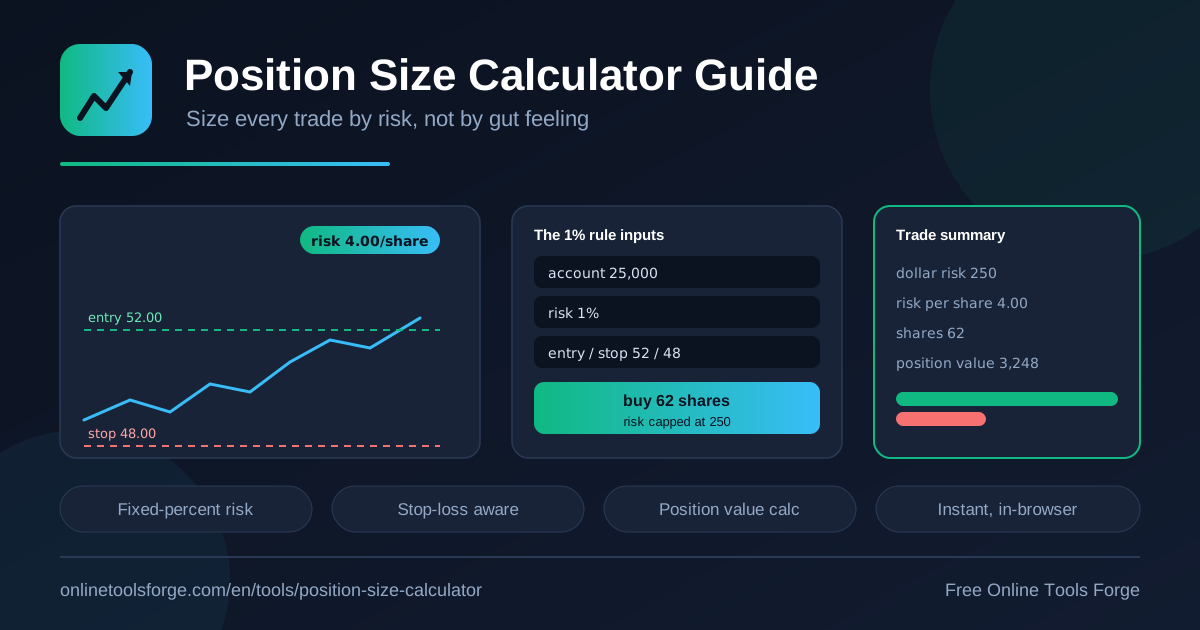
Table of Contents
Ask a room full of traders what kills more accounts than anything else, and the answer is rarely bad analysis. It is bad sizing. A great setup taken at five times the sensible size can erase months of discipline, while a mediocre setup taken at the right size barely dents the equity curve. Position sizing is the quiet skill that separates systematic traders from gamblers, and it starts with one blunt question: how much can I lose on this trade?
The Position Size Calculator answers that question in seconds. Enter your account size, the percentage of equity you are willing to risk, your planned entry price, and your stop-loss. The tool instantly returns your dollar risk, the risk per share, the exact number of shares to buy, and the total value of the resulting position. It runs 100 percent in your browser, requires no signup, and sends nothing to any server.
This guide covers how to use the calculator step by step, the math behind every output, and the habits that turn position sizing from an occasional check into a core trading discipline.
Why Use the Position Size Calculator?
- It enforces a fixed risk budget. Instead of guessing how many shares feel right, you decide the exact dollar amount you can lose before the trade ever starts.
- It adapts size to the stop. A tight stop supports more shares; a wide stop demands fewer. The calculator adjusts the share count automatically for every setup.
- It prevents account-destroying losses. Ten straight losses at 1 percent risk each leave you down roughly 10 percent — painful, but fully recoverable with a modest win streak.
- It removes emotion from the entry. When the size is precomputed from the stop, hesitation and overconfidence have far less room to interfere at the moment of truth.
- It makes trades comparable. When every position risks the same fraction of equity, your win and loss statistics measure the strategy rather than the sizing.
- It is fast and private. All results compute locally in your browser, so you can size a trade mid-session without spreadsheets, logins, or data leaving your device.
Key Features
| Feature | What it does |
|---|---|
| Account size | Sets the equity base your risk percentage applies to |
| Risk percent | Converts your chosen fraction of equity into a dollar risk budget |
| Entry price and stop-loss | Define the trade and the distance between entry and invalidation |
| Dollar risk | Shows the exact dollars on the line if the stop is hit |
| Risk per share | Shows the loss each share takes between entry and stop |
| Shares to buy | Returns the position size that keeps total loss within budget |
| Total position value | Shows the full cash commitment for margin and concentration checks |
| Zero-range guard | Flags a stop equal to entry, preventing a division-by-zero result |
A few outputs deserve extra attention:
- Dollar risk is account size multiplied by risk percent — the maximum this trade should ever cost you.
- Risk per share is entry price minus stop-loss price — the unit price of being wrong.
- Shares to buy is dollar risk divided by risk per share, rounded down so the real loss never exceeds the budget.
How to Size a Trade
- Enter your account size. Use current equity, not what you deposited years ago.
- Choose your risk percent. One percent is the conservative standard; few professionals exceed two percent per trade.
- Enter the entry price you plan to pay for the stock.
- Enter your stop-loss — the price at which your trade idea is objectively wrong.
- Read the results. Dollar risk, risk per share, shares to buy, and total position value appear instantly. Round the share count down and place the order.
The Math Behind Position Sizing
Position sizing rests on three small formulas that the calculator applies the moment you type. First, your risk appetite becomes money: dollar risk equals account size multiplied by risk percent. Risk 1 percent of a 25,000 dollar account and your budget is 250 dollars. Second, one wrong share has a price: risk per share equals entry price minus stop-loss price. Third, divide the budget by the unit price to get the position size: shares equal dollar risk divided by risk per share.
Account 25000, risk 1% -> dollar risk = 250
Entry 40, stop 36 -> risk per share = 4
Shares = 250 / 4 = 62.5 -> buy 62 shares
Position value = 62 x 40 = 2480
The share count is entirely hostage to stop distance, and that is the whole point. The same 250 dollar budget buys 125 shares against a 2 dollar stop, 62 shares against a 4 dollar stop, and only 25 shares against a 10 dollar stop. Risk stays constant while exposure flexes. A trader who fixes share count first and hunts for a stop afterward is doing the process backwards.
Why anchor to 1 percent? Percentage losses are asymmetric: a 10 percent drawdown needs an 11 percent gain to repair, while a 50 percent drawdown needs 100 percent. A small fixed risk keeps every loss a rounding error in your career curve, which is why the 1 percent rule anchors risk management for systematic traders. Finally, check the total position value. In the example, 62 shares at 40 dollars is 2,480 dollars — about 10 percent of the account. If that value exceeds your buying power or concentration comfort, shrink the position or pass on the setup.
Practical Use Cases
Day Trading Setups
Day traders take several setups per session, so per-trade risk compounds quickly. With a 30,000 dollar account risking 0.5 percent, the budget is 150 dollars. A breakout entry at 52 with a stop at 50.50 risks 1.50 per share, so the calculator sizes the trade at 100 shares with 5,200 dollars of exposure. Even five full losers in one day cost only 2.5 percent of equity.
Swing Trade Planning
Swing trades hold for days or weeks, and stops sit wider, below structure rather than under the last candle. Suppose you buy a pullback at 145 with a stop at 138: that is 7 dollars of risk per share, so a 250 dollar budget supports only 35 shares. Run the identical budget through a tighter stop and the calculator instantly shows how much larger the position could be — sizing must follow the stop, never precede it.
Portfolio Risk Budgeting
Risk per trade doubles as a portfolio-level control. Five open positions each risking 1 percent put 5 percent of equity at work simultaneously. Decide in advance that you will hold at most four concurrent positions at 0.75 percent risk each, then make every new trade fit the remaining budget. This is how systematic traders keep correlated moves from turning a routine pullback into an account event.
Backtesting Position Rules
Backtests are only honest when sizing is fixed. Apply one rule — 1 percent of equity per trade, using each setup's own entry and stop — across your entire historical sample, and the results measure the edge rather than lucky sizing. Trading every idea at the same risk level also produces cleaner expectancy statistics, because a single oversized winner or loser can no longer dominate the sample.
Best Practices
- Define the stop before the size. The stop marks where the idea is wrong; the size is whatever keeps that loss acceptable.
- Round shares down. Rounding up can push the real loss slightly above budget on a stopped-out trade.
- Recompute for every setup. Never reuse a share count from a different entry or stop, even on the same ticker.
- Keep the risk percent consistent. Varying risk size mid-streak turns your statistics into noise.
- Check position value against buying power. Correct risk does not guarantee the margin requirement is affordable.
- Cut risk after losses. Many traders size off reduced equity after a drawdown so risk stays proportional to what is left.
Put the Calculator to Work
Discipline is a system, not a mood. Open the free Position Size Calculator, run your next setup through it before you touch the buy button, and place the order at the size the math returns — not the size your gut suggests. It is instant, private, and works entirely in your browser with no signup.
Related Tools You Might Like:
Happy trading!
Frequently Asked Questions
Q: What is the 1 percent rule in trading risk management?
A: It means risking no more than 1 percent of your account equity on any single trade. Because each loss stays small, a normal losing streak dents the account without threatening its survival, giving your edge time to play out over many trades.
Q: What happens if my entry price equals my stop-loss price?
A: That would create a zero-range stop, and dividing dollar risk by zero has no meaning. The calculator guards against this input, so set distinct, realistic levels: the stop should sit where your trade idea is genuinely invalidated.
Q: Should I round the share count up or down?
A: Round down to the nearest whole share. Buying the extra share pushes the potential loss just past the budget you defined, which defeats the purpose of sizing by risk. Some brokers support fractional shares if exact math matters to you.
Q: Can I use it for instruments other than stocks?
A: Yes. Any share-based instrument with a price and a stop, such as ETFs and REITs, works with the same formulas. Leveraged derivatives like futures and options have contract multipliers and need their own sizing math.