Rental Yield Calculator: Four Metrics Every Property Investor Should Know
Use the free Rental Yield Calculator to turn price, rent, expenses, and mortgage terms into gross yield, net yield, cap rate, and cash-on-cash return before you commit to a purchase.
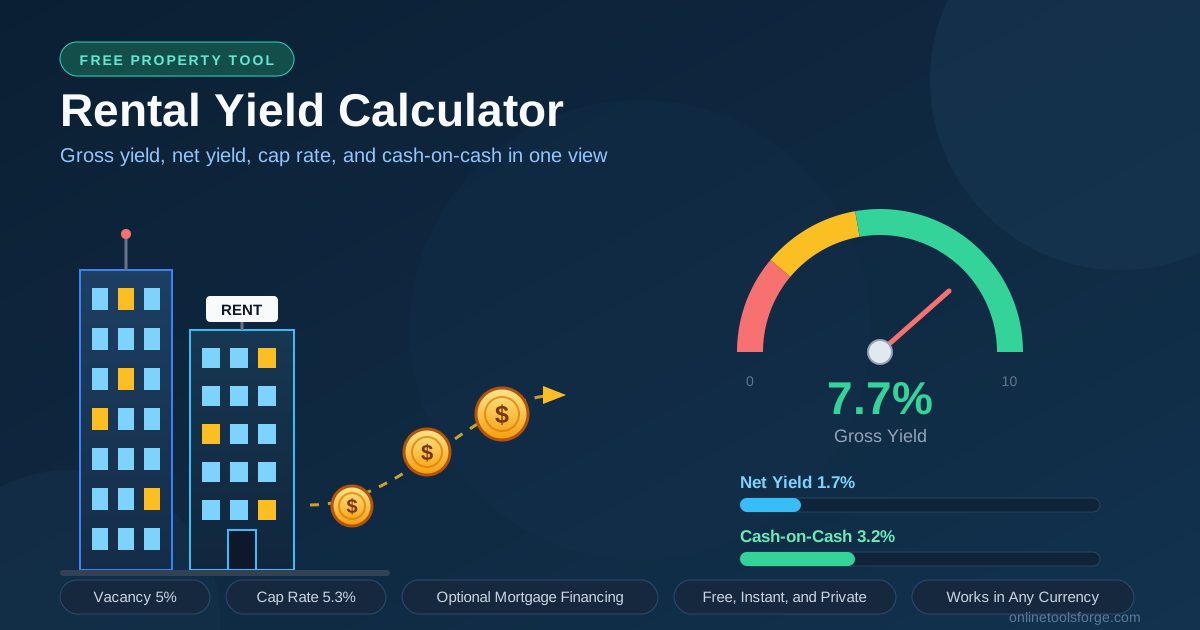
Table of Contents
Rental Yield Calculator: Four Metrics Every Property Investor Should Know
A rental property is one of the few investments where you can estimate the return before spending a dollar, yet many buyers still decide on gut feeling or a sales pitch. The free Rental Yield Calculator turns price, rent, expenses, and financing into the four metrics professionals actually use: gross yield, net yield, cap rate, and cash-on-cash return.
No single number tells the whole story: an impressive gross yield can fade once vacancy and costs are subtracted, while a lower-yield property can still win on cash-on-cash with favorable financing. This guide explains each metric and follows one worked example from asking price to final cash-on-cash return.
Why Use the Rental Yield Calculator?
- One screen, four answers. All four metrics computed together from the same inputs, instead of a spreadsheet and a cherry-picked stat.
- Vacancy is built in. The 5% default vacancy assumption forces a realistic view of rent collection.
- Financing included. Down payment, interest rate, and loan term show how mortgage payments change your cash flow.
- Comparable by design. Cap rate strips out financing, so properties in different districts are judged on the same footing.
- Private and instant. Everything runs client-side in your browser, and results update as you type.
- Currency agnostic. Yield is a ratio, so the math works identically for a 4,000,000 THB condo or a 250,000 dollar house.
Key Features
| Feature | What It Does |
|---|---|
| Four core metrics | Shows gross yield, net yield, cap rate, and cash-on-cash from one set of inputs |
| Vacancy adjustment | Reduces rent by your vacancy rate, with 5% as the default |
| Operating expenses | Subtracts annual common fees, taxes, insurance, and maintenance |
| Mortgage financing | Optional down payment percent, interest rate, and loan term produce monthly payment and debt service |
| Cash invested basis | Adds closing costs to the down payment so cash-on-cash reflects your true outlay |
| Instant results | All outputs recalculate live and copy out as a summary |
Worth knowing: net operating income is effective rent after vacancy minus expenses, so the cap rate is a true unlevered figure. Once a mortgage is entered, debt service is subtracted before net yield and cash-on-cash, and nothing is sent to a server.
How to Use the Rental Yield Calculator
- Enter the property price, including any costs to make the unit rentable.
- Enter the annual rent from comparable listings, not the seller's projection.
- Set the vacancy rate; keep the default 5% unless your market is clearly tighter or looser.
- Add annual operating expenses: common fees, property tax, insurance, repairs, and management.
- Optionally add mortgage financing, then read all four metrics, which update instantly.
Four Metrics, Four Questions
Each output answers a different question about the same property; knowing which question you are asking is half the analysis.
Gross Yield: The First Screen
Gross yield is annual rent divided by price before any costs. Deliberately crude, it is perfect for screening: if a listing cannot clear your local benchmark, stop there.
Net Yield: The Reality Check
The calculator computes effective gross income as rent times one minus vacancy, subtracts operating expenses, and divides annual cash flow by price. Here optimistic listings lose their shine: a 7.7% gross yield routinely becomes a mid-single-digit net figure.
Cap Rate: The Unlevered Comparer
Cap rate divides net operating income by price and ignores financing. Being unlevered, it fairly compares properties with different loan structures and shows whether an asking price is rich relative to income. Investors often negotiate directly from this number.
Cash-on-Cash: Your Money at Work
Cash-on-cash return divides annual cash flow by the cash you personally invested, meaning down payment plus closing costs. It measures the efficiency of your own capital once the mortgage is in place.
Why the Vacancy Assumption Matters
Vacancy is the most abused input in rental analysis. Sellers model 0% and full occupancy, yet tenants leave and units sit between lets. The 5% default means roughly eighteen vacant days a year; if your market is slower, enter 8-10%. A deal that only works at zero vacancy does not work.
A Worked Example: The 250,000 Dollar Condo
Take a condo listed at 250,000 dollars renting for 1,600 dollars a month, or 19,200 a year. Gross yield is 7.7%. With 5% vacancy, effective gross income is 18,240 dollars; subtract 5,000 dollars of annual expenses and net operating income is 13,240 dollars, a cap rate of 5.3%.
With cash, net yield matches the cap rate at 5.3%. Now finance half: 125,000 dollars down plus 7,500 in closing costs, with a 125,000 dollar loan at 6% over 30 years costing about 749 dollars a month. Annual cash flow falls to roughly 4,250 dollars, so net yield drops to 1.7% while cash-on-cash is 3.2% of the 132,500 dollars invested.
The lesson: borrowing at 6% against a 5.3% cap rate drags returns. Leverage amplifies returns only when the loan rate is below the cap rate; principal paydown and appreciation are separate benefits.
Practical Use Cases
Condos Versus Houses for Rent
Condos carry higher common fees but need less owner-funded maintenance; houses are the reverse. Run both through the calculator with honest expense profiles and compare cap rates, because the structures differ enough to flip the ranking.
Screening Listings in Minutes
Spend one minute per listing entering price and asking rent. Gross yield eliminates half the list; net yield with a realistic vacancy rate narrows the rest to two or three worth visiting.
Negotiating With Cap Rate in Hand
If a seller asks 280,000 dollars for income that supports a 5.3% cap rate at 250,000, you can show exactly what the premium does to the return and anchor your offer on income, not emotion. Cap rate turns haggling into arithmetic.
Stress-Testing a Refinance
Enter your existing loan terms, then the refinance offer. If cash-on-cash improves and net yield stays positive, it has a case; if the new payment eats your cash flow, the lower rate was no bargain.
Best Practices
- Be honest with vacancy. Treat 5% as a floor, and adjust upward for tourist markets or single-tenant towns.
- Include management fees and repairs. Even self-managing landlords pay eventually, in cash or in time.
- Compare net or cap, never gross. Gross yield is for elimination only; decisions deserve the fuller numbers.
- Remember appreciation is separate. These metrics measure cash performance; price growth is a hope, not a line item.
- Test several scenarios. Run vacancy 5% and 10%, and your loan rate plus two points, before signing.
- Revisit after purchase. Replace estimates with actuals each year.
Let the Numbers Make the Offer
The difference between a lucky landlord and a professional one is discipline with arithmetic. Open the Rental Yield Calculator, enter tonight's listing, and see whether it survives all four metrics. Thirty seconds of calculation beats years of a deal that never penciled.
Related Tools You Might Like:
- Rent vs Buy Calculator - decide whether renting and investing beats buying your next home
- Mortgage Calculator - explore monthly payments, amortization, and total interest
- Cost of Living Calculator - compare living costs across cities before you invest there
Happy calculating!
Frequently Asked Questions
Q: What is a good rental yield?
A: It depends on the market. Many investors look for gross yields above 6% and cap rates above 4-5%, but the fairest benchmark is local: compare against other income properties in the same city.
Q: Why is my net yield lower than my gross yield?
A: Net yield subtracts vacancy losses and operating expenses, and mortgage payments when financing is entered. Those costs are real and recurring, so the net figure is the honest one.
Q: What is the difference between cap rate and cash-on-cash return?
A: Cap rate divides net operating income by full price and ignores financing, ideal for comparing properties. Cash-on-cash divides annual cash flow by your invested cash, ideal for judging how hard your own money works.
Q: Is any of my data stored or shared?
A: No. It runs entirely client-side in your browser, nothing is uploaded, and closing the tab erases everything.