ROAS Calculator: Measure Ad Profitability with Break-Even ROAS
Calculate Return on Ad Spend (ROAS) from revenue and ad spend, compare it against break-even ROAS derived from your profit margin, and set target ROAS for smarter PPC budgeting.
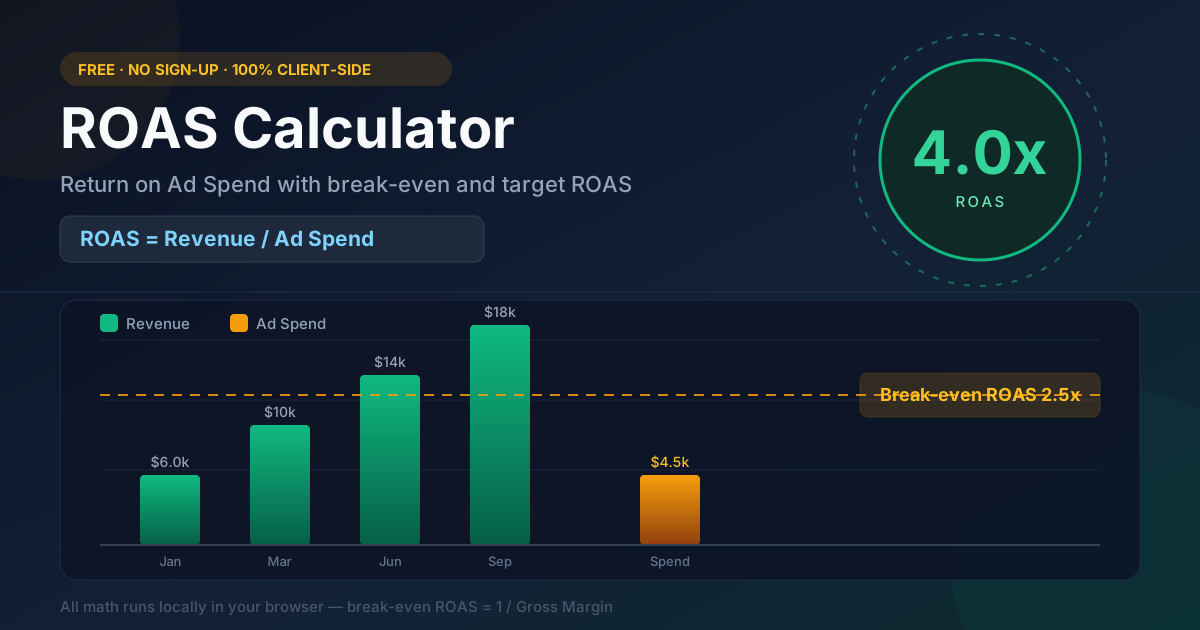
Table of Contents
ROAS Calculator: Measure Ad Profitability with Break-Even ROAS
Every advertiser eventually asks the same uncomfortable question: is this campaign actually making money, or just moving revenue around? Return on Ad Spend — ROAS — is the metric the industry leans on to answer it, yet most dashboards stop at the raw ratio. A 400% ROAS looks great on a slide, but whether it puts profit in your pocket depends entirely on your margins.
Our free ROAS Calculator closes that gap. Enter revenue and ad spend to get ROAS instantly, or flip it around and solve for the revenue or spend you need. Add your gross margin and the tool also derives your break-even ROAS — the minimum return required just to cover the ad bill — plus a target ROAS for whatever profit goal you set. It runs 100% in your browser: no sign-up, no spreadsheet, nothing leaves your device.
In this guide: what ROAS really measures, why the ratio alone misleads, and how break-even and target ROAS turn reports into decisions.
Why Use the ROAS Calculator?
Compared against your margin floor, ROAS stops being a vanity metric and becomes a decision engine:
- It separates winners from losers with one number. Revenue per dollar of ad spend is comparable across Google Ads, Meta, and marketplaces.
- It exposes the break-even trap. The tool computes the minimum ROAS your gross margin can sustain, so "looks good" and "actually profitable" stop being two different things.
- It works in every direction. Know your target ROAS? Solve for the revenue a campaign must produce, or the maximum spend you can commit.
- It makes scaling defensible. With break-even and target ROAS in hand, budget conversations become arithmetic rather than opinion.
- It is fast and private. Results update as you type, and all math happens client-side — nothing is uploaded, stored, or sent anywhere.
Key Features
| Feature | What It Does |
|---|---|
| Three solve-for modes | Enter any two of ROAS, revenue, and ad spend; the third is solved |
| Break-even ROAS | Derives the minimum ROAS your gross margin needs to cover ad costs |
| Target ROAS | Computes the return needed to hit a chosen profit goal |
| Sensible defaults | Prefilled with 10,000 revenue and 2,500 spend so the math is visible |
| Instant results | Values update as you type — no submit button, no reload |
| 100% client-side | Every calculation runs locally; no data ever leaves your device |
Two of these deserve emphasis:
- The solve-for modes make this a planning tool. Current ROAS describes the past; revenue needed at a given spend describes the plan you are about to sign.
How to Use
From raw numbers to a margin-aware verdict in under a minute:
- Enter your revenue. Use the total attributed to the campaign or period — for example, 28,000 for a month of sales.
- Enter your ad spend. Add the total media cost for the same period, such as 8,000.
- Read your ROAS. The tool shows the ratio — here 3.5, or 350% — meaning 3.50 of revenue per dollar spent.
- Enter your gross margin. Input the share of revenue left after cost of goods sold, say 30%, to get your break-even ROAS of about 3.33 and a target ROAS for any profit goal.
- Act on the comparison. Above target means room to scale; between break-even and target means profitable but tight; below break-even means extra spend is buying losses.
ROAS vs Break-Even ROAS
The core formula is simple:
ROAS = Revenue / Ad Spend
Spend 2,500 to generate 10,000 in revenue and your ROAS is 4.0, usually reported as 400%. The problem is that ROAS is a revenue ratio, and revenue is not profit. Whether it pays for itself depends on gross margin — the share of revenue left after cost of goods sold.
Break-even ROAS = 1 / Gross Margin
A 40% margin gives a break-even ROAS of 1 / 0.40 = 2.5. Below 2.5, advertising destroys money; above it, each sale contributes profit. With a 20% margin, break-even ROAS is 5.0 — and that celebrated 400% ROAS is now losing money: each dollar spent returns four dollars of revenue but only 0.80 of gross profit.
A fully worked example: an online store spends 8,000 on ads and attributes 28,000 of revenue, so ROAS = 28,000 / 8,000 = 3.5. Its products carry a 30% gross margin, making break-even ROAS 1 / 0.30 = 3.33. Gross profit is 28,000 × 0.30 = 8,400; after the 8,000 spend, the campaign clears just 400 — profitable, but a 5% dip in ROAS would put it underwater. Doubling the budget at the same ROAS doubles profit to 800: break-even is a ratio, while profit scales linearly once you clear it.
Target ROAS is where planning enters. Decide how much profit per revenue dollar you want to keep, then set the bar above break-even: target ROAS = 1 / (gross margin − desired profit share). With a 40% margin and a goal of keeping 15% of revenue after ads, the target is 1 / (0.40 − 0.15) = 4.0. Above 4.0 you exceed plan; between 2.5 and 4.0 you merely subsidize.
Practical Use Cases
PPC Budget Pacing
Mid-month pacing is where budgets leak. Instead of spreading spend evenly and hoping, check ROAS weekly against break-even: campaigns above target can absorb more budget; those near break-even stay flat until conversion data stabilizes.
Campaign Kill-or-Scale Decisions
Every account accumulates middling campaigns that survive because nobody does the math. Set a rule: below break-even ROAS over a rolling 14–30 day window gets paused; above target gets budget. Thresholds from your own margin beat an arbitrary "3x" rule of thumb.
Agency and Client Reporting
A healthy-looking ROAS beside a client who insists they are losing money derails client calls fast. Presenting ROAS alongside break-even ROAS aligns both sides on one threshold and justifies budget shifts with arithmetic a CFO can verify.
Bid Strategy Targets
Smart bidding platforms ask for a target ROAS and optimize toward it — but a wrong target quietly poisons the account. Use your computed target, not a benchmark. Start new campaigns near break-even to let the algorithm find volume, then raise it as data accumulates.
Best Practices
- Use net revenue, not gross. Subtract discounts, refunds, and chargebacks first, or the break-even comparison is fiction.
- Attribute consistently. Compare windows and attribution models on equal terms — only one of them is the number you banked.
- Segment by campaign, not just account. Blended ROAS hides the losers subsidizing the winners; judge each campaign on its own.
- Pair ROAS with CLV for repeat purchases. If customers reorder, a campaign near break-even may still be a great acquisition channel when judged on lifetime value.
- Refresh your margin input. COGS, shipping, and payment fees drift; last year's margin makes every derived threshold stale.
Put Your Numbers to Work
Your ad platforms already know your revenue and spend; they cannot tell you whether those numbers clear your margin bar. Open the free ROAS Calculator, enter two figures plus your gross margin, and know within seconds whether to scale, hold, or cut.
Related Tools You Might Like:
- CPC Calculator — break down what each click costs and sanity-check your bids.
- CTR Calculator — measure how often impressions turn into clicks.
- CLV Calculator — value customers over their lifetime to judge acquisition ROAS fairly.
Calculate with margin, scale with confidence — the Online Tools Forge Team.
Frequently Asked Questions
Q: What is a good ROAS?
A: There is no universal answer — "good" depends entirely on your gross margin. With a 40% margin, anything above 2.5x is profitable; with a 20% margin, you need above 5.0x. Compute break-even ROAS first, then set your target above it.
Q: Can a 400% ROAS still lose money?
A: Yes. If your margin is 20%, break-even ROAS is 5.0, so a 400% return loses money on every dollar: each 1.00 of spend returns 4.00 of revenue but only 0.80 of gross profit.
Q: Does the calculator store or send my numbers anywhere?
A: No. The tool is 100% client-side — all math runs in your browser, nothing is uploaded or shared, and it even works offline once loaded.