Savings Goal Calculator: Find the Exact Monthly Amount to Reach Your Target
Work out exactly how much to save each month to hit any goal, with compound interest, a starting balance, and a yearly progress schedule.
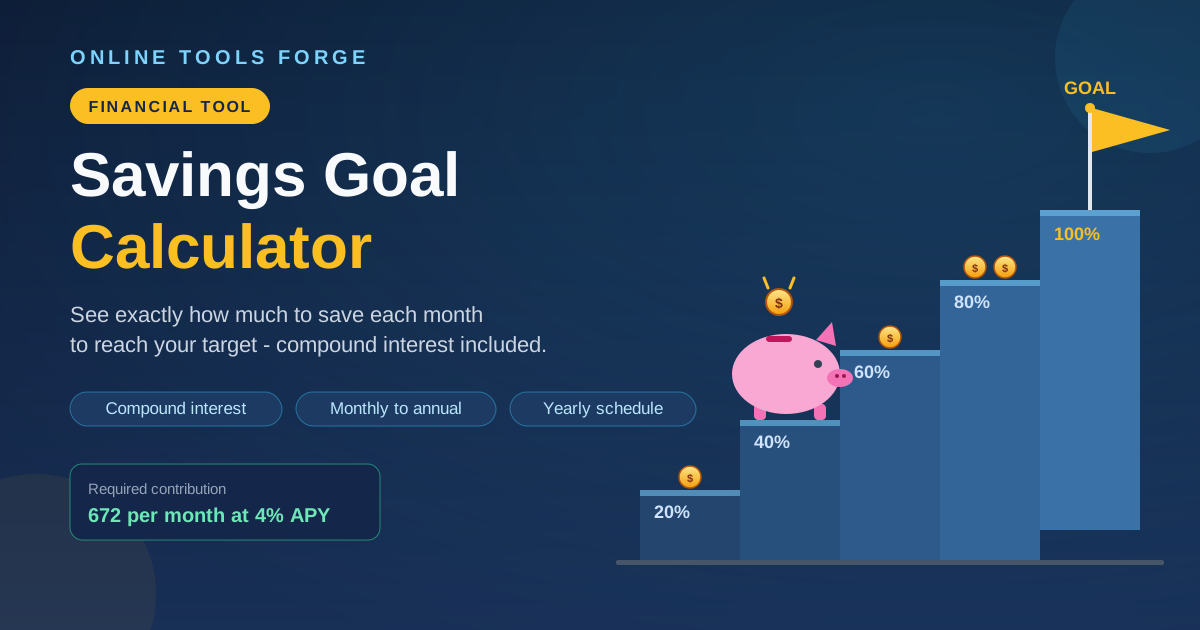
Table of Contents
Savings Goal Calculator: Find the Exact Monthly Amount to Reach Your Target
Setting a savings goal is easy; hitting it is the hard part, and the gap is usually one missing number: the exact amount to set aside each period. The savings goal calculator turns that question into a precise answer in seconds: enter what you want to save, when you need it, and what you already have, and it reports the required contribution for the frequency you choose.
What separates this from back-of-the-envelope division is compound interest. Your balance earns interest, that interest earns interest, and your starting balance quietly works the whole time. The calculator accounts for all of it, so the number you get is what you actually need to save.
Why Use the Savings Goal Calculator?
- A concrete number instead of a vague wish. "Save more" is not a plan. Knowing a goal needs 672 per month is a plan you can automate and track.
- Compound interest is built in. Simple division assumes idle money. This calculator grows both your starting balance and every contribution, so the required deposit is realistic.
- Your starting balance counts. Existing savings do part of the work, and crediting them often lowers the monthly amount more than you expect.
- It matches your pay cycle. Choose monthly, biweekly, weekly, quarterly, or annual contributions so the plan fits how income actually arrives.
- A yearly progress schedule. The result includes a year-by-year projected balance, turning a distant deadline into visible milestones.
- Private and instant. Everything runs client-side in your browser — no sign-up, no data leaving your device.
Key Features
| Feature | What It Does |
|---|---|
| Goal amount and target date | Defines the finish line and the time you have |
| Starting balance | Credits money you already have, plus its growth |
| APY input | Applies annual percentage yield so interest works for you |
| Contribution frequency | Monthly, biweekly, weekly, quarterly, or annual deposits |
| Required contribution | Solves the exact deposit per period to land on target |
| Yearly schedule | Shows projected balance and progress year by year |
- Frequency changes the total. Each deposit earns interest from the moment it lands, so 52 smaller weekly deposits can reach the same goal with slightly less outlay than 12 monthly ones.
- The schedule is a reality check. If year one looks impossible, extend the deadline or trim the goal now rather than at month ten.
How to Use the Savings Goal Calculator
- Enter your goal amount. The total you want to reach — a 20,000 emergency fund or a 5,000 trip budget.
- Set the target date. Pick the month and year you need the money; the tool converts this into the number of periods.
- Add your starting balance. Anything already saved toward this goal; leave it blank if starting from zero.
- Enter the APY. Use your account's annual percentage yield. When unsure, a conservative figure keeps the plan safe.
- Choose a frequency and read the plan. The tool shows the required deposit per period plus the yearly schedule — adjust until the plan feels achievable.
How the Math Works
The calculator solves a two-part equation.
Part one: your starting balance grows on its own. Starting with amount B at an APY of r, split into a periodic rate i (annual rate divided by periods per year), after N periods it becomes B × (1 + i)^N. A 3,000 balance at 4% APY is not 3,000 after two years — it is roughly 3,249.
Part two: contributions fill the remaining gap. Your goal minus the grown starting balance is what deposits must build. Each deposit compounds for however long it stays invested, so a fixed contribution C has a future value of C × ((1 + i)^N − 1) ÷ i. Solving for C:
C = (Goal − B × (1 + i)^N) × i ÷ ((1 + i)^N − 1)
Why frequency matters. The difference between 52 weekly deposits and 12 monthly ones is exposure time: money deposited earlier earns interest longer. Weekly amounts also feel smaller — 672 per month is about 155 per week. Biweekly (26 per year) matches half-month pay cycles, quarterly (4) suits lumpy freelance income, annual works for bonus savers.
How APY shortens the climb. Interest does real work even at modest rates. In the example below, 4% APY contributes roughly 880 of the final 20,000 — money you never deposited. Over ten or twenty years, compounding becomes the main engine, as the compound interest calculator shows.
A fully worked example. Goal: 20,000 in 2 years. Starting balance: 3,000. APY: 4%, monthly frequency. Then i = 0.04 ÷ 12 ≈ 0.00333 and N = 24 months.
- The starting balance grows to 3,000 × 1.00333^24 ≈ 3,249.
- The gap deposits must fill is 20,000 − 3,249 = 16,751.
- The annuity factor is (1.00333^24 − 1) ÷ 0.00333 ≈ 24.94.
- The required contribution is 16,751 ÷ 24.94 ≈ 671.60 — call it 672 per month.
Total deposits come to about 16,118, and interest covers the remaining 882. Rounding up to 675 buys a small margin for the months you fall slightly behind.
Practical Use Cases
Building an Emergency Fund
Target three to six months of essential expenses with a deadline. If your baseline costs are 3,000 per month and you want an 18,000 fund within 24 months, the calculator converts that into a fixed monthly deposit.
Travel, Wedding, and Down-Payment Funds
Date-driven goals are where this tool shines. A wedding in 18 months, a trip in 8, a home down payment in 4 years: each has a firm finish line, so each has one exact answer per month.
Your Kids' Education
Tuition arrives on a known schedule, so contribution math applies neatly. Set the amount and the year enrollment starts, and the tool shows what a monthly deposit builds to by then.
Gadgets and Big Purchases Without Credit
A 1,200 laptop needed in 6 months is roughly 196 per month. Saving up instead of financing means no lender interest, no credit check, and a full-price purchase the day it drops.
Best Practices for Reaching Your Goal
- Automate on payday. Schedule the transfer for the day salary lands; money that moves before you see it never gets spent.
- Keep the fund liquid. Short-term goals belong in a high-yield savings account, not locked investments. Arriving on time matters more than extra yield.
- Revisit when income changes. A raise or a lean quarter changes what you can contribute — rerun the numbers instead of quietly abandoning the plan.
- Round contributions up. If the tool says 672, transfer 675 or 700; small buffers absorb the months that go wrong.
- One goal, one account. Separating goals prevents borrowing from the travel fund for a spontaneous purchase.
- Track progress quarterly. Compare your actual balance against the yearly schedule; 5% behind is a nudge, 30% behind means recalculating now.
Set Your Target Today
A goal without a number is just an intention. Open the savings goal calculator, enter your target, and walk away with the exact monthly amount — two minutes, entirely in your browser, and "someday" becomes a schedule.
Related Tools You Might Like:
- Compound Interest Calculator — see how your balance compounds over long horizons
- APY Calculator — convert rates into the real annual yield your account pays
- FIRE Calculator — project when your savings can fund financial independence
Happy saving — may every staircase step bring you closer to your flag!
Frequently Asked Questions
Q: Does the calculator include compound interest?
A: Yes. Your starting balance and every contribution grow at the APY you enter. That is why the required contribution is usually lower than simple goal-divided-by-months math.
Q: Which contribution frequency should I choose?
A: The one matching your pay cycle. Monthly suits salaried income, biweekly and weekly invest money sooner, quarterly fits irregular freelance income, annual suits bonus savers.
Q: What if my starting balance already meets the goal?
A: The tool detects it and reports no further contribution is needed.
Q: Is the required contribution exact or an estimate?
A: A precise estimate under steady assumptions: constant APY and on-time deposits. Round up slightly and check the yearly schedule to stay realistic.