Thai Baht Text Converter: Write Any Amount in Thai Words for Invoices and Cheques
Free Number to Thai Baht Text converter. Turn any amount into formal Thai baht words with correct บาท and สตางค์ rules for invoices, cheques and receipts. 100% client-side.
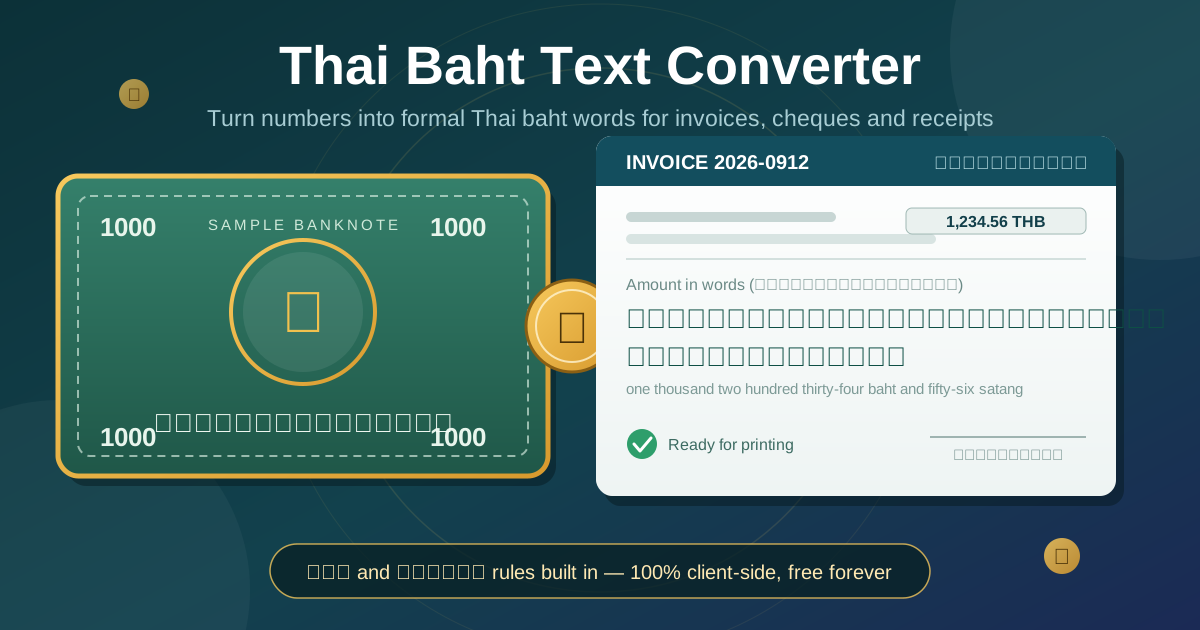
Table of Contents
Thai Baht Text Converter: Write Any Amount in Thai Words for Invoices and Cheques
Anyone who has prepared a Thai invoice, written a cheque from a Thai bank, or reviewed Thai accounting paperwork knows the numeric amount is only half the story. Thai convention — and in practice legal expectation — also requires the amount in words, in a field called จำนวนเงินตัวอักษร (the amount in letters). On a cheque the words legally control the payment, so an error can mean a rejected instrument. The Thai Baht Text Converter removes the guesswork instantly.
Getting Thai number words right is genuinely tricky. The word for one, หนึ่ง, changes to เอ็ด in certain trailing positions, so 21 reads ยี่สิบเอ็ด rather than ยี่สิบหนึ่ง, and a whole-baht amount must end with the suffix ถ้วน. Type 1,234.56 into the converter and you get หนึ่งพันสองร้อยสามสิบสี่บาทห้าสิบหกสตางค์ — one thousand two hundred thirty-four baht and fifty-six satang — formatted exactly as a Thai accountant or teller expects.
Everything runs in your browser: free, no sign-up, equally at home on a phone or desktop. This guide covers usage, the Thai reading rules involved, and where the tool saves the most time.
Why Use Thai Baht Text Converter?
- Legally safer documents — On Thai cheques the words take precedence over the digits, so accurate wording protects you from rejected payments.
- Special cases handled automatically — เอ็ด after tens, ยี่สิบ for twenty, the ถ้วน suffix, and satang endings are applied for you; nothing to memorise.
- Instant live conversion — The wording updates as you type; paste an amount from a spreadsheet and copy the result in seconds.
- Awkward amounts welcome — Zero baht (ศูนย์บาท), satang-only values, and large million-baht figures all convert correctly.
- Private by design — Every conversion is computed client-side; amounts you type are never uploaded or stored.
- Free and accessible — No account, no paywall, and a responsive layout on any screen.
Key Features
| Feature | What It Does |
|---|---|
| Live numeric input | Converts amounts to formal Thai words as you type. |
| Baht and satang split | Reads the integer part with บาท and the decimal part with สตางค์. |
| Whole-baht ถ้วน rule | Appends ถ้วน automatically when there is no satang portion. |
| Zero handling | Shows ศูนย์บาท for zero and reads satang-only values without a baht part. |
| Large-value support | Handles figures into the millions with correct Thai place words. |
| One-click copy | Copies the wording to your clipboard for pasting anywhere. |
| 100% client-side | All conversion happens in your browser; nothing reaches a server. |
- Official conventions — Output matches accountant practice on ใบกำกับภาษี (tax invoices) and cheque stubs, ready to paste into official forms.
- Works offline — As a static client-side tool it keeps converting on slow or unreliable connections.
- Zero delay — No server round-trip, so results appear the instant you type.
How to Use
- Open the tool — Go to the Thai Baht Text Converter page in any browser.
- Enter the amount — Type or paste the figure in two-decimal form, such as 1234.56 or 1000.00.
- Read the Thai wording — The formal baht text appears immediately, with บาท and สตางค์ parts and the ถ้วน suffix where required.
- Copy the result — Use the copy button to place the wording on your clipboard.
- Paste and cross-check — Insert it into your document, then verify digits and words match before printing or signing.
Thai Number-to-Text Rules Worth Knowing
Thai builds large numbers from place words rather than grouping words: หน่วย (unit), สิบ (ten), ร้อย (hundred), พัน (thousand), หมื่น (ten thousand), แสน (hundred thousand), and ล้าน (million). Each digit is read with its place, so 1,234 becomes หนึ่งพันสองร้อยสามสิบสี่ — one-thousand, two-hundred, three-tens, four.
Several special cases famously trip people up:
- หนึ่ง becomes เอ็ด in trailing positions. When one ends a multi-digit group it reads เอ็ด: 21 is ยี่สิบเอ็ด and 101 is หนึ่งร้อยเอ็ด. A leading one keeps หนึ่ง, as in หนึ่งร้อย for 100.
- Two softens to ยี่ in the tens place. Twenty is ยี่สิบ, not สองสิบ, while two elsewhere stays สอง, as in สองร้อย for 200.
- Whole baht amounts end in ถ้วน. With no satang portion the wording closes with บาทถ้วน, so 1,000 reads หนึ่งพันบาทถ้วน — ถ้วน signals the amount is exact and complete.
- Satang follows the baht part. The decimal portion is read as an ordinary number and closed with สตางค์, with no ถ้วน: 0.25 reads ยี่สิบห้าสตางค์.
- Zero baht is written out. A zero amount reads ศูนย์บาท, and a value under one baht like 0.75 reads เจ็ดสิบห้าสตางค์ with no baht part.
A fully worked example for 1,234.56:
- Baht part 1,234 reads หนึ่งพันสองร้อยสามสิบสี่, then takes บาท.
- Satang part 56 reads ห้าสิบหก, then takes สตางค์.
- Result: หนึ่งพันสองร้อยสามสิบสี่บาทห้าสิบหกสตางค์.
Contrast that with 1,234.00, which reads หนึ่งพันสองร้อยสามสิบสี่บาทถ้วน — one suffix changes the whole line, which is why machines beat tired humans on billing day.
Practical Use Cases
Invoice and Receipt Footers
Thai tax invoices (ใบกำกับภาษี) and receipts (ใบเสร็จรับเงิน) print the amount in words beneath the numeric total, labelled จำนวนเงินตัวอักษร. Converting each total with the tool keeps every document consistent, even when bills come from bulk templates.
Cheque Writing
On a Thai cheque the written amount is the legally controlling figure; if it disagrees with the digits, the words win. Enter the digits, then let the converter produce the official wording for the amount line — a step that prevents costly reissues.
Accounting Documents
Payment vouchers (ใบสำคัญจ่าย), petty cash summaries, and journal entries often require both figure and words for audit trails. Pasting the converter output keeps records uniform across the finance team, including staff who do not read Thai.
Purchase Orders and Contracts
Purchase orders, quotations, and agreements often restate the total in words to remove ambiguity. The converter lets procurement staff fill in that clause without waiting on a bilingual colleague.
Best Practices
- Always cross-check that the numeric amount and the Thai wording match before printing or signing.
- Keep the two-decimal format (1234.56, 1000.00) so the converter knows exactly where the satang begins.
- Use the official wording verbatim on legal forms — copy the output exactly rather than paraphrasing.
- Decide rounding before converting — round 1234.567 to 1234.57 first; the words must describe the final figure.
- Convert the number actually on the document, not one retyped from memory.
- Recheck after any edit — if the total changes, regenerate the wording rather than editing the Thai by hand.
Try It Now
The next time a form demands the amount in Thai words, open the free Thai Baht Text Converter, paste the figure, and copy bank-ready wording in seconds — private, accurate, always available.
Related Tools You Might Like:
- Number to Words Converter — spell numbers in words for international documents.
- Roman Numeral Converter — switch between Roman numerals and decimal numbers.
- Currency Converter — check exchange rates before invoicing foreign clients.
We hope this guide helps you write Thai baht amounts with confidence. The Online Tools Forge Team publishes free, privacy-first tools and bilingual guides every week.
Frequently Asked Questions
Q: Is the Thai Baht Text Converter free to use?
A: Yes — completely free with no sign-up, limits, or watermark. It runs in your browser, so convert as many amounts as you need.
Q: Why does 21 read ยี่สิบเอ็ด instead of ยี่สิบหนึ่ง?
A: In formal Thai, หนึ่ง (one) changes to เอ็ด when it ends a number after other digits, so 21 becomes ยี่สิบเอ็ด. The converter applies this automatically, including in satang.
Q: What does the ถ้วน suffix mean and when is it added?
A: ถ้วน signals that the amount is exact. It follows บาท only when there is no satang portion, so 1,000 reads หนึ่งพันบาทถ้วน, while 1,000.50 reads หนึ่งพันบาทห้าสิบสตางค์ without ถ้วน.
Q: Does the tool store or send the amounts I enter?
A: No. Conversion happens client-side in your browser; nothing is transmitted, logged, or shared. You can even use it offline once the page has loaded.
Q: Can I use the output on official legal documents?
A: The output follows standard conventions used on Thai invoices, cheques, and receipts. Always cross-check the final document against the numeric amount before signing, since the completed form remains your responsibility.