treadmill-pace-converter: Complete Online Guide, Features & Practical Examples
Learn how to use the free treadmill-pace-converter in your browser with step-by-step instructions, practical use cases, and expert tips.
Free Interactive Tool
Treadmill Pace Converter
Convert treadmill belt speed to running pace and back in km or miles, with an incline-adjusted flat-ground equivalent via the ACSM equation and calorie estimates, fully client-side.
Table of Contents
The Treadmill Pace Converter translates belt speed into the running pace you would log outdoors and back again, in kilometres or miles. Because a belt at incline costs more effort than flat road, it also computes a flat-ground equivalent using the ACSM running equation, plus an energy estimate per hour for your body weight. Everything is computed locally in your browser — no accounts, no data collection.
Whether you are double-checking numbers on a deadline, validating edge cases, or standardizing a repeatable workflow, the treadmill-pace-converter gives you an interactive, zero-install workspace directly in your browser. Every calculation and transformation runs locally on your device — no account registration, no paywalls, and no sensitive inputs uploaded to external servers.
In this guide, we walk through why dedicated tooling beats manual back-of-the-envelope work, explore every feature inside the interface, and cover step-by-step instructions alongside real-world scenarios.
Why Use treadmill-pace-converter?
- Immediate Clarity: Log treadmill sessions with the pace your outdoor app expects.
- Focused Workflow: See how much harder 2% incline really is at the same belt speed.
- Transparent Logic: Match indoor workouts to road-training pace targets.
- Practical Accuracy: Estimate energy use per hour from speed, grade and weight.
- Time-Saving Defaults: Compare km and mile paces without mental arithmetic.
- 100% Client-Side Privacy: Every operation executes inside your browser session, keeping your data private and responsive even on slow connections.
Key Features
| Feature Area | What It Delivers | Execution Mode |
|---|---|---|
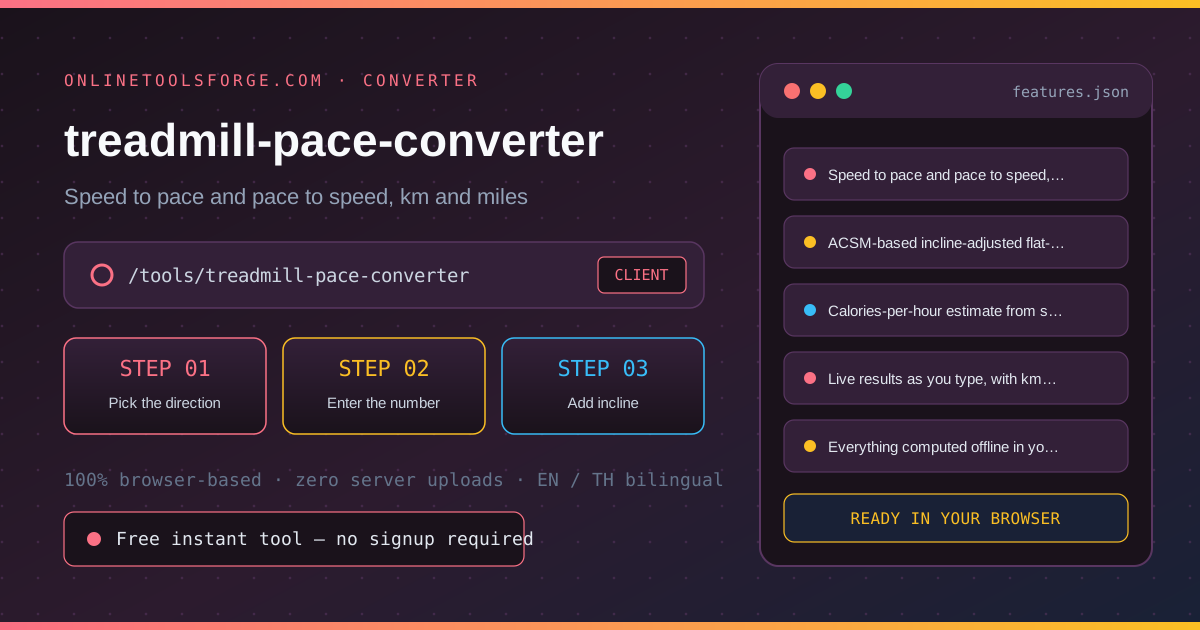
| Capability 1 | Speed to pace and pace to speed, km and miles | Instant browser execution |
| Capability 2 | ACSM-based incline-adjusted flat-road equivalent | Instant browser execution |
| Capability 3 | Calories-per-hour estimate from speed, grade and weight | Instant browser execution |
| Capability 4 | Live results as you type, with km and mile paces shown together | Instant browser execution |
| Capability 5 | Everything computed offline in your browser | Instant browser execution |
- Interactive Feedback: Results recalculate on the fly as you adjust inputs, letting you compare multiple scenarios in seconds.
- Bilingual Interface: Switch seamlessly between English and Thai labels whenever you collaborate across multilingual teams.
- Copy & Export Ready: Grab formatted outputs or summaries with one click so you can paste them straight into docs, tickets, or spreadsheets.
How to Use treadmill-pace-converter
From belt speed to outdoor-ready pace numbers in four steps.
- Open the Tool: Head to the treadmill-pace-converter in any modern desktop or mobile browser.
- Pick the direction: Choose speed-to-pace when the treadmill shows km/h or mph, or pace-to-speed when your training plan says something like 5:30 per kilometre.
- Enter the number: Type the belt speed, or the pace in minutes and seconds per unit. Pick the distance unit you train in.
- Add incline: Add the belt incline to see the flat-road pace that costs the same effort — a 2% grade is the classic treadmill-to-road correction.
- Read the equivalent: The converter shows pace per km and per mile side by side, the flat-road equivalent speed and the hourly energy cost for your weight.
Core Concepts & How It Works
Understanding the underlying mechanics helps you interpret the output with confidence. The Treadmill Pace Converter translates belt speed into the running pace you would log outdoors and back again, in kilometres or miles. Because a belt at incline costs more effort than flat road, it also computes a flat-ground equivalent using the ACSM running equation, plus an energy estimate per hour for your body weight. Everything is computed locally in your browser — no accounts, no data collection.
Instead of hiding assumptions behind a single opaque result, the treadmill-pace-converter surfaces intermediate values and clear labels so you can audit how the final answer is assembled:
- Explicit Input Validation: Boundaries and unit expectations are checked immediately, preventing silent NaN or unit-mismatch bugs.
- Deterministic Output: Given the same inputs, the tool produces identical, reproducible results every time — ideal for team reviews and documentation.
- Edge-Case Visibility: Built-in warnings highlight when inputs approach practical limits or require special interpretation.
Practical Use Cases
1. Logging indoor sessions in your outdoor running app
When tackling logging indoor sessions in your outdoor running app, manual spreadsheets and ad-hoc scripts often introduce rounding errors or inconsistent assumptions. With the treadmill-pace-converter, you can load your exact parameters, inspect the breakdown immediately, and verify how each variable affects the outcome before committing to a decision.
2. Preparing for a road race while training on a gym treadmill
When tackling preparing for a road race while training on a gym treadmill, manual spreadsheets and ad-hoc scripts often introduce rounding errors or inconsistent assumptions. With the treadmill-pace-converter, you can load your exact parameters, inspect the breakdown immediately, and verify how each variable affects the outcome before committing to a decision.
3. Dialling in the belt speed that matches a target race pace
When tackling dialling in the belt speed that matches a target race pace, manual spreadsheets and ad-hoc scripts often introduce rounding errors or inconsistent assumptions. With the treadmill-pace-converter, you can load your exact parameters, inspect the breakdown immediately, and verify how each variable affects the outcome before committing to a decision.
4. Comparing effort across different incline settings
When tackling comparing effort across different incline settings, manual spreadsheets and ad-hoc scripts often introduce rounding errors or inconsistent assumptions. With the treadmill-pace-converter, you can load your exact parameters, inspect the breakdown immediately, and verify how each variable affects the outcome before committing to a decision.
5. Estimating energy use for weight-management goals
When tackling estimating energy use for weight-management goals, manual spreadsheets and ad-hoc scripts often introduce rounding errors or inconsistent assumptions. With the treadmill-pace-converter, you can load your exact parameters, inspect the breakdown immediately, and verify how each variable affects the outcome before committing to a decision.
Best Practices
- Start with realistic baseline values before testing extreme edge cases so you have a clear reference point to compare against.
- Verify units and formatting on every input field — many discrepancies come from mixing percentages, decimals, or measurement units.
- Test sensitivity by changing one variable at a time in the treadmill-pace-converter to see which input has the largest impact on your result.
- Document your assumptions alongside the exported output so teammates can reproduce the exact state later.
- Pair with companion utilities in the same category when your workflow spans multiple conversion or validation steps.
Frequently Asked Questions
Q: How does the treadmill pace conversion work? A: Belt speed in km/h or mph converts directly to minutes per kilometre or mile — 10 km/h is a 6:00 min/km pace. With an incline set, the converter also reports the flat-road speed that costs the same effort using the ACSM running equation.
Q: Why does 2% incline matter so much? A: A 2% grade is the standard correction between treadmill and road: it compensates for the missing wind resistance and the belt helping your back leg. At the same belt speed, 2% incline effort roughly matches flat outdoor running.
Q: Does the converter handle both km and miles? A: Yes. Pick your unit once and the results show pace per km and per mile together, so you can log a gym session in the same units your outdoor app and race results use.
Q: How accurate is the calorie estimate? A: It applies the ACSM running equation to your speed, grade and body weight — a solid population average for steady running. Individual metabolism varies by a few percent, so treat the number as a solid estimate rather than a lab measurement.
Try treadmill-pace-converter Today
Ready to streamline your workflow? Open the treadmill-pace-converter now to run instant, accurate calculations right in your browser — completely free and with zero setup required.
Related Tools You Might Like
Happy building and calculating!