XIRR Calculator: Measure True Annualized Returns on Irregular Cash Flows
The XIRR Calculator solves annualized returns for irregular cash flows, SIP plans and private deals using Newton and bisection solving with a classic IRR cross-check, all client-side.
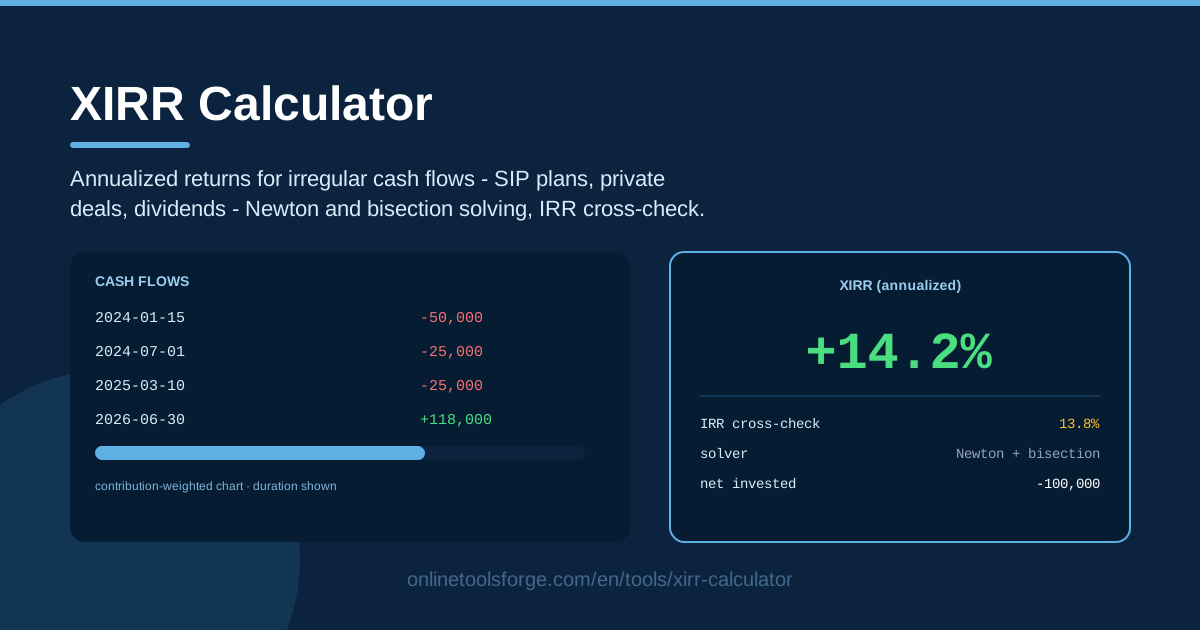
Table of Contents
Every investor eventually asks the same question: what is my real, annualized return? The honest answer is harder to produce than it sounds, because real portfolios never move on a tidy schedule. You deposit in January, top up in June, reinvest dividends in October, and partially exit the following spring. The XIRR Calculator is built for exactly this messiness: enter each dated cash flow and it solves the annualized rate that ties your entire investment history together.
XIRR — the Extended Internal Rate of Return — is the standard professionals use when money moves on irregular dates. Unlike a simple profit percentage, it respects time: a dollar invested for five years must work far harder than one invested for five months to earn the same annualized return.
The calculator runs entirely in your browser. No accounts, no uploads — just instant solving, a totals panel, a duration readout, and a contribution-weighted chart showing which deposits actually drove your performance.
Why Use XIRR Calculator?
- Real investments are never monthly-neat. Textbook formulas assume equal, evenly spaced payments. Real life delivers a bonus deposit in March, a car-repair withdrawal in August, and an opportunistic buy during a dip. XIRR weights every flow by the time it actually worked.
- Simple percentages lie when you add funds. Invest $10,000, add another $10,000, and a $23,000 portfolio is not "up 15%". The timing of each deposit changes the true annualized figure dramatically, and XIRR strips out the illusion.
- Annualization makes investments comparable. A 30% gain over four years and an 18% gain over eight months are nothing alike. XIRR expresses both as a per-year rate you can line up side by side.
- SIP and DCA investors need it most. Systematic plans create dozens of dated contributions, and no fund-reporting number reflects your actual entry dates. XIRR computes the return of your specific purchase history.
- Private deals come with no official return figure. Angel rounds, peer loans and property flips produce payouts on unpredictable dates. XIRR converts that stream into a clean annualized rate.
- Your financial data stays yours. All math runs client-side in JavaScript, so sensitive portfolio details never touch a server.
Key Features
| Feature | What it does |
|---|---|
| Dated cash flow entry | Add unlimited flows on any dates — investments negative, returns positive. |
| Newton and bisection XIRR solver | Solves the annualized rate fast via Newton, falling back to robust bisection when needed. |
| Classic IRR cross-check | Computes period-based IRR alongside XIRR to validate the result. |
| Totals and duration | Shows total invested, total returned, net profit and elapsed duration. |
| Contribution-weighted chart | Visualizes each deposit weighted by size and time in the market. |
| Pure client-side math | Everything runs in your browser with no network calls. |
Two details are worth calling out:
- Dual-solver reliability. Newton converges in a handful of iterations for well-behaved flows, while the bisection fallback guarantees an answer even when derivatives misbehave.
- A genuine sanity check. When XIRR and the IRR cross-check agree, you know the solution is stable rather than a numerical artifact.
How to Use XIRR Calculator
- Enter your dated cash flows. List every money event with its actual date: the initial deposit, every top-up, every dividend, every withdrawal, and the final value you hold or received.
- Mark investments negative, returns positive. Money out of your pocket is -1,000; money back to you is +1,200. This sign convention is what lets the solver find a meaningful rate.
- Solve for XIRR. The Newton and bisection solving runs instantly and displays the annualized return; edit any flow and it recomputes.
- Cross-check with classic IRR. Agreement confirms the result. A large gap usually means a mistyped date or a flipped sign somewhere in the list.
- Read duration and totals. Review the elapsed duration, total invested and total returned, then scan the contribution-weighted chart to see which deposits carried the return.
XIRR vs IRR vs Simple Returns
Start with the simplest metric and watch it fail. Suppose you invest $10,000 and two years later it is worth $11,000 — a 10% gain. Now suppose instead you invested $5,000 in year one, added $5,000 in year two, and ended at $11,000. Identical simple figure, completely different performance: half your money only worked for one year. A simple percentage has no concept of when money arrived, so it treats a late deposit as if it had been invested the whole time. That is why simple percentages lie with multiple deposits.
Annualization fixes the time blindness by expressing the result as one constant per-year rate. XIRR finds the single rate at which every flow, discounted by the exact number of days it was invested, sums to zero — effectively asking what fixed bank-account rate would have reproduced your outcome.
Mechanically the rate is found iteratively. Newton's method starts from a guess, measures the slope of the net-present-value curve, and jumps toward the zero crossing, usually converging within a few steps. When the curve is too steep or flat for Newton to behave, bisection brackets the answer between a too-low rate and a too-high rate, then halves the gap until the answer is pinned down — speed plus a guaranteed convergence.
XIRR also fails for a knowable reason: no sign change. If every flow is positive or every flow is negative, there is no meaningful internal rate of return, because the solver needs at least one investment and one return to balance. A missing minus sign on a deposit therefore produces an error rather than a number — the tool telling you the history is incomplete. Open positions need today's value entered as a positive flow before an XIRR can exist at all.
The IRR cross-check earns its place because classic IRR assumes evenly spaced periods. For a monthly SIP, IRR and XIRR should nearly coincide, so a match validates your inputs; for genuinely irregular flows, the gap between them quantifies how much the calendar irregularity matters — and XIRR is the figure to trust.
Finally, XIRR is the fairest lens for SIP versus lump-sum debates. A lump-sum return rides on a single entry date, while a SIP return blends many entry dates into one rate. Run both histories through the calculator and you can settle the argument with your own numbers instead of fund-marketing figures.
Practical Use Cases
SIP Mutual Fund Returns
A monthly SIP of $500 for three years produces 36 dated contributions plus a current value. Enter each debit as a negative flow on its date and the redemption value as a positive flow today. The resulting XIRR is your true personal annualized return — often meaningfully different from the fund's published CAGR, because your money entered on different dates than the fund's launch.
Private Deal Performance
You put $25,000 into a friend's business, receive $4,000 in year one, nothing in year two, and $30,000 when the deal exits in year three. No statement will ever print your return for you. Feed the four flows in and XIRR hands you an annualized figure you can compare against public-market alternatives.
Dividend Reinvestment Streams
A dividend portfolio throws off irregular cash: quarterly payouts of varying sizes, occasionally reinvested at odd dates. Record payouts as positives and reinvestments as negatives, and XIRR reveals the blended yield-plus-growth your strategy actually produced — invaluable when deciding whether to keep reinvesting or take the income.
Comparing Two Investment Histories
You hold a broker portfolio and a robo-advisor account, both fed irregularly over the same period. Compute XIRR for each history, and the contribution-weighted chart shows which account's deposits generated the better rate — turning a vague gut feeling into a defensible allocation decision.
Best Practices
- Date every cash flow precisely. A deposit recorded a month late skews the annualization; pull exact dates from bank or broker statements, not memory.
- Include fees as flows. Account fees, advisory charges and trading costs are money out — enter them as negative flows so XIRR reflects net reality.
- Sanity-check against CAGR for single deposits. With one negative and one positive flow, XIRR should equal the position's CAGR; if it does not, a date or amount is wrong.
- Keep the sign convention strict. Out of your pocket is negative, into your pocket is positive. Swapped signs are the top cause of solver errors.
- Remember taxes. XIRR is pre-tax unless you make it otherwise: enter after-tax amounts, or model the tax bill as a separate negative flow.
- Mark open positions to today. Add the current value as a positive flow dated now, and rerun XIRR periodically to track performance over time.
Ready to see your real annualized return? Open the XIRR Calculator, enter your cash flow history, and get a defensible number in seconds — no signup, and your data never leaves your browser.
Related Tools You Might Like:
- Compound Interest Calculator — project how lump sums and regular contributions grow with compounding.
- Annuity Calculator — plan level income streams and payouts over fixed periods.
- Loan Calculator — break down loan payments, interest and amortization schedules.
Happy investing!
Frequently Asked Questions
Q: What is the difference between XIRR and IRR? A: IRR assumes cash flows occur at evenly spaced periods, while XIRR uses the actual dates of each flow and annualizes accordingly. For regular monthly contributions the two agree closely; for irregular real-world flows, XIRR is the accurate measure.
Q: Why does the calculator show an error for my cash flows? A: XIRR needs at least one negative flow (money invested) and one positive flow (money returned) to balance. Check that every deposit carries a minus sign and that you have recorded your current or final value as a positive flow.
Q: Is XIRR the same as CAGR? A: Only for a single deposit and a single withdrawal. CAGR measures growth between two points in time, while XIRR generalizes the idea to any number of dated flows, which is why it suits SIP plans and multi-deposit portfolios.
Q: Is my financial data safe? A: Yes. All Newton and bisection solving runs client-side in your browser. Nothing is uploaded, stored or transmitted, so you can safely analyze private deals and personal portfolios.