Clothing Size Converter: Decode US, UK, EU and JP Sizes Before You Order
Convert clothing sizes between US, UK, EU, IT, JP, and AU systems for tops, dresses, and pants, with nearest-row matching against commonly published charts. Free, instant, and 100% client-side.
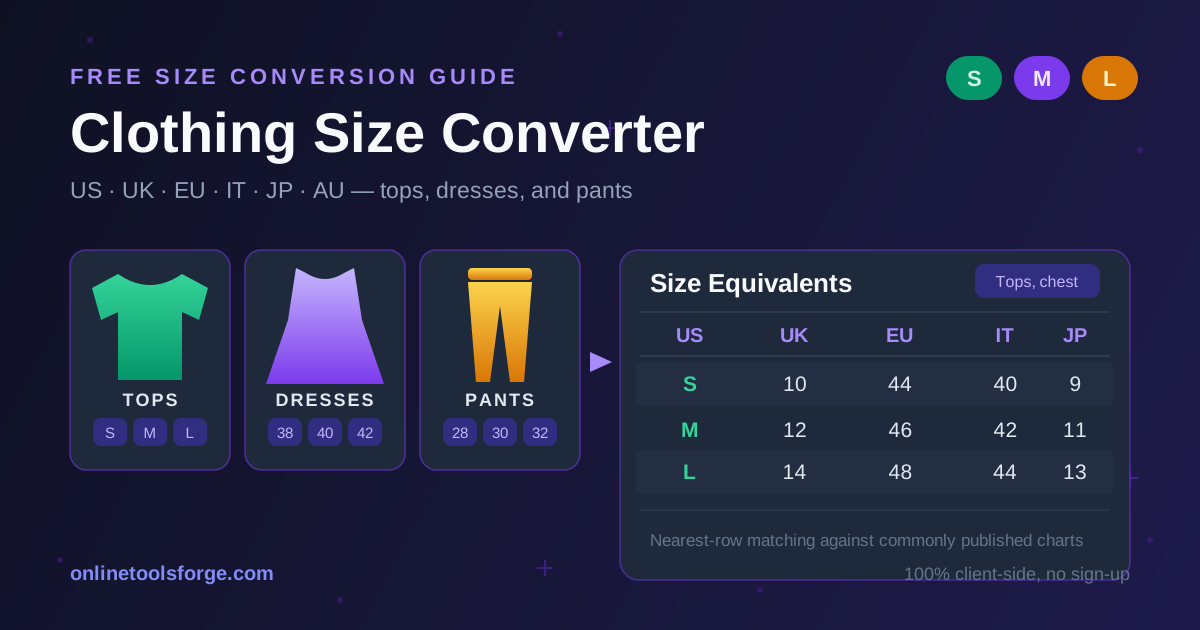
Table of Contents
Clothing Size Converter: Decode US, UK, EU and JP Sizes Before You Order
Ordering clothes from abroad is a size-lottery. The t-shirt that fits as a Medium at home becomes a UK 12, an EU 46, an IT 42, or a Japanese 11 depending on where the parcel ships from. The labels look familiar, but the numbers belong to entirely different grading systems — and guessing wrong means returns, fees, and weeks of waiting for a refund.
The free Clothing Size Converter turns that lottery into a lookup. Pick a garment type — tops, dresses, or pants — enter the size you know, and the tool returns the equivalent row across US, UK, EU, IT, JP, and AU, plus a universal INT letter baseline. Matching runs against commonly published charts, and everything happens 100% client-side in your browser.
This guide covers how to use the tool, why no exact formula exists, and how to convert with judgment so what you order is what fits.
Why Use the Clothing Size Converter?
- Every major system in one result. One input returns UK, EU, IT, JP, and AU equivalents plus an INT letter size — no cross-referencing six charts in six tabs.
- Garment-aware conversion. Tops are graded on chest, dresses follow their own numeric ladder, and pants sell by waist; the tool switches tables so "Medium" fits what you are buying.
- Nearest-row matching, honestly labeled. Results come from a lookup of commonly published equivalents, not an invented formula — like professional size charts.
- Private by design. Everything runs 100% client-side — lookups never leave your device, with no account required.
- Fast, free, no install. Three taps from question to confident pick on phone or desktop — no app, sign-up, or paywall.
Key Features
| Feature | What it does |
|---|---|
| Size systems | US, UK, EU, IT, JP, and AU, plus a universal INT letter baseline |
| Tops | Chest-based letters (XS through 3XL) mapped across all systems |
| Dresses | US numerics (2 to 14) mapped to every regional row |
| Pants | US inch waists (24 to 36) mapped to each system |
| Matching method | Nearest-row lookup against commonly published equivalence charts |
| Privacy | 100% client-side — your sizes are never transmitted anywhere |
Two details stand out:
- The INT column is your anchor. When national labels disagree, it shows which row you actually landed on.
- Letters and numbers coexist on purpose. US tops run in letters, US dresses in numbers — enter whatever the page shows.
How to Use
- Pick the garment type. Choose tops, dresses, or pants so the correct grading table loads.
- Select the system you know. US, UK, EU, IT, JP, or AU — whichever the product page uses.
- Enter your size. A letter like M for tops, a number like 8 for dresses, or a waist like 30 for pants.
- Read the converted row. The tool fills in every other system at once, matched to the nearest published equivalent.
- Order with a margin. Between rows or a slim-cut brand? Take the larger size — and check the brand's chart when one exists.
Why There Is No Universal Size
US sizes grew out of chest measurements in inches. Menswear was graded by chest circumference — 38, 40, 42 — and the letters were layered on top as shorthand; womenswear grew its own numeric ladder.
EU and IT sizes follow the continental tradition. European women's sizes roughly approximate half the bust circumference in centimeters (an EU 38 suits a bust near 92 to 96 cm). Italy shifts the scale a few points (an EU 38 reads as IT 42), and the UK adds its own offset. The scales look related but were standardized separately.
JP sizing cuts trimmer. Japanese charts are drafted on a smaller base block and lean on their own numeric ladder (5, 7, 9, 11). A JP 11 often corresponds to what US brands call a Medium.
Each garment type sizes differently. Tops key on chest, dresses compress bust, waist, and hips into one number, and pants sell by inch waist in the US but by a different number elsewhere. The tool makes the consequence visible: the same INT M lands on EU 46 for a tops row but EU 38 for a dress row — different traditions, not an inconsistency.
Vanity sizing quietly moved the labels. Over decades, brands re-graded charts so shoppers could buy smaller numbers for the same body — and national systems drifted at different speeds.
That is why conversions are nearest-row approximations, not exact math. No formula turns a US M into an EU 46 — only equivalence tables that reputable charts roughly agree on. The tool matches your input to the closest row and shows it whole, so you can judge the mapping yourself.
A worked example. Suppose your t-shirts fit as a US Medium. Choose tops, US, and M. The converter returns the nearest row: UK 12, EU 46, IT 42, JP 11, AU 12, INT M. Order a UK 12 blouse or an IT 42 knit with confidence; if the brand cuts slim, step up to the neighboring JP 13 row.
Practical Use Cases
Cross-Border Online Shopping
Marketplace listings mix systems freely: a US 8 dress, an EU 40 coat, and a JP L shirt in one cart. Convert each to your home system before checkout and everything sits on one scale you know.
Gift Buying Without Awkward Questions
Asking for measurements spoils the surprise — but you know they wear a US M top. Convert it to the UK 12 the store sells to keep both the secret and the fit.
Marketplace and Reseller Listings
Reselling across borders? List the original size plus its converted equivalents, and buyers in each region find their own number — fewer size-related returns.
Travel Packing and On-the-Road Buys
Rack labels in Tokyo or Milan follow a system you may not think in. A quick conversion points you to the right hanger when you need a replacement.
Best Practices
- Check the brand's own size chart when one exists. Brand-specific fit beats any universal table; use the converter to decode the chart, not replace it.
- Measure a garment that already fits. Measurements from your best-fitting clothes beat any label for sanity-checking a converted row.
- Size up between rows. A tailor can take in a large garment cheaply; a small one usually cannot be rescued.
- Convert per garment type. Your tops size does not transfer to pants or dresses — convert what you are buying.
- Treat JP sizing as a half-step smaller. When ordering from Japanese stores, lean toward the larger adjacent row unless the chart says otherwise.
- Keep a personal size note. Save your converted row — letter, dress number, waist — so the next purchase takes seconds.
Convert Before You Checkout, Not After
A two-minute conversion beats a two-week return. The Clothing Size Converter is free, instant, and completely private — pick the garment type, enter the size you know, and order the size that fits.
Related Tools You Might Like:
- Unit Converter — convert length, mass, volume, and more when a chart quotes centimeters.
- Height Converter — switch between cm and feet/inches for your own measurements.
- Ideal Weight Calculator — estimate a healthy weight range to frame your fitness goals.
Happy converting, and may every parcel fit the first time.
Frequently Asked Questions
Q: Why do my tops and dress sizes convert to different EU numbers?
A: Tops letters trace back to chest inches; dress sizes approximate half the bust in centimeters. So the same INT M maps to EU 46 for tops but EU 38 for dresses — both correct.
Q: Are the conversions exact?
A: No. Size systems are label conventions, not measurements, so the tool matches your input to the nearest row in commonly published charts. Treat it as a starting point and defer to the brand's own chart.
Q: Is my size data uploaded anywhere when I use the tool?
A: No. The converter runs 100% client-side — every lookup happens on your device, and nothing is transmitted or stored.