How to Dial In Any Cup With a Coffee Brew Ratio Calculator
Learn how a coffee brew ratio calculator turns dose, water, and ratio into perfect pour-over, espresso, French press, and cold brew recipes — plus what each ratio actually tastes like.
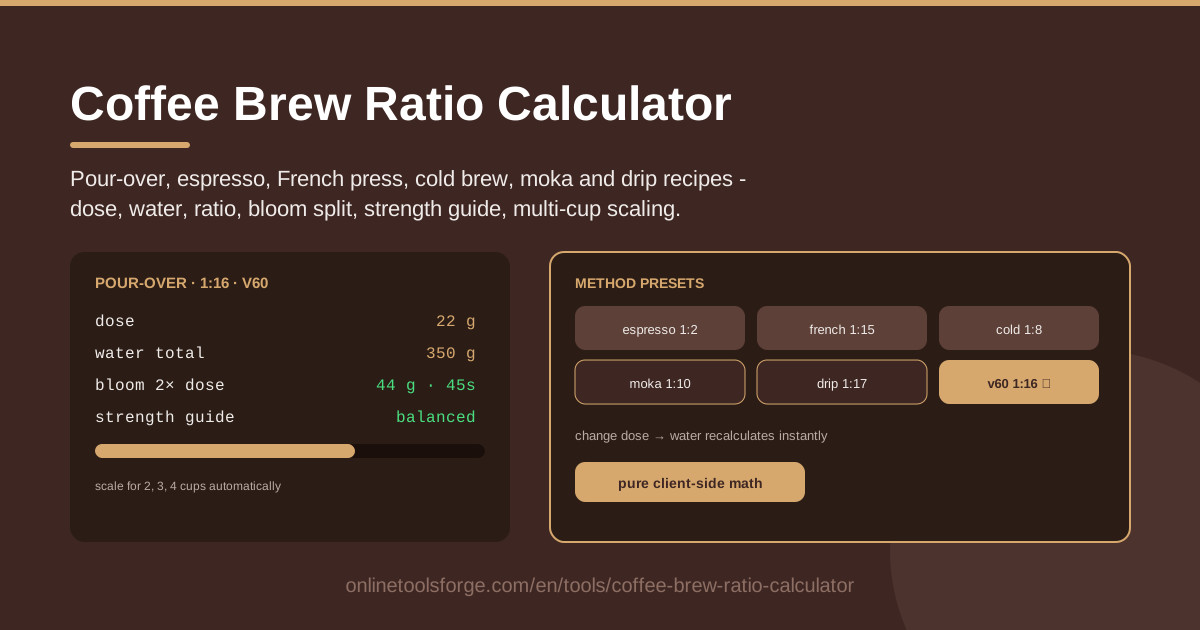
Table of Contents
Great coffee is mostly math before it is magic. Three numbers — the dose of ground coffee, the amount of water, and the ratio between them — decide whether your morning cup lands balanced and sweet or thin and bitter. The free Coffee Brew Ratio Calculator turns those three numbers into a complete recipe in seconds, with method presets for pour-over, espresso, French press, cold brew, moka pot, and drip coffee.
Most home brewers eyeball it: scoops of coffee, splashes of water, and hope. That works until you open a new bag of beans, borrow a friend's recipe, or brew for four people instead of one — and suddenly the same "scoop" produces a completely different cup. A ratio-based workflow fixes this, because a ratio like 1:16 travels anywhere: it works for a 15 g pour-over, a one-litre French press, and everything in between.
In this guide you will learn what the tool does, how to use it step by step, and — most importantly — how different ratios actually taste across brewing methods, so you can move from "I hope this works" to "I know exactly what I'm brewing."
Why Use Coffee Brew Ratio Calculator?
- Stop guessing and start repeating. When you know the cup you loved was 20 g of coffee at a 1:16 ratio, you can brew the identical cup tomorrow. Numbers turn luck into a process.
- Work in whichever direction you think. Enter dose and water to see the ratio, or enter a ratio and one value to solve for the rest — the calculator fills in every missing number.
- Switch methods without re-learning the math. Method presets load proven starting ratios for pour-over, espresso, French press, cold brew, moka pot, and drip, so your pour-over habits translate into a cold brew batch instantly.
- Nail the bloom every time. The bloom water split tells you exactly how much water to use for degassing, so your first pour is precise instead of approximate.
- Scale up without losing the flavor. Multi-cup scaling keeps the ratio constant as you multiply cups, so the six-cup batch tastes like the one-cup brew you perfected.
- Control strength on purpose. The strength guide shows whether your ratio leans strong and syrupy or light and delicate, so every adjustment is deliberate.
Key Features
| Feature | What it does |
|---|---|
| Flexible inputs | Enter dose and water, dose and ratio, or water and ratio — the tool solves for whatever is missing. |
| Six method presets | One tap loads a starting ratio tuned for pour-over, espresso, French press, cold brew, moka pot, and drip. |
| Bloom water split | Calculates the bloom volume (typically 2× dose) and the remaining water for your later pours. |
| Strength guide | Interprets your ratio in plain language, from strong and heavy to light and tea-like. |
| Multi-cup scaling | Multiplies the recipe by cups or servings while keeping dose, water, and ratio in proportion. |
| Client-side math | Everything runs in your browser — no accounts, no uploads, and it keeps working offline. |
- The calculator is bidirectional: many tools only go from dose to water, but here you can also start from a bag's recommended ratio and find the dose your brewer actually needs.
- Presets are starting points, not laws — load one, then nudge the ratio and watch the water and strength readouts update together.
- Because it is pure client-side math, the page loads instantly and nothing about your recipe is stored or transmitted.
How to Use Coffee Brew Ratio Calculator
- Pick your brewing method. Choose the preset that matches your gear — pour-over, espresso, French press, cold brew, moka pot, or drip. This loads a sensible starting ratio, such as 1:16 for pour-over or 1:2 for espresso.
- Set your dose or number of cups. Weigh your coffee (say 20 g), or if you are brewing for a group, enter cups and let the tool derive the dose from a standard per-cup volume.
- Read the water and bloom split. The calculator shows total water — 320 g for a 20 g dose at 1:16 — and splits out the bloom water, usually 40 g (2× dose), so you know exactly where your first pour stops.
- Adjust the strength. Too weak? Move toward 1:15. Too heavy? Ease toward 1:17. The strength guide updates as you change the ratio, so you can feel the difference before you brew it.
- Scale for guests. Going from one cup to four? Multiply the cups and every number — dose, water, bloom — scales linearly while the ratio stays locked.
Ratios by Method
For pour-over and drip, the ratio is your strength dial. At 1:15 — 20 g of coffee to 300 g of water — the cup is noticeably heavier: more body, more sweetness and bitterness together, flavors pressed toward the front of the palate. At 1:17 the same 20 g disperses through 340 g of water, producing a lighter, more tea-like cup where delicate acidity and floral notes have room to show. The 1:16 midpoint is what most recipes call "balanced." Neither end is better: a washed Ethiopian often shines at 1:17, while a dark roast can taste flat until you pull it back toward 1:15.
Espresso plays by different rules, because you weigh the output, not just the input. The standard brew ratio is 1:2: an 18 g dose becomes a 36 g yield — 36 g of liquid espresso in the cup — in roughly 25 to 30 seconds. A 1:1 ratio (18 g in, 18 g out) is a ristretto: short, thick, and intense. A 1:3 ratio is a lungo: longer, thinner, and more bitter. The calculator's espresso preset works in yield terms, so the recipe reads the way baristas write it: 18 g in, 36 g out.
It also helps to know there are two families of brewing. In percolation (pour-over, drip, moka pot, espresso), water constantly flows past fresh coffee, so extraction keeps building and ratios from 1:2 to 1:17 are normal. In immersion (French press, cold brew), the grounds sit in all the water at once; extraction slows as the water saturates, so those methods use tighter ratios — around 1:12 to 1:15 for French press — plus coarse grinds and long steeps. Cold brew is immersion taken to the extreme: 1:5 to 1:8, steeped 12 to 18 hours, yielding a concentrate you dilute with water or milk before drinking.
The bloom split deserves its own math. Fresh coffee traps carbon dioxide; when hot water first hits the bed, gas escapes and the grounds swell. Pouring roughly 2× dose — 40 g for a 20 g dose — wets everything while leaving room for gas to escape. Crucially, bloom water is part of your total water, not added on top: a 320 g recipe splits into 40 g for the bloom and 280 g for the main pour. Skipping that split is exactly how recipes end up either short or flooded.
Finally, think of the strength guide as translating ratio into taste, with grind as the other half of the picture: ratio sets how concentrated the cup is, while grind sets how much flavor gets pulled out of the grounds. As for scaling, the math is purely linear. One cup at 250 ml and 1:16 needs about 15.6 g of coffee; four cups need 1,000 g of water and 62.5 g of coffee — every value multiplied by four, ratio unchanged. That linearity is precisely why doubling a recipe never requires rethinking it.
Practical Use Cases
Dialing In a New Bag of Beans
You just opened a light-roast Ethiopian. Start at the preset 1:16: 15 g dose, 240 g water, 30 g bloom. Taste. If it is sour and thin, extract more — grind finer first, then push toward 1:15 if needed. If it is bitter and drying, relax toward 1:17 or grind coarser. Because the calculator adjusts dose and water together, each test brew changes exactly one thing, and after two or three cups you have the bag's recipe written down.
Brewing for Guests Without Guessing
Four people want coffee, your brewer tops out at 500 g, and mental arithmetic is not happening before caffeine does. Enter four cups: the calculator returns 1,000 g of water, a 62.5 g dose, and a 125 g bloom — or scales a single 15 g recipe up to a larger brewer in one move. Guests get the same cup you calibrated, in the volume they asked for.
A Cold Brew Concentrate Batch
Cold brew rewards ratio discipline. At 1:5, 200 g of coarse grounds plus 1,000 g of water yields roughly a litre of concentrate after an overnight steep. The strength guide keeps you from landing at drinking strength by accident — and when a friend asks for the recipe, "1:5, steep 16 hours, dilute 1:1" is a complete answer.
Café-Style Recipe Cards
Serious cafés write recipes as numbers, not scoops: "V60, 15 g / 250 g, 1:16.7, 40 g bloom." Use the calculator to convert any recipe you find online into numbers for your own gear, then tape the working version to your grinder. When your shots start to drift, you will know immediately whether dose, yield, or ratio moved.
Best Practices
- Weigh everything, including water. Grams, not scoops or eyeballed pours. A basic scale is the highest-return purchase in coffee.
- Change one variable at a time. Ratio and grind both change the cup; adjusting both at once teaches you nothing about which one mattered.
- Remember grind and ratio interact. A coarser grind at the same ratio tastes weaker because extraction drops. If you must grind coarser, a slightly tighter ratio compensates.
- Account for water held by the grounds. Coffee absorbs roughly its own weight in water, so a 20 g dose "keeps" about 20 g of what you poured — one more reason immersion methods run tighter ratios.
- Log the recipes that worked. Note dose, water, ratio, grind setting, and roast. Your best cup should be reproducible next month, not a rumor.
- Treat presets as starting points. Presets are medians of what works; your beans, water, and palate move the target.
Ready to stop guessing? Open the Coffee Brew Ratio Calculator, pick your method, and brew a recipe that repeats exactly tomorrow. It is free, runs entirely in your browser, and works just as well on a phone propped against the grinder as on a laptop.
Related Tools You Might Like:
- Unit Converter — convert between grams, ounces, milliliters, and more for recipes written in any unit.
- Scientific Calculator — a full-featured scientific calculator for the arithmetic that ratios don't cover.
- Times Table Generator — build multiplication tables, handy for mental-math warm-ups and homework help.
Happy brewing!
Frequently Asked Questions
Q: What coffee ratio should I use for pour-over? A: Start at 1:16 — for example 20 g of coffee to 320 g of water. Move toward 1:15 for a stronger, fuller cup and toward 1:17 for a lighter, more delicate one.
Q: Why does espresso use a different kind of ratio? A: Espresso recipes are written as dose-to-yield, not dose-to-water. A 1:2 brew ratio means 18 g of grounds produce 36 g of liquid espresso; the calculator's espresso preset uses yield so the numbers match how baristas phrase recipes.
Q: Is bloom water added on top of my total water? A: No. The bloom is the first part of your total water — typically 2× your dose — not extra. If total water is 320 g and the dose is 20 g, the split is 40 g for the bloom plus 280 g for the main pour.
Q: Does the calculator store my recipes or send data anywhere? A: No. All math runs client-side in your browser. Nothing is uploaded, no account is needed, and the tool keeps working even without an internet connection.