EV Charging Cost Calculator: Know What Every Charge Costs Before You Plug In
Estimate EV charging costs from battery kWh, charge level, and electricity tariff with cost-per-100km output and a petrol car comparison — all offline in your browser.
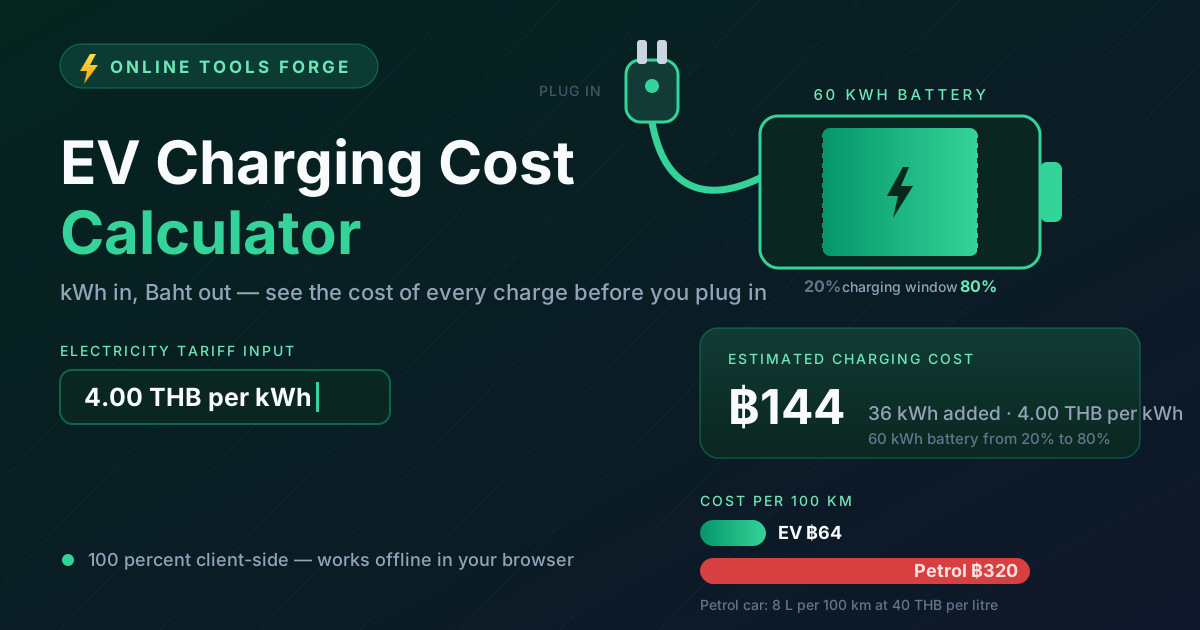
Table of Contents
EV Charging Cost Calculator: Know What Every Charge Costs Before You Plug In
The most popular sales pitch for electric vehicles is simple: electricity is cheaper than petrol. The claim is true — and by a wide margin — but by exactly how much depends on three things: the size of your battery, the charge window you use, and the electricity tariff you pay. The EV Charging Cost Calculator takes those three inputs and turns them into a precise figure, so cheaper driving becomes a number you can budget around.
In seconds, the tool estimates what a charging session will cost, converts it into a cost per 100 km figure, and lines it up against a comparable petrol car. Everything runs 100% client-side in your browser — no sign-up, no uploads, nothing ever leaves your device.
Whether you already drive an EV or are weighing one against a petrol car, this guide covers how the calculator works, the math behind it, and the habits that keep bills low.
Why Use EV Charging Cost Calculator?
- See the true price of every session — A dashboard percentage says nothing about money. Enter battery size and charge window; get a cost in your own currency every time.
- Compare EV and petrol on equal terms — The petrol car comparison converts your session cost into a cost per 100 km and sets it beside a fuel-powered equivalent — savings measured, not guessed.
- Think in cost per 100 km, not per plug-in — Session costs swing with how empty the battery was; per-distance figures are the only fair way to track spending.
- Test any tariff instantly — Home rates, time-of-use plans, and public DC fast charging all price energy differently. Change one field and the whole picture shifts.
- Completely private — The calculation runs entirely in your browser; nothing is tracked, uploaded, or stored, so you can model your real home tariff freely.
Key Features
| Feature | What it does |
|---|---|
| Battery capacity (kWh) | The usable size of your EV battery. |
| Current charge level | The percentage the battery is at right now. |
| Target charge level | Your destination percentage; 80 percent is the usual daily target. |
| Electricity tariff | Your price per kWh from a bill or charging network. |
| Charging cost | What the full session will cost, instantly. |
| Cost per 100 km | Tariff and consumption as a per-distance running cost. |
| Petrol car comparison | The equivalent petrol cost per 100 km, side by side. |
- Currency-agnostic — The tariff is just a number per kWh, so it works in baht, dollars, euros, or any currency.
- Instant recalculation — Results update as you type, making scenario comparisons effortless.
- Transparent math — The kWh added and the tariff stay visible for verification against your bill.
How to Use
- Enter your battery capacity in kWh. Find it in the vehicle specifications — for example, 60 kWh for a mid-size electric car.
- Set the current charge level. Read it off your dashboard or charging app; 20 percent is a common daily low point.
- Set the target charge level. For routine charging, 80 percent balances battery health and speed; save 100 percent for long trips.
- Enter your electricity tariff per kWh. Copy the rate from your utility bill, or a public charger's price for sessions away from home.
- Read the results. You get the session cost, the cost per 100 km, and the petrol comparison.
kWh In, Baht Out
Everything flows from one formula:
charge added = battery capacity × (target percent − current percent) ÷ 100
Worked example: you drive a 60 kWh EV home with 20 percent left and want 80 percent by morning. The energy added is 60 × (80 − 20) ÷ 100 = 36 kWh. At a home tariff of 4.00 per kWh, the session costs 144 in your currency — before losses.
That caveat matters. AC charging through the onboard converter typically loses about 10 percent as heat, so the grid delivers roughly 40 kWh to put 36 kWh into the pack, nudging the real bill toward 160. Add 10 percent for bill-accurate numbers.
Location changes everything. Home AC power is almost always the cheapest energy around, while public DC fast chargers commonly price the same kWh at two to four times the home rate. The same 36 kWh that costs 144 at home can cost 400 or more at a highway fast charger — the calculator quantifies that gap before the receipt does.
The cost per 100 km output is where EVs shine. An efficient EV uses roughly 16 kWh per 100 km, so at a 4.00 tariff that is 64 per 100 km. A comparable petrol sedan burning 8 litres per 100 km at 40 per litre spends 320 per 100 km — home charging is about five times cheaper. Rely on premium DC charging and the gap shrinks fast. Electricity really is cheaper than petrol — by exactly how much depends on your tariff and charge level, and now you can compute both in seconds.
Practical Use Cases
Comparing Home and Public Charging
Run the same session twice — home tariff, then a public rate — and the price of convenience becomes concrete: one weekly fast-charge session can cost as much as a month of home charging.
Monthly Driving Cost Budgeting
Multiply cost per 100 km by monthly mileage — say 1,200 km — for a defensible budget line. When tariffs change, recalculate once and the forecast stays honest.
EV vs Petrol Purchase Decisions
Debating a switch? Compare the EV's cost per 100 km at your real tariff against your petrol car's fuel bill over the same distance, then multiply the difference by annual mileage. A marketing claim becomes a payback estimate.
Road Trip Planning
Before a long drive, model each stop: the energy you will add and its cost at that station's tariff. Budgeting beats watching the meter with surprise.
Best Practices
- Charge at home when possible — Home AC power is nearly always the cheapest energy available; treat public charging as the exception.
- Watch time-of-use tariffs — Charge overnight on off-peak rates and enter that tariff to see the true saving.
- Keep the battery between 20 and 80 percent — The window is gentler on battery chemistry and typically quicker to fill; the Battery Life Calculator covers the degradation side.
- Account for charging losses — Add about 10 percent to any AC estimate so your budget matches the bill that arrives.
- Recalculate when tariffs change — One field update keeps your cost per 100 km current; stale assumptions quietly break budgets.
- Track cost per 100 km, not session costs — Distance-based figures compare cleanly across cars, tariffs, and months.
Put real numbers behind your charging routine: open the EV Charging Cost Calculator, enter your battery, charge window, and tariff, and see your cost per 100 km in under a minute.
Related Tools You Might Like:
- Battery Life Calculator — how charging habits, depth of discharge, and cycle counts shape battery lifespan.
- Unit Price Calculator — compare prices per unit across pack sizes — handy for evaluating charging plans.
- Electricity Cost Calculator — what any household appliance costs to run per day, month, and year.
Charge smarter, drive cheaper — and let the numbers decide where you plug in.
Frequently Asked Questions
Q: How accurate is the charging cost estimate?
A: Exact for the inputs you provide. Real-world drift comes from charging losses, battery age, and time-varying tariffs, so treat it as a close planning figure rather than a receipt.
Q: Does the calculator include charging losses?
A: The base result is energy added multiplied by your tariff. Since AC charging loses about 10 percent as heat, add 10 percent for the figure that appears on your utility bill.
Q: Can I use any currency?
A: Yes. The tariff is simply a price per kWh — enter it in baht, dollars, euros, or anything else; every output uses the same unit.
Q: Is any of my data uploaded or stored?
A: No. The calculator runs 100% client-side in your browser; nothing you type is ever sent to a server.