JSON Schema Faker: Generate Realistic Mock Data from JSON Schema in Your Browser
Learn how JSON Schema Faker turns any JSON Schema into realistic, deterministic mock JSON with seeded determinism, format-aware strings, $ref resolution, and example/default precedence — entirely in your browser.
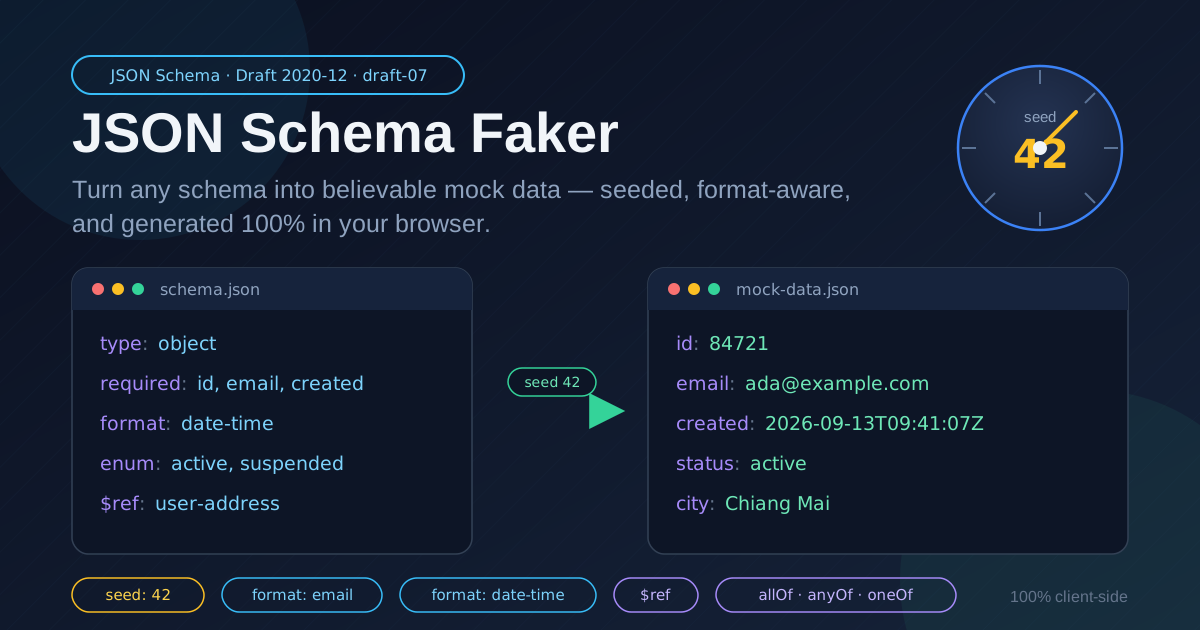
Table of Contents
JSON Schema Faker: Generate Realistic Mock Data from JSON Schema in Your Browser
Every frontend team knows the wait: the API contract is signed off, but the backend is weeks away. Meanwhile, the placeholder [{ id: 1 }, { id: 2 }] in your code tells you nothing about how the real interface will behave with names, timestamps, and edge cases. The JSON Schema Faker closes that gap: paste a JSON Schema — Draft 2020-12, 2019-09, or draft-07 — and it generates mock JSON that honors every type, constraint, and format you declared, entirely in your browser.
What separates believable mock data from random noise is fidelity. Lorem-ipsum strings and gibberish emails slip through your UI until production data arrives and breaks it. This tool reads the contract you already wrote and respects it: format: email yields a plausible address, bounds and enums are honored, and required fields always appear. Nothing leaves your machine — generation runs 100% client-side.
This guide covers why schema-driven generation beats hand-written fixtures, how to use the tool, and the details that matter: $ref resolution, composition, example/default precedence, and seeded determinism.
Why Use JSON Schema Faker?
- Your schema is already the spec. Fixtures generated from it can never drift from the contract — when the schema changes, regenerate instead of hand-editing dozens of files.
- Seeded determinism makes output reproducible. The same seed always produces the same document — a fixture you can commit, diff, and assert against.
- Format-aware strings look real. Fields tagged with email, date-time, uri, or uuid come out shaped correctly, so validators and formatters get production-like values.
- Complex schemas are handled, not ignored. $ref pointers resolve across the document, and allOf, anyOf, oneOf are understood — deeply nested API schemas work, not just toy examples.
- Your data wins when it exists. An example or default on a property takes precedence over random generation.
- Zero upload, zero setup. No CLI, no server round-trip — proprietary field names never leave your browser.
Key Features
| Feature | What it means for you |
|---|---|
| Draft 2020-12, 2019-09, draft-07 | Modern and legacy schemas, no pre-conversion |
| Seeded determinism | Same seed, identical output — ideal for stable fixtures |
| Format-aware strings | email, date-time, uri produce realistic values |
| Types, required, enums | Output always satisfies the constraints you declared |
| $ref resolution | Internal references resolve across the whole document |
| allOf / anyOf / oneOf | Composition keywords are interpreted, not skipped |
| example and default precedence | Declared values override random generation |
| 100% client-side | Processed in your browser; nothing is uploaded |
- Seed control turns random output into a fixture. Set it once, note it in your test file, and every teammate regenerates the same data.
- Precedence makes the tool collaborative. Fields pinned with example stay put while the rest varies.
How to Use
- Open the tool. Navigate to the JSON Schema Faker page. The editor is ready on load — no account, no configuration.
- Paste your JSON Schema. From a two-property object to a long document with definitions. Drafts 2020-12, 2019-09, and draft-07 are detected automatically.
- Set a seed (optional but recommended). The same seed plus the same schema always produces the same output — exactly what committed fixtures need.
- Generate and inspect. Check that required fields are present, enum values come from the allowed set, and formatted strings look right.
- Copy or regenerate. Paste the output into your mock server or tests. Change the seed for new variations, or update the schema and regenerate to stay in sync.
From Schema to Believable Data
The tool is best understood as an interpreter for your schema. For every node it asks: what type is declared, which constraints apply, and is there a value to honor instead of inventing one? Types come first. A plain string becomes a readable word; add "format": "email" and it becomes something like [email protected]. Numbers respect minimum and maximum, enumerations are drawn strictly from the enum array, and required properties are always emitted. References and composition are where simpler generators give up: $ref pointers resolve within the document, allOf merges its branches into one object, and anyOf/oneOf pick one matching branch — real-world API schemas generate correctly without preprocessing.
Precedence is the polish. When a property declares example or default, that value wins over random generation:
{
  "type": "object",
  "required": ["id", "email", "role"],
  "properties": {
    "id": { "type": "integer", "minimum": 1, "maximum": 99999 },
    "email": { "type": "string", "format": "email" },
    "role": { "type": "string", "enum": ["admin", "editor", "viewer"] },
    "joined": { "type": "string", "format": "date-time" }
  }
}
With seed 42, the generator might produce:
{
  "id": 84721,
  "email": "[email protected]",
  "role": "viewer",
  "joined": "2026-09-13T09:41:07Z"
}
Every field satisfies the schema: the id is in range, the email is well-formed, the role comes from the enum, and the timestamp parses as ISO 8601. Rerun with the same seed and you get those exact bytes; change it to 43 and the shape stays identical while values vary.
Why does reproducibility matter for tests? Because flaky fixtures are worse than no fixtures. Seeded generation gives you realism with the stability of a checked-in file, and a one-digit change yields a fresh edge case when needed.
Practical Use Cases
Frontend Development Before the Backend Ships
The schema is agreed, the backend is sprints away, and the UI needs realistic payloads today. Generate a seeded mock response, wire it into your mock server, and build loading, empty, and overflow states against contract-shaped data.
Test Fixtures That Never Flake
Integration tests need data varied enough to be meaningful and stable enough to assert on. Pin the seed in CI so every run sees identical input. When the schema evolves, regenerate, review the diff, and update assertions deliberately.
Demo Environments That Look Real
A demo with test test test in every field undermines the product. Generate a few documents with different seeds and load them into your demo environment, so stakeholders see believable names, dates, and statuses — no hand-crafted rows, no production data.
API Documentation Examples
Documentation with fake-looking examples erodes trust in an API. Generate examples from the endpoint schemas: the schema changes, the example regenerates, and readers always see payloads that actually validate.
Best Practices
- Pin the seed for stable tests. Record the seed next to any fixture it feeds; schema-plus-seed is the fixture's source of truth.
- Keep schemas honest. The generator is only as realistic as the contract — add required lists, enums, bounds, and formats where they truly apply.
- Use formats for realistic strings. Annotating fields as email, date-time, or uuid upgrades the output from "any string" to "a string your code will parse."
- Prefer example and default for load-bearing values. Pin prominent fields with example so screenshots and demos stay stable.
- Regenerate after schema changes. Make it part of the definition-of-done for contract changes; a stale fixture quietly tests a payload the API no longer produces.
- Review generated data before shipping it. Deterministic does not mean contextually perfect — scan the output once and adjust where needed.
Try It Now
Ready to stop hand-writing fixtures? Open the JSON Schema Faker, paste your API contract's schema, set a seed you can remember, and copy production-shaped mock data in seconds.
Related Tools You Might Like:
- OpenAPI to TypeScript Converter — turn OpenAPI specifications into typed TypeScript interfaces that pair with generated mock data.
- JSON Schema Visualizer — render complex schemas as readable diagrams to review structure before generating fixtures.
- JSON Formatter — beautify, validate, and minify the generated JSON before committing.
Happy generating — may your fixtures be realistic and your tests forever green.
Frequently Asked Questions
Q: Which JSON Schema drafts does the tool support?
A: Draft 2020-12, Draft 2019-09, and draft-07. In most cases you can paste the schema without conversion.
Q: How does seeded determinism work?
A: Your seed initializes the generator's random choices, so the sequence of values is fully determined by the pair of schema and seed. The same pair always yields identical output — which is what makes the data safe as a committed fixture.
Q: What happens when a property has both an example and a default?
A: Declared values take precedence. An example is emitted first; otherwise the tool falls back to the default; only with neither does it synthesize a valid value from the type, constraints, and format.
Q: Can it handle large schemas with $ref and composition keywords?
A: Yes. Internal $ref pointers resolve across the document, allOf merges branches, and anyOf/oneOf select a matching branch — all without manual preprocessing.
Q: Is my schema uploaded anywhere?
A: No. Generation runs entirely in your browser — your schema and the output never leave your machine.