license-compatibility-checker: Complete Online Guide, Features & Practical Examples
Learn how to use the free license-compatibility-checker in your browser with step-by-step instructions, practical use cases, and expert tips.
Free Interactive Tool
Open Source License Compatibility Checker
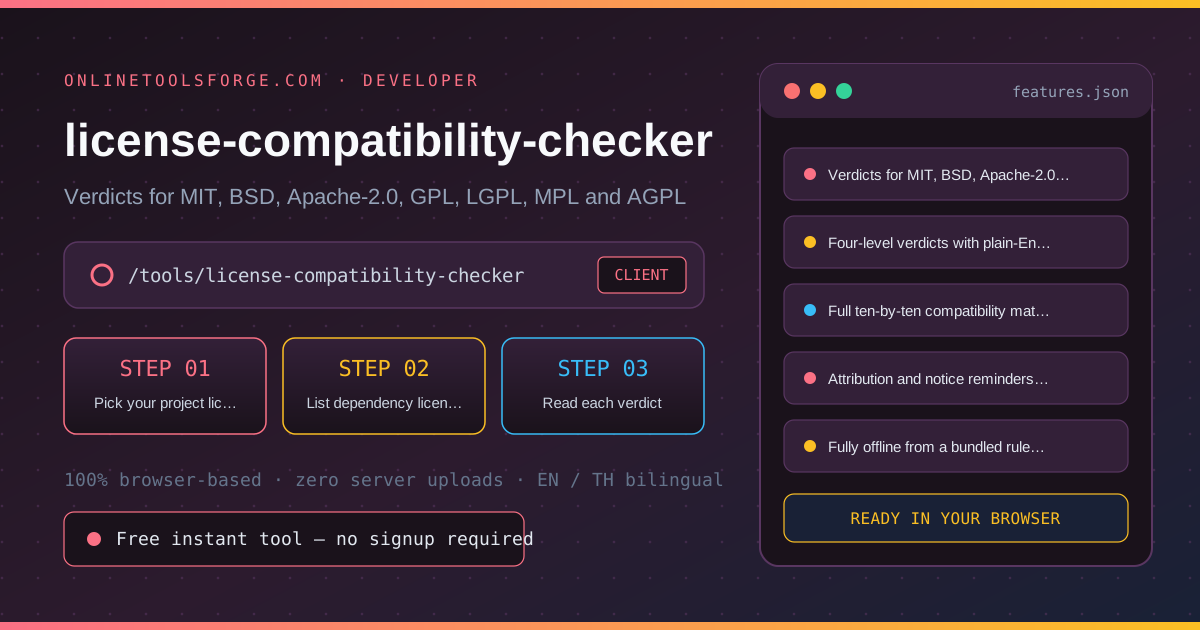
Select your project license and dependency licenses to get a compatibility verdict per dependency, with copyleft explanations and attribution-notice requirements from a bundled rule table, fully offline.
Table of Contents
The Open Source License Compatibility Checker compares your project license against every dependency license — MIT, BSD-2/3, Apache-2.0, GPL-2.0/3.0, LGPL-2.1/3.0, MPL-2.0 and AGPL-3.0 — using a bundled rule-of-thumb table. Each dependency gets a colour-coded verdict with a plain explanation, alongside a full ten-by-ten compatibility matrix and distribution reminders, all computed offline.
Whether you are double-checking numbers on a deadline, validating edge cases, or standardizing a repeatable workflow, the license-compatibility-checker gives you an interactive, zero-install workspace directly in your browser. Every calculation and transformation runs locally on your device — no account registration, no paywalls, and no sensitive inputs uploaded to external servers.
In this guide, we walk through why dedicated tooling beats manual back-of-the-envelope work, explore every feature inside the interface, and cover step-by-step instructions alongside real-world scenarios.
Why Use license-compatibility-checker?
- Immediate Clarity: Instant per-dependency verdicts with colour-coded severity.
- Focused Workflow: Plain-language explanations of what each copyleft license demands.
- Transparent Logic: Full matrix view for planning a re-licensing change.
- Practical Accuracy: Attribution reminders that keep NOTICE files honest.
- Time-Saving Defaults: Bundled rule table — consistent, offline and free.
- 100% Client-Side Privacy: Every operation executes inside your browser session, keeping your data private and responsive even on slow connections.
Key Features
| Feature Area | What It Delivers | Execution Mode |
|---|---|---|
| Capability 1 | Verdicts for MIT, BSD, Apache-2.0, GPL, LGPL, MPL and AGPL | Instant browser execution |
| Capability 2 | Four-level verdicts with plain-English explanations | Instant browser execution |
| Capability 3 | Full ten-by-ten compatibility matrix reference | Instant browser execution |
| Capability 4 | Attribution and notice reminders for distributions | Instant browser execution |
| Capability 5 | Fully offline from a bundled rule table — no API calls | Instant browser execution |
- Interactive Feedback: Results recalculate on the fly as you adjust inputs, letting you compare multiple scenarios in seconds.
- Bilingual Interface: Switch seamlessly between English and Thai labels whenever you collaborate across multilingual teams.
- Copy & Export Ready: Grab formatted outputs or summaries with one click so you can paste them straight into docs, tickets, or spreadsheets.
How to Use license-compatibility-checker
From a dependency list to a clear per-license verdict.
- Open the Tool: Head to the license-compatibility-checker in any modern desktop or mobile browser.
- Pick your project license: Choose the license your own code is under — MIT and Apache-2.0 are the common permissive starting points.
- List dependency licenses: Tick every license your dependencies use. The verdict table updates instantly for the whole set.
- Read each verdict: Yellow means notices are enough, orange means copyleft conditions apply, and red means the licenses conflict so one side has to change.
- Mind the distribution duties: Use the attribution reminders to keep copyright notices, license texts and change statements in your releases.
Core Concepts & How It Works
Understanding the underlying mechanics helps you interpret the output with confidence. The Open Source License Compatibility Checker compares your project license against every dependency license — MIT, BSD-2/3, Apache-2.0, GPL-2.0/3.0, LGPL-2.1/3.0, MPL-2.0 and AGPL-3.0 — using a bundled rule-of-thumb table. Each dependency gets a colour-coded verdict with a plain explanation, alongside a full ten-by-ten compatibility matrix and distribution reminders, all computed offline.
Instead of hiding assumptions behind a single opaque result, the license-compatibility-checker surfaces intermediate values and clear labels so you can audit how the final answer is assembled:
- Explicit Input Validation: Boundaries and unit expectations are checked immediately, preventing silent NaN or unit-mismatch bugs.
- Deterministic Output: Given the same inputs, the tool produces identical, reproducible results every time — ideal for team reviews and documentation.
- Edge-Case Visibility: Built-in warnings highlight when inputs approach practical limits or require special interpretation.
Practical Use Cases
1. Checking a new dependency before adding it to a product
When tackling checking a new dependency before adding it to a product, manual spreadsheets and ad-hoc scripts often introduce rounding errors or inconsistent assumptions. With the license-compatibility-checker, you can load your exact parameters, inspect the breakdown immediately, and verify how each variable affects the outcome before committing to a decision.
2. Planning a license change across a codebase
When tackling planning a license change across a codebase, manual spreadsheets and ad-hoc scripts often introduce rounding errors or inconsistent assumptions. With the license-compatibility-checker, you can load your exact parameters, inspect the breakdown immediately, and verify how each variable affects the outcome before committing to a decision.
3. Auditing an existing dependency tree for conflicts
When tackling auditing an existing dependency tree for conflicts, manual spreadsheets and ad-hoc scripts often introduce rounding errors or inconsistent assumptions. With the license-compatibility-checker, you can load your exact parameters, inspect the breakdown immediately, and verify how each variable affects the outcome before committing to a decision.
4. Teaching open-source licensing basics to a team
When tackling teaching open-source licensing basics to a team, manual spreadsheets and ad-hoc scripts often introduce rounding errors or inconsistent assumptions. With the license-compatibility-checker, you can load your exact parameters, inspect the breakdown immediately, and verify how each variable affects the outcome before committing to a decision.
5. Preparing NOTICE and attribution files for a release
When tackling preparing notice and attribution files for a release, manual spreadsheets and ad-hoc scripts often introduce rounding errors or inconsistent assumptions. With the license-compatibility-checker, you can load your exact parameters, inspect the breakdown immediately, and verify how each variable affects the outcome before committing to a decision.
Best Practices
- Start with realistic baseline values before testing extreme edge cases so you have a clear reference point to compare against.
- Verify units and formatting on every input field — many discrepancies come from mixing percentages, decimals, or measurement units.
- Test sensitivity by changing one variable at a time in the license-compatibility-checker to see which input has the largest impact on your result.
- Document your assumptions alongside the exported output so teammates can reproduce the exact state later.
- Pair with companion utilities in the same category when your workflow spans multiple conversion or validation steps.
Frequently Asked Questions
Q: Is Apache-2.0 compatible with GPL-2.0? A: No. Apache-2.0 is considered incompatible with GPL-2.0-only, mainly because of its patent-termination and indemnification clauses. Apache-2.0 code can be combined with GPL-3.0 code, because GPL-3.0 explicitly accepts it.
Q: Can my MIT project use a GPL dependency? A: Only by accepting that the combined work is distributed under GPL. Your MIT code stays MIT, but the whole application must follow the GPL terms when you distribute it. For a permissive product, look for a permissive or weakly-copyleft replacement.
Q: What makes LGPL different from GPL? A: LGPL adds a linking exception: other software may call the library while keeping its own license, provided the library is dynamically linked and users can relink or replace it. Static linking folds the full LGPL terms into the combined work.
Q: Is this checker legal advice? A: No. It applies a bundled rule-of-thumb table so you can reason about common cases quickly. Real projects — especially commercial ones — should confirm licensing decisions with a lawyer or an OSPO before shipping.
Try license-compatibility-checker Today
Ready to streamline your workflow? Open the license-compatibility-checker now to run instant, accurate calculations right in your browser — completely free and with zero setup required.
Related Tools You Might Like
Happy building and calculating!