substitution-cipher-solver: Complete Online Guide, Features & Practical Examples
Learn how to use the free substitution-cipher-solver in your browser with step-by-step instructions, practical use cases, and expert tips.
Free Interactive Tool
Substitution Cipher Solver
Crack simple substitution ciphers automatically with frequency analysis and deterministic hill climbing, then refine the letter mapping by hand with per-letter lock-in. Fully offline.
Table of Contents
The Substitution Cipher Solver cracks monoalphabetic ciphers the way a cryptographer would, but in under a second: letter frequencies choose the starting key, a deterministic hill climb improves it against a dictionary and bigram scores, and rotated restarts escape weak local optima. The winning key loads into an editable 26-letter mapping grid — fix any letter by hand with the preview re-rendering live, lock the ones you trust, and re-crack with those pinned. Punctuation and spacing are preserved, so the answer reads like the original message.
Whether you are double-checking numbers on a deadline, validating edge cases, or standardizing a repeatable workflow, the substitution-cipher-solver gives you an interactive, zero-install workspace directly in your browser. Every calculation and transformation runs locally on your device — no account registration, no paywalls, and no sensitive inputs uploaded to external servers.
In this guide, we walk through why dedicated tooling beats manual back-of-the-envelope work, explore every feature inside the interface, and cover step-by-step instructions alongside real-world scenarios.
Why Use substitution-cipher-solver?
- Immediate Clarity: Automatic cracking for English text of a sentence or more.
- Focused Workflow: Editable mapping grid with live re-decryption.
- Transparent Logic: Per-letter lock-in that survives re-cracking.
- Practical Accuracy: Deterministic: the same input always yields the same result.
- Time-Saving Defaults: Fully offline — pasted ciphertext never leaves the page.
- 100% Client-Side Privacy: Every operation executes inside your browser session, keeping your data private and responsive even on slow connections.
Key Features
| Feature Area | What It Delivers | Execution Mode |
|---|---|---|
| Capability 1 | Automatic cracking via frequency analysis and hill climbing | Instant browser execution |
| Capability 2 | Dictionary and bigram scoring tuned for English plaintext | Instant browser execution |
| Capability 3 | Editable 26-letter mapping with live re-decryption | Instant browser execution |
| Capability 4 | Per-letter lock-in that survives re-cracking | Instant browser execution |
| Capability 5 | Fully offline with copyable output | Instant browser execution |
- Interactive Feedback: Results recalculate on the fly as you adjust inputs, letting you compare multiple scenarios in seconds.
- Bilingual Interface: Switch seamlessly between English and Thai labels whenever you collaborate across multilingual teams.
- Copy & Export Ready: Grab formatted outputs or summaries with one click so you can paste them straight into docs, tickets, or spreadsheets.
How to Use substitution-cipher-solver
From a wall of scrambled letters to readable text in four steps.
- Open the Tool: Head to the substitution-cipher-solver in any modern desktop or mobile browser.
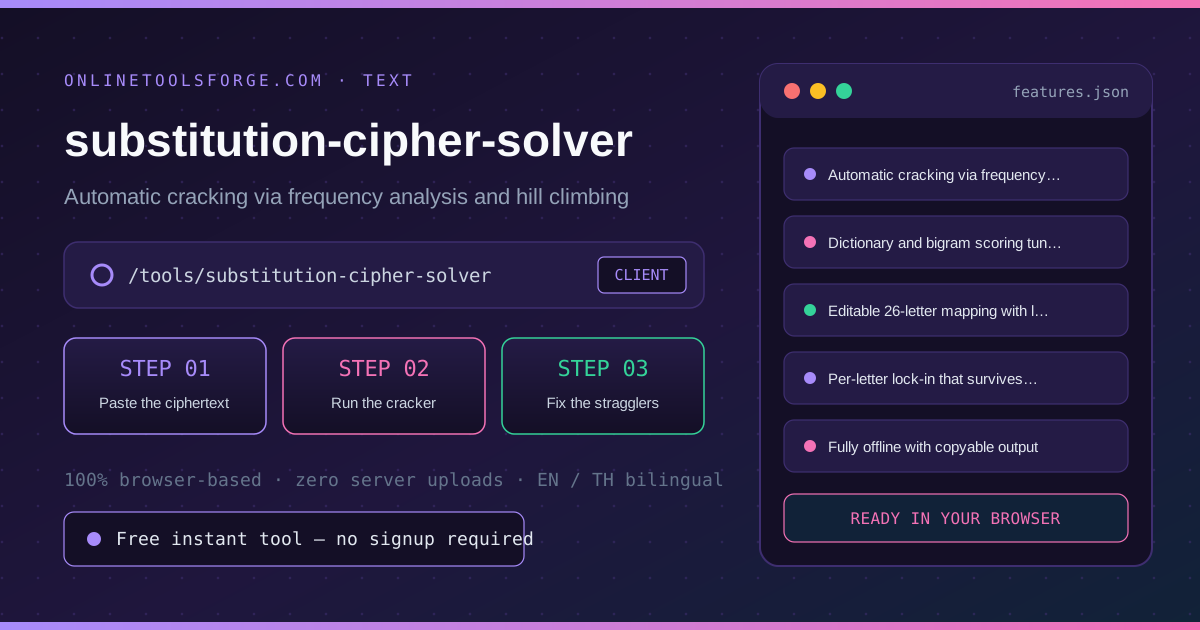
- Paste the ciphertext: Paste the encrypted message keeping its spacing and punctuation. Only letters are analyzed; everything else passes through untouched.
- Run the cracker: Click the crack button. Letter frequencies choose a starting key and a deterministic hill climb improves it against a dictionary and bigram scores, usually landing close to the answer on English text of a sentence or more.
- Fix the stragglers: Scan the decrypted text for wrong letters and correct them in the mapping grid — the preview re-renders as you change each one.
- Lock and re-crack: Lock the letters you trust and run another pass; the solver keeps every locked letter pinned and only reshuffles the rest. Copy the finished plaintext when it reads cleanly.
Core Concepts & How It Works
Understanding the underlying mechanics helps you interpret the output with confidence. The Substitution Cipher Solver cracks monoalphabetic ciphers the way a cryptographer would, but in under a second: letter frequencies choose the starting key, a deterministic hill climb improves it against a dictionary and bigram scores, and rotated restarts escape weak local optima. The winning key loads into an editable 26-letter mapping grid — fix any letter by hand with the preview re-rendering live, lock the ones you trust, and re-crack with those pinned. Punctuation and spacing are preserved, so the answer reads like the original message.
Instead of hiding assumptions behind a single opaque result, the substitution-cipher-solver surfaces intermediate values and clear labels so you can audit how the final answer is assembled:
- Explicit Input Validation: Boundaries and unit expectations are checked immediately, preventing silent NaN or unit-mismatch bugs.
- Deterministic Output: Given the same inputs, the tool produces identical, reproducible results every time — ideal for team reviews and documentation.
- Edge-Case Visibility: Built-in warnings highlight when inputs approach practical limits or require special interpretation.
Practical Use Cases
1. Solving cryptoquotes and newspaper puzzles
When tackling solving cryptoquotes and newspaper puzzles, manual spreadsheets and ad-hoc scripts often introduce rounding errors or inconsistent assumptions. With the substitution-cipher-solver, you can load your exact parameters, inspect the breakdown immediately, and verify how each variable affects the outcome before committing to a decision.
2. Puzzle-hunt and ARG cipher stages
When tackling puzzle-hunt and arg cipher stages, manual spreadsheets and ad-hoc scripts often introduce rounding errors or inconsistent assumptions. With the substitution-cipher-solver, you can load your exact parameters, inspect the breakdown immediately, and verify how each variable affects the outcome before committing to a decision.
3. Teaching frequency analysis in a cryptography unit
When tackling teaching frequency analysis in a cryptography unit, manual spreadsheets and ad-hoc scripts often introduce rounding errors or inconsistent assumptions. With the substitution-cipher-solver, you can load your exact parameters, inspect the breakdown immediately, and verify how each variable affects the outcome before committing to a decision.
4. Decoding old family or game letters enciphered by hand
When tackling decoding old family or game letters enciphered by hand, manual spreadsheets and ad-hoc scripts often introduce rounding errors or inconsistent assumptions. With the substitution-cipher-solver, you can load your exact parameters, inspect the breakdown immediately, and verify how each variable affects the outcome before committing to a decision.
5. Checking a constructed puzzle has a solvable, unique answer
When tackling checking a constructed puzzle has a solvable, unique answer, manual spreadsheets and ad-hoc scripts often introduce rounding errors or inconsistent assumptions. With the substitution-cipher-solver, you can load your exact parameters, inspect the breakdown immediately, and verify how each variable affects the outcome before committing to a decision.
Best Practices
- Start with realistic baseline values before testing extreme edge cases so you have a clear reference point to compare against.
- Verify units and formatting on every input field — many discrepancies come from mixing percentages, decimals, or measurement units.
- Test sensitivity by changing one variable at a time in the substitution-cipher-solver to see which input has the largest impact on your result.
- Document your assumptions alongside the exported output so teammates can reproduce the exact state later.
- Pair with companion utilities in the same category when your workflow spans multiple conversion or validation steps.
Frequently Asked Questions
Q: How much text does the solver need? A: English text of a sentence or more works well — a hundred letters is usually enough for the frequency start plus the dictionary scoring to lock in the common letters, and three hundred or more makes the hill climb very reliable. Very short texts leave too many ties, so fix the letters you know and re-crack with them locked.
Q: What is the lock for? A: The lock pins a letter mapping so the cracker cannot move it. When you have identified two or three letters — say you recognized a signature word — lock them and re-run; the solver shuffles only the unlocked letters, which turns a hard search into a small one.
Q: Does it work on Caesar or ROT13 ciphers? A: Yes. Caesar, ROT13 and Atbash are all special cases of a simple substitution, so the same cracking pipeline handles them — or just read the mapping grid, where a Caesar cipher shows up as a uniform shift you can spot immediately.
Q: Why is one letter still wrong at the end? A: Letters that appear only once or twice in the ciphertext carry almost no frequency signal, so the climb may leave two rare letters swapped. Read the decrypted text, spot the nonsense word, and swap the pair in the mapping grid — the preview corrects instantly.
Try substitution-cipher-solver Today
Ready to streamline your workflow? Open the substitution-cipher-solver now to run instant, accurate calculations right in your browser — completely free and with zero setup required.
Related Tools You Might Like
Happy building and calculating!