Wordle Solver: Filter Five-Letter Words by Your Clues
Enter green, yellow, and gray clues to instantly shortlist Wordle answers from an offline five-letter word list, ranked by letter frequency. Free and fully in-browser.
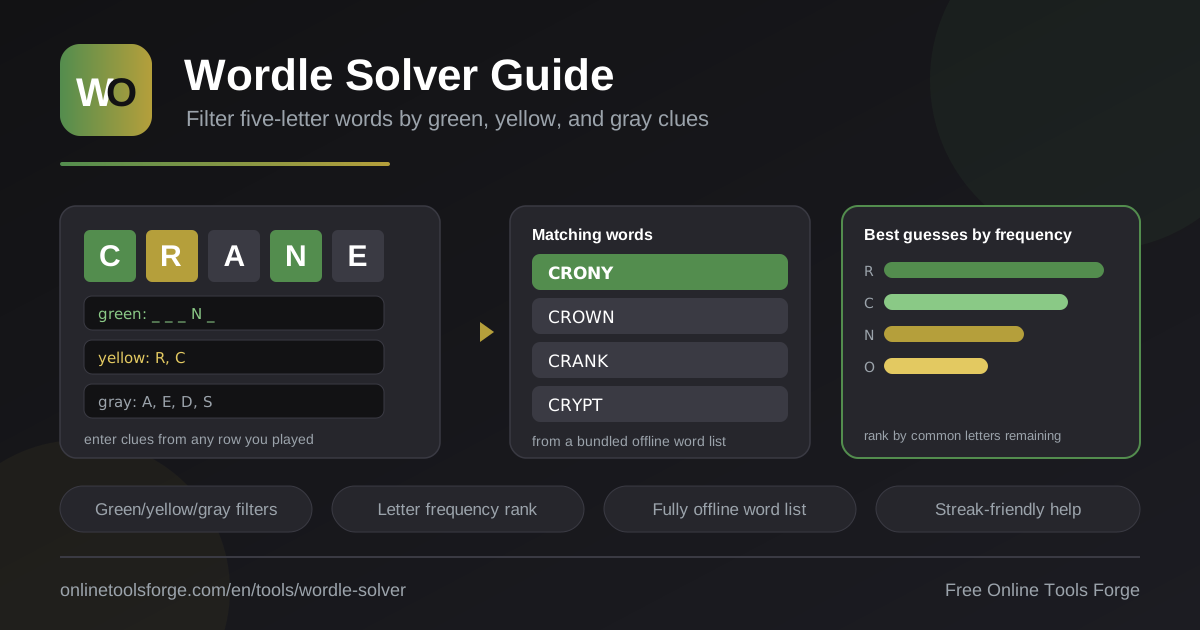
Table of Contents
Three guesses in, one lonely yellow letter on the board, and a streak on the line — every Wordle player knows that sinking feeling. The Wordle Solver turns it around: enter the green, yellow, and gray clues you have gathered, and the tool instantly filters a bundled five-letter word list down to the answers that still fit. It then ranks the survivors by letter frequency, so your next guess is informed rather than desperate.
Everything runs in your browser against a fully offline word list, so there is nothing to install and no account to create. Open the page, type your clues, and get a shortlist in seconds — even on a plane with no Wi-Fi. This guide explains how the tool works, how to read the clue colors precisely, and how to fold it into a smarter word game strategy.
Why Use the Wordle Solver?
- Escape the endgame wall. When several letters are known but the arrangement stays elusive, a filtered candidate list surfaces words your brain keeps skipping.
- Never waste a guess. The solver shows exactly which words remain legal, so you stop trying letters you have already ruled out.
- Learn letter frequency. The frequency ranking teaches you which letters dominate English five-letter words, sharpening your unaided play over time.
- Work fully offline. The word list is bundled with the tool, so it loads instantly and keeps working without an internet connection.
- Protect your streak. A quick shortlist in the final two guesses is often the difference between a green grid and a broken streak.
- Free and private. All filtering happens locally in your browser; your puzzle progress never leaves your device.
Key Features
| Feature | What it does |
|---|---|
| Green letter positions | Lock confirmed letters into their exact spots in the answer pattern. |
| Yellow letters | Mark letters that must appear somewhere, just not where you tried them. |
| Gray letters | Exclude letters that are not in the answer at all. |
| Instant filtering | Checks a bundled offline five-letter word list the moment your clues change. |
| Candidate suggestions | Displays every remaining word that satisfies all of your clues. |
| Frequency ranking | Ranks best guesses by letter frequency to surface promising candidates first. |
Two details worth knowing:
- The filter is strict: a word appears only if it satisfies every green, yellow, and gray constraint at once, so the list shrinks honestly as clues accumulate.
- Suggestions update live, so you can toggle a letter gray or move a yellow marker and instantly see how the candidate pool responds.
How to Use the Solver
- Open the Wordle Solver in your browser alongside your daily puzzle.
- Enter your known answer pattern: place green letters in their confirmed positions and leave unknown slots blank.
- List your yellow letters — the ones that must appear somewhere in the word, just not where you played them.
- List your gray letters so the tool excludes them from every candidate.
- Review the shortlist and the frequency-ranked suggestions, pick your next guess, then update the clues after each round until a single word remains.
The whole loop takes seconds per guess, which is exactly what you want while the daily puzzle clock runs.
Reading the Clue Colors
The solver is only as good as the clues you feed it, so precision matters. Green is the strongest signal: it confirms both the letter and its exact position, and the tool hard-codes that letter into the pattern. Yellow is subtler: the letter is definitely in the answer, but not in the position you played, and the filter remembers that exclusion. Gray is the simplest: the letter appears nowhere in the word and disappears from consideration.
The power comes from combining them. Every candidate must simultaneously match all green positions, contain every yellow letter somewhere outside its marked spots, and contain zero gray letters. That triple test collapses the roughly 2,300 possible answers into a handful — often just one or two.
Letter frequency then guides the final choice. When several candidates remain, words built from common letters such as E, A, R, O, T, and S are statistically more likely to be correct, so they rise to the top of the ranking. This is why frequency-rich openings like CRANE or SLATE are so effective at generating useful clues early.
A quick walkthrough: you play SLATE and the board returns S gray, L gray, A yellow in position 3, T green in position 4, and E green in position 5. Enter that clue set:
Green:  _ _ _ T E
Yellow: A (not in position 3)
Gray:   S, L
The shortlist instantly narrows to words ending in TE that hold an A outside position 3, with no S or L — MATTE is the classic survivor. One more look at the board and the puzzle is solved.
Practical Use Cases
Rescuing a Hard Daily Puzzle
Some answers are simply nasty — words like FJORD or WRYLY packed with letters most players rarely try. When three guesses have produced little, paste your clues into the solver and let the offline word list do the brute force. A board that looked hopeless often narrows to two or three legal words, and the frequency ranking tells you which one to commit to first.
Protecting a Streak
Streaks are won or lost in the last two guesses. Instead of gambling on a hunch, check the candidates: if five words remain and they share few letters, a safety guess dense in untested common letters can guarantee the answer lands on the final row. The solver makes that calculation visible instead of guesswork.
Learning Frequency Strategy
Use the tool as a coach, not just a crutch. After a few sessions, notice how often E, A, R, O, and T appear in candidate lists and how rarely J, Q, X, and Z do. That pattern is letter frequency at work, and internalizing it makes your solo guesses sharper with every puzzle you attempt.
Adapting to Other Word Games
Wordle clones and printable variants all follow the same green-yellow-gray logic. Whether a game uses a different word list or gives you four tries instead of six, the same clue entry applies: greens pin positions, yellows relocate, grays eliminate. One wordle helper covers the whole family of guessing games.
Best Practices
- Update clues after every guess. The filter compounds; three accurate rounds usually leave a single word.
- Double-check yellows. Forgetting that a yellow letter cannot sit in its tested position is the fastest route to a wrong shortlist.
- Trust gray letters. Reusing an eliminated letter quietly wastes a guess the solver already saved for you.
- Open with frequency-rich words. Guesses like CRANE or SLATE maximize information even when they are not the answer.
- Burn a guess when many candidates remain. If eight words share little vocabulary, testing fresh common letters splits the field faster than picking one of them.
- Treat it as a learning aid. Study why the top suggestion ranked highest and you will need the helper less over time.
Ready to turn a stubborn grid into a green row? Open the Wordle Solver, drop in your clues, and let the offline word list finish the job — free, instant, and entirely in your browser.
Related Tools You Might Like:
- Crossword Generator — build custom crossword puzzles from your own word lists.
- Random Word Generator — spark practice rounds and creative prompts with random words.
- Word Counter — track word, character, and sentence counts in any text.
Happy solving!
Frequently Asked Questions
Q: Is the Wordle Solver free to use?
A: Yes. The tool is completely free, runs entirely in your browser, and ships with a fully offline five-letter word list — no sign-ups and no connection required.
Q: Does the solver give away the answer?
A: It never sees your puzzle; you enter only the clues the game already showed you. It lists every word consistent with those clues, and the final pick is still yours.
Q: What about words with repeated letters?
A: Enter each clue exactly as the game displayed it. Green and yellow positions are honored literally and gray letters are excluded, which handles most duplicate-letter situations correctly.
Q: Can I use it for other word games?
A: Absolutely. Any game using green-yellow-gray feedback — Wordle clones, daily challenges, and paper variants — works with the same clue entry, making it a versatile five letter word finder.