SWIFT and BIC Code Validator: Validate and Decode ISO 9362 Bank Codes
Learn how to validate SWIFT and BIC codes per ISO 9362 and decode the bank, country, location, and branch parts before an international wire transfer leaves your account.
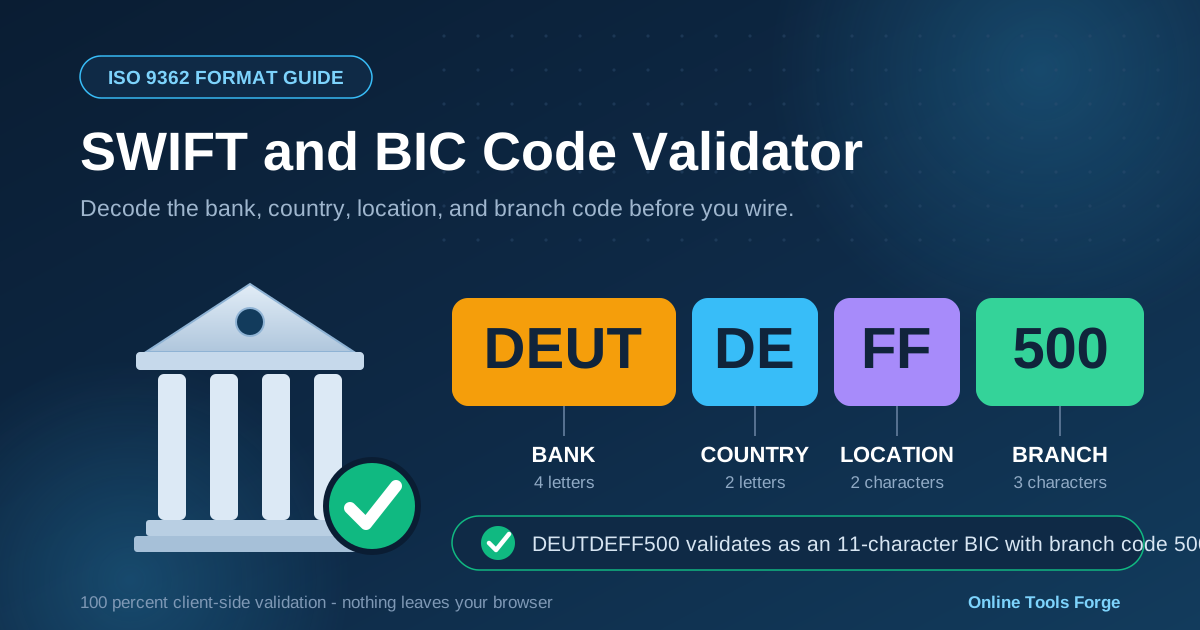
Table of Contents
SWIFT and BIC Code Validator: Validate and Decode ISO 9362 Bank Codes
Every international wire transfer depends on one short string of characters: the SWIFT/BIC code. Defined by ISO 9362, a BIC (Bank Identifier Code) tells the global banking network exactly which institution—in which country, city, and often branch—should receive the money. When even one character is wrong, the payment is rarely rejected politely: wires get held at intermediary banks, returned with fees deducted, or parked at the wrong office for days.
The frustrating part is that a wrong BIC usually looks right: nothing in the formatting warns you that the country code is nonsense or the bank code belongs to another institution. That is exactly what the free SWIFT-BIC Validator is built to catch. It validates the code against the ISO 9362 structure and decodes it into four readable parts, so you can confirm it says what the payee claims. Everything runs entirely in your browser—nothing you type is ever transmitted.
Why Use the SWIFT-BIC Validator?
Many websites tell you whether a BIC "looks valid." Fewer tell you why it fails or what it identifies. What sets this tool apart:
- Structured error messages, not just pass or fail. The validator reports specific failure types—invalid bank code, invalid country code, invalid location code, or invalid branch code—so you know exactly which segment to fix.
- Full ISO 9362 decoding. The tool splits the code into bank code (4 letters), country code (2 letters), location code (2 alphanumeric characters), and optional branch code (3 characters), labeled in plain language.
- Country context built in. The two-letter country code is mapped to its country name, so DE reads as Germany—a quick check that the bank country matches the payee's.
- Head-office detection. When the branch code is XXX, the tool flags it as the head office rather than a specific branch—a common cause of misrouted wires.
- Accepts both code lengths. The 8-character primary-office form and the full 11-character form are both supported.
- 100 percent client-side. Validation and decoding happen entirely in your browser—nothing touches a server.
Key Features
| Feature | What It Does |
|---|---|
| ISO 9362 validation | Checks the length is 8 or 11 characters and applies per-position character rules |
| Structured error types | Pinpoints which part failed: invalid bank, country, location, or branch code |
| Part-by-part decoding | Breaks the code into bank, country, location, and branch segments |
| Country name lookup | Maps the 2-letter country code to its country name |
| Head-office flagging | Identifies the XXX branch code as the institution's head office |
| Client-side processing | Parses and validates locally with no network calls |
Two practical notes: the decoded output is a conversation tool—"your location code, not your bank code, looks off" speeds up fixes with vendors—and the country name is a tripwire. If it does not match the payee's country, stop and re-verify.
How to Use
- Open the tool at the SWIFT-BIC Validator page.
- Paste or type the BIC exactly as the payee provided it.
- Review the validation result. A pass confirms structure; a failure names the exact invalid part.
- Read the decoded breakdown. Does the bank match the institution on the invoice? Does the country match the payee's? Does the branch point where you expect?
- Verify anything ambiguous with the payee. If the code resolves to a head office but the payee expects a local branch, confirm the correct code in writing first.
Inside an 11-Character BIC
ISO 9362 defines a BIC as four positional parts. Here is the real-format example DEUTDEFF500, decoded piece by piece:
| Segment | Value | Meaning |
|---|---|---|
| Bank code | DEUT | Four letters identifying the financial institution—here, the Deutsche Bank code family |
| Country code | DE | Two letters holding the ISO 3166-1 country code—Germany |
| Location code | FF | Two alphanumeric characters pinpointing the city—here, Frankfurt |
| Branch code | 500 | Three optional characters identifying a specific branch or office |
Worth internalizing:
- The 8-character form is the primary-office form. DEUTDEFF is a complete, valid BIC routing to the bank's primary office at that location; appending a branch code gives the 11-character form. For delivery to a particular branch, the full form is usually safer—confirm with the payee.
- XXX means head office. DEUTDEFFXXX points to the head office, not to "no branch." Some banks process head-office wires centrally; others require the true branch code, so never assume XXX is interchangeable.
- Each error type points to a distinct mistake. An invalid bank code usually means a typo or a code from the wrong institution. An invalid country code means the two letters are not a valid ISO 3166-1 code—often a transposition like ED for DE. An invalid location code means positions 7–8 break the alphanumeric rules, while an invalid branch code means the last three characters violate the allowed pattern.
- Validation confirms structure, not existence—a structurally perfect code can still be retired or belong to a different institution.
Practical Use Cases
Invoice and Vendor Onboarding
Validate the BIC on a new supplier's invoice before the details enter your payment system. Decoding takes seconds and surfaces mismatched countries or malformed segments—cheap now, expensive after a failed wire.
Cross-Border Payroll
Companies paying remote employees abroad juggle dozens of bank codes. Running each BIC through the validator at onboarding, alongside IBAN validation where supported, catches transcription errors before they become delayed salaries.
Finance-Team QA of Payment Files
Before a batch payment file goes to the bank, spot-check a sample of its BICs. The structured error types expose systemic issues: if every failure is an invalid location code, you likely have a template problem rather than fifty independent typos.
Customer Support Verification
Support teams handling "where is my payment?" calls can decode the customer's BIC and instantly see whether it points where they intended—including the head-office-versus-branch distinction behind many held wires.
Best Practices
- Confirm bank and branch with the payee, in writing. Validation proves the code is well-formed; only the payee can confirm it is their code and their branch.
- Do not treat XXX as a universal default. It means head office—ask for the specific branch code when funds must reach a local branch.
- Pair BIC validation with IBAN validation. The BIC identifies the bank; the IBAN identifies the account. Validating both covers far more than either alone.
- Never trust formatting alone. A correctly shaped BIC can still be retired or reassigned. Structural validity is a filter, not an approval.
- Re-validate after any edit. Corrected details introduce new typos at a surprising rate.
- Record the decoded parts alongside the raw code to ease future audits.
Validate Your Next Wire Before It Leaves
A misplaced character in a BIC is invisible to the eye and expensive in practice. Before your next international payment, paste the code into the free SWIFT-BIC Validator, read the decoded parts, and send it with confidence.
Related Tools You Might Like:
- IBAN Validator — validate international bank account numbers with checksum checks
- Credit Card Validator — verify card numbers with Luhn validation
- Thai ID Validator — validate Thai national identification numbers with checksum verification
This guide is for general information only and does not constitute financial or banking advice. Always confirm payment details directly with the receiving bank and payee.
Frequently Asked Questions
Q: What is the difference between a SWIFT code and a BIC code?
A: None—BIC (Bank Identifier Code) is the official ISO 9362 term, while "SWIFT code" is the popular name borrowed from the SWIFT network. Both refer to the same identifier, and this tool treats them identically.
Q: Can the validator tell me whether a BIC actually exists and is active?
A: No. The tool confirms ISO 9362 structural validity and decodes each part, but that does not guarantee a code is registered or active—confirming that requires a current BIC directory. Treat the validator as a first-pass check and confirm with the payee's bank.
Q: Should I use the 8-character or 11-character form?
A: Use whichever form the payee provides. The 8-character form routes to the primary office, which most banks handle correctly—but for a specific branch, use the full 11-character form and confirm it with the payee.
Q: Why does my BIC contain digits instead of only letters?
A: That is expected. Only the bank code and country code are restricted to letters. The location code and branch code may contain digits, so codes like DEUTDEFF500 are perfectly valid.