Tap Drill Size Chart: Every Drill Size You Need for Metric, UNC and UNF Tapping
Find the right pilot hole in seconds with the Tap Drill Size Chart: metric coarse and fine, UNC and UNF threads, the 75% thread formula, decimal inch equivalents and clearance hole fits.
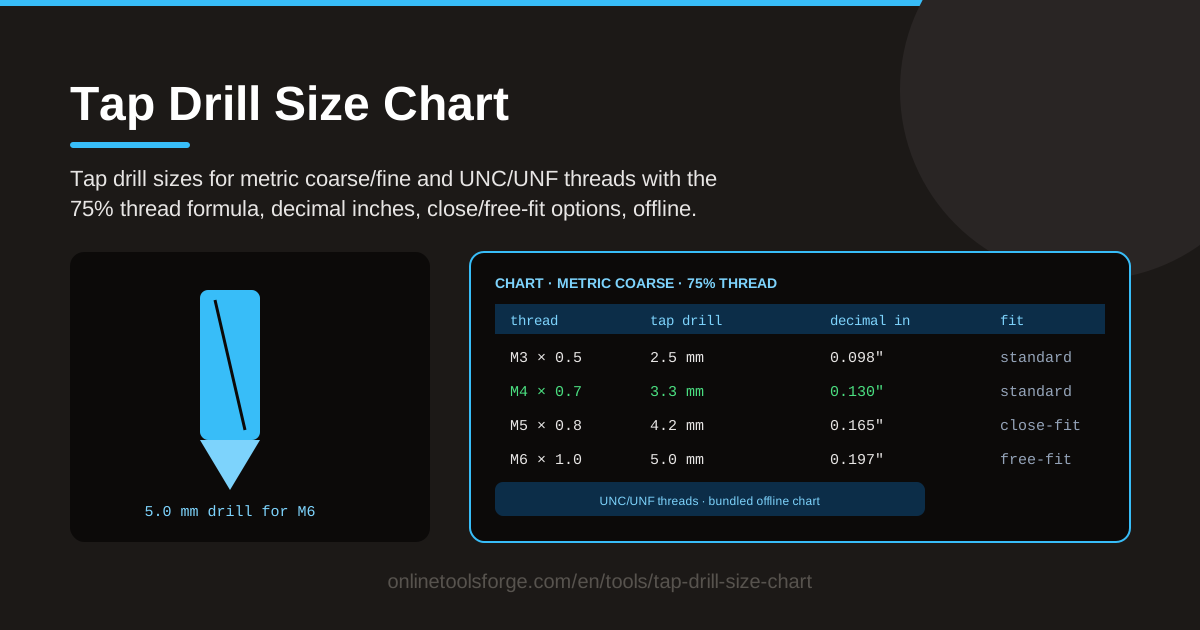
Table of Contents
A snapped tap can ruin a part — and an afternoon — in seconds. More often than not the culprit is not the tap but the pilot hole: too small and the tap binds, heats up and twists off; too big and the threads come out shallow and the screw pulls out under load. The Tap Drill Size Chart takes the guesswork out of that first, most important hole.
The tool runs entirely in your browser. Pick a thread family — metric coarse, metric fine, UNC or UNF — find your thread in the bundled offline chart, and it shows the recommended tap drill size, its decimal inch equivalent, and matching close-fit or free-fit clearance hole options. No spreadsheet, no greasy paper chart, no maths on a shop rag.
Below we walk through the tool step by step, explain the 75% thread rule behind every number in the chart, and share tips that apply everywhere from aluminium heatsinks to classic-car repairs.
Why Use Tap Drill Size Chart?
- Stop guessing at pilot holes. Every size comes from the standard 75% thread engagement calculation, so the hole is neither too tight for the tap nor too weak for the screw.
- Four thread families in one place. Metric coarse, metric fine, UNC and UNF sit in a single chart, handy when a project mixes metric and inch fasteners.
- Works offline in the browser. The chart data is bundled with the page, so lookups keep working in a workshop with patchy or no internet connection.
- Decimal inch equivalents built in. If your drill bits are labelled in inches but your thread is metric, the tool converts the size instantly.
- Close-fit and free-fit clearance options. For bolts passing through a mating part, you get both the precision hole and the quick-assembly hole.
- Faster than a paper chart. Reading a drill size takes seconds, with no risk of reading the wrong row on a crowded wall poster.
Key Features
| Feature | What it does |
|---|---|
| Thread family selector | Switch between metric coarse, metric fine, UNC and UNF threads instantly. |
| Tap drill lookup | Shows the recommended drill size for your thread using the 75% thread engagement formula. |
| Decimal inch equivalents | Converts every recommendation between millimetres and decimal inches to match any drill bit set. |
| Clearance hole options | Provides close-fit and free-fit diameters for bolts passing through a part rather than threading into it. |
| Bundled offline chart | All thread data ships inside the page, so lookups keep working without an internet connection. |
- The 75% calculation is applied for you — no subtracting pitch from major diameter on paper.
- The whole chart is bundled locally, so it loads fast and behaves like a shop reference, not another page that dies when the Wi-Fi drops.
- Every result appears in both metric and decimal inch form, matching whichever drill set is on your bench.
How to Use Tap Drill Size Chart
- Pick your thread standard. Choose metric coarse, metric fine, UNC or UNF from the thread family options. If you are unsure, most modern fasteners in Asia and Europe are metric coarse; inch threads appear most often on American equipment and older machinery.
- Find your thread. Scan the bundled chart for your designation, such as M5, M8 × 1.0, 1/4-20 or 1/4-28. The designation gives the nominal diameter and, for fine pitches, the pitch or threads per inch.
- Read the tap drill size. The tool shows the recommended drill — 4.2 mm for an M5 × 0.8 tap, for example — along with its decimal inch equivalent, 0.1654 in, so you can grab the right bit from either system.
- Choose the fit clearance. If the bolt must pass through a mating part rather than thread into it, pick a close-fit hole for precise alignment or a free-fit hole for quick, forgiving assembly.
- Drill and tap. Drill the pilot hole squarely, deburr the entry, then tap the thread with cutting oil and steady half-turn reversals to break the chips.
The 75% Thread Rule and Fits
Thread engagement percentage describes how much of a full V-shaped thread profile actually exists in the tapped hole. A 100% thread is the complete theoretical form; 75% engagement keeps three quarters of that depth. Because strength comes from the thread root and shear area — not the sharp tip — the final quarter of depth adds very little holding power while multiplying friction and cutting torque.
That is why 75% is the industry standard. The shortcut behind the chart is simple: tap drill size = major diameter − pitch. For M5 × 0.8 that is 5.0 − 0.8 = 4.2 mm; M8 × 1.25 gives 6.8 mm; M10 × 1.5 gives 8.5 mm. Inch charts for UNC and UNF threads apply the same logic through minor diameter tables, which is why a 1/4-20 tap takes a No. 7 drill (0.201 in) while the finer 1/4-28 tap takes the larger No. 3 drill (0.213 in).
Chasing 100% thread is almost always a mistake. The extra depth sends torque soaring, builds heat and snaps small taps, while the joint gains only a few percent of real strength. Materials matter too: soft aluminium taps at 75% with ease, but in tough stainless steel many machinists step up one drill size to around 65–70% engagement to keep torque under control.
Clearance holes solve a different problem. When a bolt passes through one part and threads into another, the through hole must clear the shank. A close-fit hole is only a few tenths of a millimetre larger than the bolt — about 5.3 mm for M5 — and keeps parts precisely located; a free-fit hole is clearly larger, roughly 5.5–5.8 mm for M5, allowing faster assembly and small misalignments. Note also that metric fine threads (M8 × 1.0 instead of M8 × 1.25) use a smaller pitch, so the same major diameter needs a larger drill: 7.0 mm rather than 6.8 mm. UNC is the inch-world coarse family, UNF the fine one — and every chart entry carries a decimal inch equivalent (4.2 mm = 0.1654 in, 6.8 mm = 0.2677 in), so either drill system works.
Practical Use Cases
Tapping M5 holes in aluminium
You are mounting a heatsink to a 6061 aluminium plate. Look up M5 in the tool: a 4.2 mm drill (0.1654 in) for 75% thread. In aluminium this taps with almost no torque, and the resulting threads easily outlast the screws. For the bolt passing through the heatsink flange, the free-fit clearance of 5.5–5.8 mm absorbs drilling misalignment between the two parts.
Automotive UNC repairs
American cars and machinery lean heavily on UNC and UNF fasteners. A stripped 1/4-20 hole in an aluminium intake takes a No. 7 (0.201 in) drill and a standard tap; a finer 1/4-28 repair uses a No. 3 (0.213 in) drill. Because the chart covers the whole UNC and UNF series with decimal equivalents, you can drill the repair right on the first try.
Inserts for 3D-printed parts
Heat-set brass inserts and tapped threads both need accurately sized holes, but printed plastics forgive less than metal. The tool helps two ways: the tap drill sizes let you cut threads into larger printed holes at reduced engagement, and the clearance hole options define the through hole to model in the mating bracket, so the bolt threads into metal below rather than plastic.
Machine shop reference
The paper tap drill chart on the shop wall is ten years old, coffee-stained and missing the metric fine column. Opening the bundled offline chart on a shop tablet replaces it entirely — it loads instantly, needs no signal, and shows the decimal inch equivalent next to every metric size.
Best Practices
- Use cutting oil. A few drops cut torque dramatically, improve thread finish and extend tap life, especially in steel and stainless.
- Back off the tap to break chips. Rotate in about half a turn, then reverse a quarter turn to snap the chip. Never force long turns in deep holes.
- Test on scrap first. Drill and tap a scrap offcut of the same material to confirm the size and engagement feel right before touching the real part.
- Match the drill bit exactly — 4.2 ≠ 4.5. Grabbing a nearby 4.5 mm bit instead of the specified 4.2 mm quietly removes a fifth of your thread engagement. Check the bit marking before it touches metal.
- Start square. A tap entering at an angle cuts a lopsided thread and often breaks. Use a tap guide or start slowly and check from two directions.
- Chamfer the hole entry. A small countersink before tapping helps the tap start straight and keeps the first thread from crumbling away.
Ready to drill the right hole the first time? Open the Tap Drill Size Chart, pick your thread, and tap with confidence — free, offline-friendly, and no sign-up required.
Related Tools You Might Like:
- Board Foot Calculator — work out lumber volume for your next woodworking build.
- Drywall Calculator — estimate sheets, screws and compound before you start hanging.
- Unit Converter — convert between millimetres, inches and other units on the spot.
Happy machining!
Frequently Asked Questions
Q: What drill size do I need for an M5 tap? A: For a standard 75% thread engagement, use a 4.2 mm drill (0.1654 in). The tool's chart also lists metric fine and other thread options if your material calls for a lighter or heavier thread.
Q: Why 75% thread engagement instead of 100%? A: Beyond about 75%, each extra percent of thread depth adds very little strength but a lot of cutting torque, heat and breakage risk. Threads shear off at the root, not the tip, so 75% captures most of the strength at a fraction of the effort.
Q: What is the difference between close-fit and free-fit clearance holes? A: A close-fit hole is only slightly larger than the bolt, keeping parts precisely aligned — ideal for located joints. A free-fit hole is noticeably larger, making assembly faster and forgiving small misalignments between parts.
Q: Does the Tap Drill Size Chart work without an internet connection? A: Yes. The full chart for metric coarse, metric fine, UNC and UNF threads is bundled inside the page itself, so once loaded the lookups keep working in a workshop with no signal.