Week Number Calculator: Convert Dates to ISO-8601 Weeks and Back
Convert any Gregorian date to its ISO-8601 week number and week-year, or turn a code like 2026-W37 into a Monday-to-Sunday date range. Free, instant, and 100% client-side.
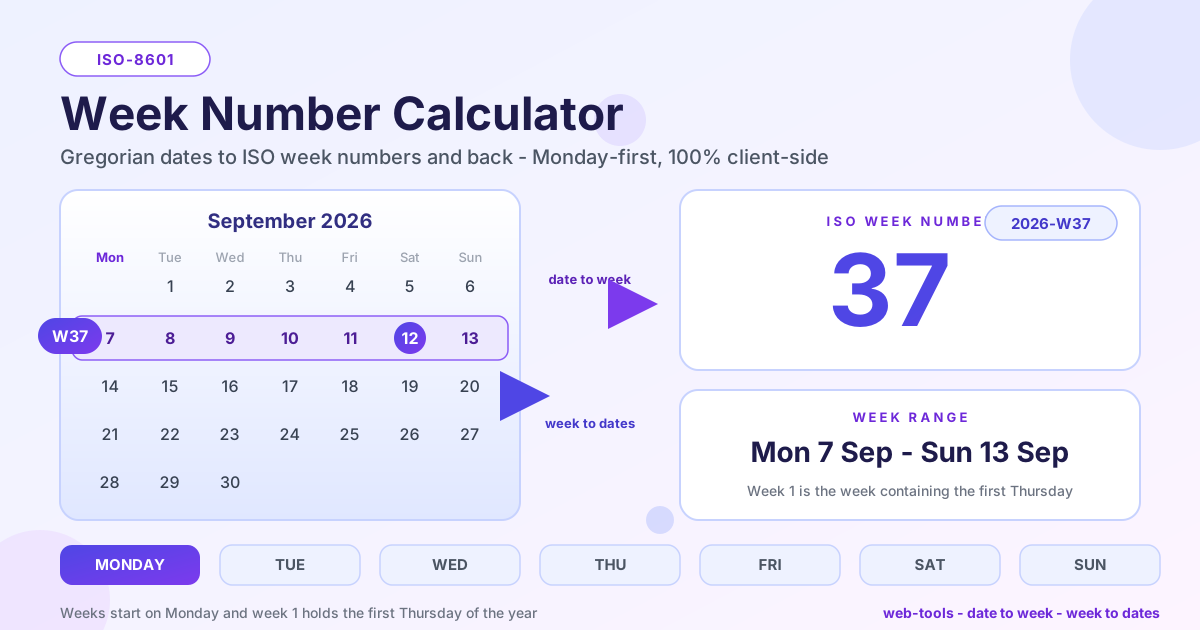
Table of Contents
Week Number Calculator: Convert Dates to ISO-8601 Weeks and Back
Ask ten teams which week September 12 falls in and you may get two answers — a week number only means something once everyone agrees on the rules. Under ISO-8601, September 12, 2026 is week 37, running Monday, September 7 through Sunday, September 13. The Week Number Calculator applies those rules instantly: pick any Gregorian date to get its ISO week number and week-year, or type a code like 2026-W37 to get the exact Monday-to-Sunday range it covers.
Why does this matter? Sprint plans, release trains, factory schedules, payroll calendars, and academic timetables all lean on week numbers — and each breaks silently when two people read "week 1" differently. Days at the end of December can belong to week 1 of the next year, while the first days of January can still belong to the previous year's last week. Guessing those boundaries by hand is how scheduling bugs are born. This guide covers both directions, the boundary rules, and real-world uses — all 100% client-side.
Why Use the Week Number Calculator?
- Correct ISO-8601 semantics by default. Weeks start on Monday, and week 1 is the week containing the first Thursday of the year — not loose "days divided by seven" math.
- Bidirectional conversion. Date-to-week answers "which week is March 3?" while week-to-date answers "which days does 2026-W09 cover?"
- Full week codes, not bare numbers. You get 2026-W37, week-year included — the part people forget to record and the part that makes week 1 unambiguous.
- Boundary dates handled honestly. December 29–31 can map to week 1 of next year; the tool reports what the standard says.
- Valid ranges up front. It knows 52-week versus 53-week years and rejects impossible entries like week 53 in a 52-week year.
- Private and instant. All math runs locally in your browser — no upload, no signup, no limits.
Key Features
| Feature | What it does |
|---|---|
| Date-to-week mode | Convert any Gregorian date to its ISO week number, week-year, and weekday |
| Week-to-date mode | Convert a week-year and week number into a Monday-to-Sunday date range |
| ISO week code | Shows the full standard code, for example 2026-W37 |
| Week validation | Distinguishes 52-week and 53-week years and rejects invalid week numbers |
| Boundary handling | Applies the first-Thursday rule at every December and January edge |
| 100% client-side | All calculations run in your browser; nothing is uploaded |
The week code is the star output: 2026-W37 is compact, sortable, and safe in a sprint name or batch label. Validation matters too — some years have 53 ISO weeks, and hardcoding 52 eventually schedules work into a week that does not exist.
How to Use the Week Number Calculator
- Open the tool. It loads instantly in any modern browser, and every computation runs locally.
- Choose your direction. Use date-to-week when you have a calendar date; use week-to-date when you have a code like 2026-W37.
- Enter your input. Select the Gregorian date, or type the week-year and week number as separate values so the week-year is captured explicitly.
- Read the result. Date-to-week returns the week number, week-year, weekday, and Monday-to-Sunday range; week-to-date returns the exact start and end dates.
- Copy and use the code. Paste the YYYY-Www code or date range anywhere — anyone using ISO-8601 reads it identically.
ISO-8601 Week Rules That Trip Everyone Up
The standard looks simple and hides three rules behind endless calendar bugs.
Rule one: weeks start on Monday. ISO-8601 ignores Sunday-first calendars. Every ISO week is exactly Monday through Sunday, no partial weeks. Sunday-first spreadsheets are not producing ISO week numbers and will disagree for most dates.
Rule two: week 1 contains the first Thursday. Equivalently, week 1 is the first week with four or more days in the new calendar year. That anchor guarantees week 1 always contains January 4, and it means the ISO week-year is not always the calendar year.
Rule three: the week-year can disagree with the calendar year. Because weeks are indivisible blocks, a year's final Monday-to-Wednesday can be claimed by the next year as week 1, and its first Friday-to-Sunday can still belong to the previous year. Store the week-year, not the calendar year, with every week code.
Worked examples:
- December 29–31, 2025. January 1, 2026 is a Thursday, so week 1 of 2026 runs Monday, December 29, 2025 through Sunday, January 4, 2026. Those December days are 2026-W01, even though the calendar year says 2025.
- January 1–3, 2027. January 1, 2027 is a Friday, so the first Thursday of 2027 falls on January 7 and week 1 starts Monday, January 4. The first three days of 2027 belong to 2026-W53, a 53-week year.
- December 31, 2020 to January 3, 2021. All four days sat inside 2020-W53 — logging January 1–3 as "2021 week 1" is off by a year and a week.
US versus ISO confusion. North American convention typically starts weeks on Sunday and defines week 1 as containing January 1. Excel's default WEEKNUM is Sunday-first while ISOWEEKNUM follows the standard, so "week 1" can mean three different weeks. Stating ISO-8601 explicitly is the only reliable fix.
Practical Use Cases
Sprint planning and week-numbered releases
Agile teams compress "the sprint starting Monday, September 7" into 2026-W37 — short enough for a branch name or release tag. Platforms that ship weekly use the code as the release identifier, keeping release notes sortable as plain text.
Manufacturing and logistics week codes
Factories, food producers, and distributors stamp week codes on everything: a carton marked 2026-W37 was packed in ISO week 37, and shelf-life offsets can be verified at a glance. A pallet logged under the wrong week-year can trip an audit or a recall trace.
Payroll weeks
Payroll periods anchor to week numbers, and the boundary rules decide which period the last days of December fall into — changing the reporting year for taxes and accruals. Checking those days in the converter takes seconds and prevents painful corrections.
Academic terms and reporting periods
Universities key timetables to ISO weeks — "teaching begins in week 36" — and reporting teams slice dashboards into ISO weeks so every period is exactly seven days. Converting term dates to week numbers and back keeps calendar and curriculum aligned.
Best Practices
- Always state ISO-8601 when sharing a week number. "Week 37" is ambiguous; "ISO-8601 2026-W37" is not.
- Store the week-year, not the calendar year. The full 2026-W01 code classifies December boundary rows correctly forever.
- Verify boundary dates every December. Convert December 28–31 and January 1–3 explicitly before finalizing anything that crosses a year.
- Remember some years have 53 weeks. Validate against the year rather than assuming 1–52.
- Keep one convention across tools. If your spreadsheet is Sunday-first and your board is ISO, standardize on ISO.
- Use the full code in identifiers. Prefer 2026-W37 over bare 37 in tags and file names — it sorts correctly and survives context loss.
Start Converting Dates to Weeks
Whether you are naming a sprint, printing production codes, or closing a payroll year, the Week Number Calculator gives you standards-correct answers in both directions, entirely on your own device. Open it, convert a boundary date, and see how much cleaner week-based planning becomes.
Related Tools You Might Like:
- Business Days Calculator — count working days between dates, skipping weekends and holidays.
- Date Format Converter — reformat dates between ISO-8601, US, European, and timestamp styles.
- Age Calculator — compute exact age in years, months, and days from any birth date.
Weeks are just weeks — until two calendars disagree. With ISO-8601 on your side, every week number you write will mean exactly the same seven days.
Frequently Asked Questions
Q: What is an ISO-8601 week number?
A: It is the number of the week within a year under ISO-8601, where every week runs Monday through Sunday and week 1 is the week containing the first Thursday of the year. Each week also carries a week-year, giving codes like 2026-W37.
Q: Why can December dates belong to week 1 of the next year?
A: Because ISO weeks are indivisible Monday-to-Sunday blocks. If the week containing December 29–31 also contains a Thursday in January, it counts as week 1 of the new year, so those December days carry the next year's week-year.
Q: How do I know whether a year has 52 or 53 ISO weeks?
A: A year has 53 ISO weeks when January 1 falls on a Thursday, or on a Wednesday in a leap year. The tool validates automatically and rejects a week 53 entered for a 52-week year.
Q: Does the calculator upload my dates anywhere?
A: No. All conversions run 100% client-side in your browser — no date or keystroke ever leaves your device.