BAC Calculator: Estimate Your Blood Alcohol Content Over Time
Use the free BAC Calculator to estimate blood alcohol content over time with the Widmark formula, including time-to-zero projections and legal-limit thresholds.
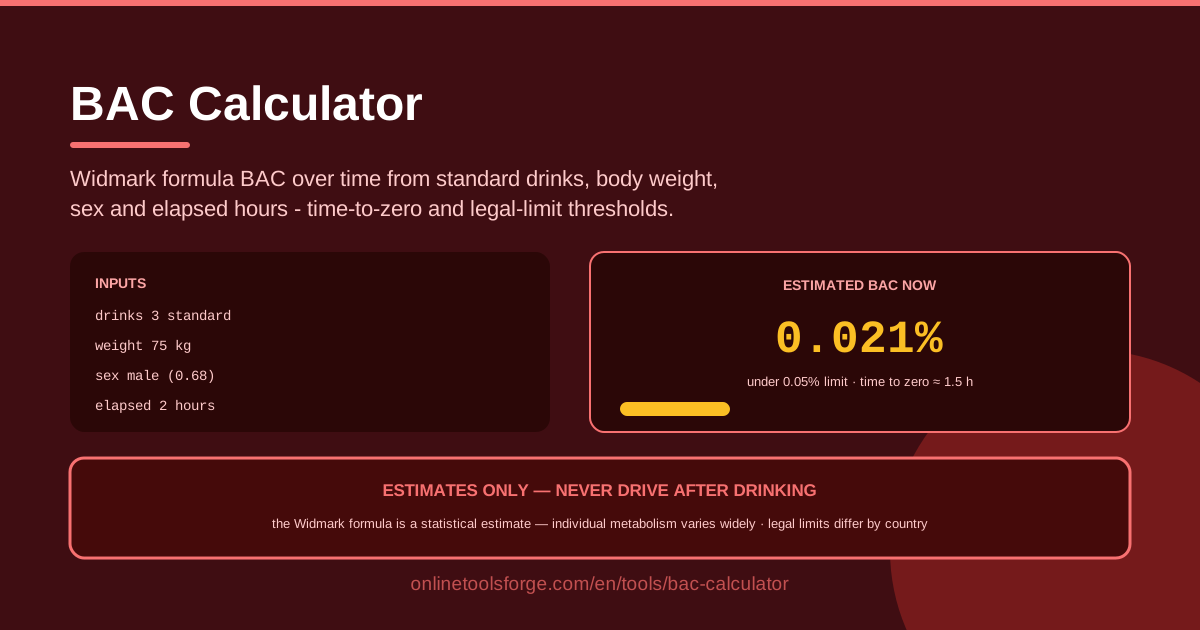
Table of Contents
Whether you are planning a night out, hosting friends, or simply curious about how alcohol moves through the body, the BAC Calculator gives you a fast, private way to estimate your blood alcohol content over time. Enter the number of standard drinks you have had, your body weight, your sex, and how many hours have passed, and the tool applies the Widmark formula to project your estimated BAC — and when it should reach zero.
The Widmark formula has been used by toxicologists, driver-education programs, and health professionals for decades. It is not a breathalyzer and cannot measure you directly, but as an educational estimate it clearly shows how drinks, body size, sex, and time shape impairment and recovery.
This guide covers how to use the calculator, how the math works under the hood, and how to interpret the results responsibly. Every number the tool shows is an estimate, and the app says so plainly with a prominent disclaimer.
Why Use BAC Calculator?
- Instant answers with no signup. Open the page, type a few numbers, and see results immediately — no accounts, no downloads, no waiting.
- Grounded in established science. The Widmark formula is among the most cited models in alcohol pharmacokinetics, used in classrooms and research for generations.
- See the full timeline, not just a snapshot. The tool projects BAC hour by hour and estimates your time-to-zero, so you can see the whole evening and the morning after.
- Understand legal-limit thresholds. Common per se limits such as 0.05% and 0.08% are marked for reference so you can see how far an estimate sits from typical legal boundaries.
- Completely private, client-side math. Every calculation runs in your browser. Nothing you type is uploaded, stored, or shared.
- A practical tool for honest planning. Seeing the numbers laid out makes it easier to arrange a designated driver or rideshare early.
Key Features
| Feature | What it does |
|---|---|
| Standard drink input | Counts the standard drinks you have consumed |
| Body weight field | Scales the estimate, because alcohol distributes through body mass |
| Sex selection | Applies the correct Widmark distribution ratio |
| Elapsed hours | Subtracts alcohol your body has already metabolized |
| BAC over time | Projects your estimated blood alcohol content hour by hour |
| Time-to-zero projection | Estimates when your BAC likely reaches 0.00% |
| Legal-limit markers | Flags common thresholds such as 0.05% and 0.08% |
| Estimates-only disclaimer | Keeps the limits of the math visible at all times |
A few details are worth calling out:
- Everything runs entirely client-side, so the tool works offline once loaded and never sends inputs anywhere.
- The standard drink convention assumes about 14 grams of pure alcohol per drink — roughly one 12 oz beer at 5%, a 5 oz glass of wine at 12%, or a 1.5 oz shot at 40%.
- The legal-limit markers are educational reference points, not legal advice.
How to Use BAC Calculator
- Count your standard drinks. Tally what you actually consumed — a large craft beer or stiff mixed drink can equal more than one standard drink.
- Enter your body weight and sex. These determine how alcohol distributes through your body, so accurate values matter for a realistic estimate.
- Set the elapsed hours. Enter how many hours have passed since you began drinking; the calculator subtracts the alcohol already processed in that window.
- Read your estimated BAC and time-to-zero. Check the projected percentage against the legal-limit markers and note the estimated time until it reaches zero.
- Heed the disclaimer. The result is a rough estimate for education only — never a measurement, and never a green light to drive.
How the Widmark Formula Works
The Widmark formula estimates BAC as the alcohol consumed, divided by how much body mass it disperses into, minus what the body has eliminated since. In simplified form:
BAC ≈ (grams of alcohol ÷ (r × body weight in grams)) × 100 − (0.015 × hours)
Each component matters:
- Drinks convert to grams of alcohol. One standard drink contains about 14 grams of pure alcohol, so three drinks is roughly 42 grams.
- The distribution ratio (r) depends on sex. Alcohol dissolves into body water; men average about 0.68 and women about 0.55. A lower ratio means the same grams of alcohol produce a higher BAC.
- The metabolism rate is roughly 0.015% per hour. Your liver eliminates alcohol at a fairly steady pace, so every hour subtracts about 0.015 percentage points from your BAC.
Quick example: a 70 kg man (r = 0.68) drinks 3 standard drinks, or 42 grams of alcohol, so 42 ÷ (0.68 × 70,000) × 100 ≈ 0.088%. After two hours of metabolism it falls to roughly 0.058%. Time-to-zero is the current estimate divided by 0.015, so ≈ 5.9 hours.
Why is this an estimate rather than a measurement? Real elimination rates vary widely between individuals, from roughly 0.010% to 0.025% per hour, distribution ratios vary with body composition, and drink strengths are often miscounted. Legal limits also differ by country: the United States uses 0.08% for most adult drivers, much of Europe, Australia, and Canada set 0.05%, and several jurisdictions apply near-zero rules for novice or commercial drivers. Finally, the formula cannot know what you know — whether you ate, what medications you take, your health, your fatigue, or how strong that last cocktail was. Food slows absorption, some medications interact with alcohol, and illness can change elimination.
Practical Use Cases
Understanding Next-Morning Risk
Suppose you finish your last drink at 1 a.m. with an estimated BAC of 0.15%. At about 0.015% per hour, you would not reach zero until late morning — and could still be impaired behind the wheel at 8 a.m. Running the numbers shows why "hangover driving" is a real and common risk.
Planning a Safe Ride Home
The time-to-zero projection makes it obvious that "one more hour" rarely clears several drinks. If the estimate says six hours, the responsible move is a designated driver, rideshare, or transit — decided before the evening starts.
Party-Host Awareness
Hosts can use the calculator to think through their guests' timelines: pacing the bar, serving real food, and having ride options ready before the party ends. It turns vague good intentions into a concrete plan.
Health Education and Awareness
Teachers, workplace-safety trainers, and health educators can run live demonstrations with the tool. Comparing scenarios — same drinks, different weight or sex — makes the science memorable in a way a lecture alone rarely achieves.
Best Practices
- Treat every result as a rough estimate, never a measurement of your actual blood alcohol.
- Never drive after drinking, regardless of what any calculator says.
- When in doubt, do not drive at all — a rideshare is always cheaper than an accident.
- Understand that coffee, cold showers, and food do not speed up metabolism; only time lowers your BAC.
- Count drinks honestly, including pour sizes that exceed one standard drink.
- Add a safety margin to the time-to-zero projection, because individual elimination rates vary.
Ready to see how drinks, body weight, and time actually interact? Open the BAC Calculator, enter a few numbers, and get an instant educational estimate — free, private, and computed entirely on your own device.
Related Tools You Might Like:
- Calorie Deficit Calculator — plan your nutrition and fitness goals with the same no-signup simplicity.
- Unit Converter — quickly convert weight, volume, and other units used in health calculations.
- Refinance Calculator — make clear-headed financial decisions with instant payment comparisons.
Stay safe out there!
Frequently Asked Questions
Q: How accurate is the BAC Calculator? A: It applies a well-established scientific formula, but the result is an estimate, not a measurement. Real elimination rates vary from roughly 0.010% to 0.025% per hour, and food, medication, and health all shift the true number. Treat the output as a rough guide — never as permission to drive.
Q: What counts as one standard drink? A: One standard drink contains about 14 grams of pure alcohol — roughly a 12 oz (355 ml) beer at 5% ABV, a 5 oz (150 ml) glass of wine at 12%, or a 1.5 oz (45 ml) shot of spirits at 40%. Craft beers, strong cocktails, and generous pours often contain more than one standard drink.
Q: Why does sex change the estimate? A: The Widmark formula uses a body-water distribution ratio averaging around 0.68 for men and 0.55 for women. Because alcohol distributes into body water, the same drinks generally produce a higher estimated BAC for a woman of the same weight.
Q: Does coffee, food, or a cold shower sober me up faster? A: No. Only time lowers your BAC, at an average of about 0.015% per hour as your liver metabolizes the alcohol. Coffee may make you feel alert, but your actual blood alcohol level does not drop any faster.