cricket-required-run-rate-calculator: Complete Online Guide, Features & Practical Examples
Learn how to use the free cricket-required-run-rate-calculator in your browser with step-by-step instructions, practical use cases, and expert tips.
Free Interactive Tool
Cricket Required Run Rate Calculator
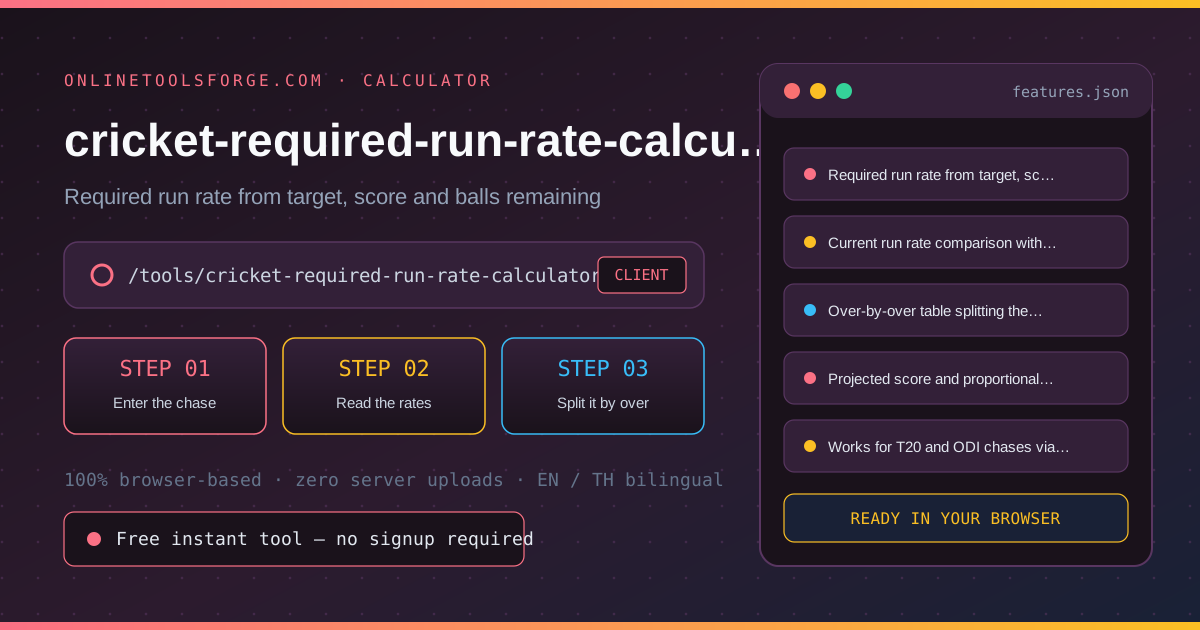
Calculate the required run rate for a cricket chase from target, current score and balls remaining, compare it with the current run rate, and see an over-by-over plan, projected score, proportional par hints and a plain-English verdict.
Table of Contents
The Cricket Required Run Rate Calculator turns any second-innings chase into numbers: runs still needed, the required run rate, your current run rate, an over-by-over plan, a projected finish and a proportional par hint — with a plain-English verdict on whether the chase is ahead of the game or needs accelerating.
Whether you are double-checking numbers on a deadline, validating edge cases, or standardizing a repeatable workflow, the cricket-required-run-rate-calculator gives you an interactive, zero-install workspace directly in your browser. Every calculation and transformation runs locally on your device — no account registration, no paywalls, and no sensitive inputs uploaded to external servers.
In this guide, we walk through why dedicated tooling beats manual back-of-the-envelope work, explore every feature inside the interface, and cover step-by-step instructions alongside real-world scenarios.
Why Use cricket-required-run-rate-calculator?
- Immediate Clarity: Instant required run rate from any chase situation.
- Focused Workflow: Side-by-side comparison with the current run rate.
- Transparent Logic: Over-by-over plan breaks the ask into chaseable chunks.
- Practical Accuracy: Projected score and par hint add context without noise.
- Time-Saving Defaults: Honest labelling: the par guide is proportional, not official DLS.
- 100% Client-Side Privacy: Every operation executes inside your browser session, keeping your data private and responsive even on slow connections.
Key Features
| Feature Area | What It Delivers | Execution Mode |
|---|---|---|
| Capability 1 | Required run rate from target, score and balls remaining | Instant browser execution |
| Capability 2 | Current run rate comparison with a plain-English verdict | Instant browser execution |
| Capability 3 | Over-by-over table splitting the runs still needed into chunks | Instant browser execution |
| Capability 4 | Projected score and proportional par score as context hints | Instant browser execution |
| Capability 5 | Works for T20 and ODI chases via the match-overs field | Instant browser execution |
- Interactive Feedback: Results recalculate on the fly as you adjust inputs, letting you compare multiple scenarios in seconds.
- Bilingual Interface: Switch seamlessly between English and Thai labels whenever you collaborate across multilingual teams.
- Copy & Export Ready: Grab formatted outputs or summaries with one click so you can paste them straight into docs, tickets, or spreadsheets.
How to Use cricket-required-run-rate-calculator
Turn the chase situation into a clear per-over target.
- Open the Tool: Head to the cricket-required-run-rate-calculator in any modern desktop or mobile browser.
- Enter the chase: Type the target, the current score, the overs and balls faced, and the overs and balls left in the innings.
- Read the rates: The calculator shows the runs needed, the required run rate and your current run rate side by side, so you can see the gap instantly.
- Split it by over: Open the over-by-over plan to turn the total into smaller per-over chunks you can actually chase.
- Check the verdict: Use the verdict, the projected score and the proportional par hint to decide whether to rotate strike or start swinging.
Core Concepts & How It Works
Understanding the underlying mechanics helps you interpret the output with confidence. The Cricket Required Run Rate Calculator turns any second-innings chase into numbers: runs still needed, the required run rate, your current run rate, an over-by-over plan, a projected finish and a proportional par hint — with a plain-English verdict on whether the chase is ahead of the game or needs accelerating.
Instead of hiding assumptions behind a single opaque result, the cricket-required-run-rate-calculator surfaces intermediate values and clear labels so you can audit how the final answer is assembled:
- Explicit Input Validation: Boundaries and unit expectations are checked immediately, preventing silent NaN or unit-mismatch bugs.
- Deterministic Output: Given the same inputs, the tool produces identical, reproducible results every time — ideal for team reviews and documentation.
- Edge-Case Visibility: Built-in warnings highlight when inputs approach practical limits or require special interpretation.
Practical Use Cases
1. Planning a T20 chase during the drinks break
When tackling planning a t20 chase during the drinks break, manual spreadsheets and ad-hoc scripts often introduce rounding errors or inconsistent assumptions. With the cricket-required-run-rate-calculator, you can load your exact parameters, inspect the breakdown immediately, and verify how each variable affects the outcome before committing to a decision.
2. Checking what an ODI middle order must do from here
When tackling checking what an odi middle order must do from here, manual spreadsheets and ad-hoc scripts often introduce rounding errors or inconsistent assumptions. With the cricket-required-run-rate-calculator, you can load your exact parameters, inspect the breakdown immediately, and verify how each variable affects the outcome before committing to a decision.
3. Club captains setting per-over targets for their batters
When tackling club captains setting per-over targets for their batters, manual spreadsheets and ad-hoc scripts often introduce rounding errors or inconsistent assumptions. With the cricket-required-run-rate-calculator, you can load your exact parameters, inspect the breakdown immediately, and verify how each variable affects the outcome before committing to a decision.
4. Fans following a live chase and weighing up the ask
When tackling fans following a live chase and weighing up the ask, manual spreadsheets and ad-hoc scripts often introduce rounding errors or inconsistent assumptions. With the cricket-required-run-rate-calculator, you can load your exact parameters, inspect the breakdown immediately, and verify how each variable affects the outcome before committing to a decision.
5. Coaches teaching run-rate maths with real situations
When tackling coaches teaching run-rate maths with real situations, manual spreadsheets and ad-hoc scripts often introduce rounding errors or inconsistent assumptions. With the cricket-required-run-rate-calculator, you can load your exact parameters, inspect the breakdown immediately, and verify how each variable affects the outcome before committing to a decision.
Best Practices
- Start with realistic baseline values before testing extreme edge cases so you have a clear reference point to compare against.
- Verify units and formatting on every input field — many discrepancies come from mixing percentages, decimals, or measurement units.
- Test sensitivity by changing one variable at a time in the cricket-required-run-rate-calculator to see which input has the largest impact on your result.
- Document your assumptions alongside the exported output so teammates can reproduce the exact state later.
- Pair with companion utilities in the same category when your workflow spans multiple conversion or validation steps.
Frequently Asked Questions
Q: What is required run rate in cricket? A: Required run rate is what the batting side still needs: runs required divided by overs remaining. Needing 90 from 8 overs means a required run rate of 11.25. The calculator converts any live situation into that number instantly and puts it next to the current run rate.
Q: How is it different from current run rate? A: Current run rate looks backward: runs already scored divided by overs already bowled. Required run rate looks forward at what the chase still demands. Comparing the two tells you whether you are ahead of the game or falling behind it.
Q: Is the par score official DLS? A: No. The par hint here is a simple proportional guide — the target scaled by the share of overs completed — so you can sense-check a chase at a glance. Real DLS uses resource tables that adjust for wickets in hand and rain interruptions.
Q: Does it work for T20 and ODI chases? A: Yes. Set the match overs to 20 for a T20 or 50 for an ODI, then enter the live situation. The over-by-over plan adapts to whatever overs and balls actually remain, including part overs.
Try cricket-required-run-rate-calculator Today
Ready to streamline your workflow? Open the cricket-required-run-rate-calculator now to run instant, accurate calculations right in your browser — completely free and with zero setup required.
Related Tools You Might Like
Happy building and calculating!