Blood Glucose Converter: Read mg/dL and mmol/L With Confidence
Convert blood glucose between mg/dL and mmol/L, classify readings against ADA fasting and post-meal ranges, and estimate HbA1c from average glucose — free and fully in your browser.
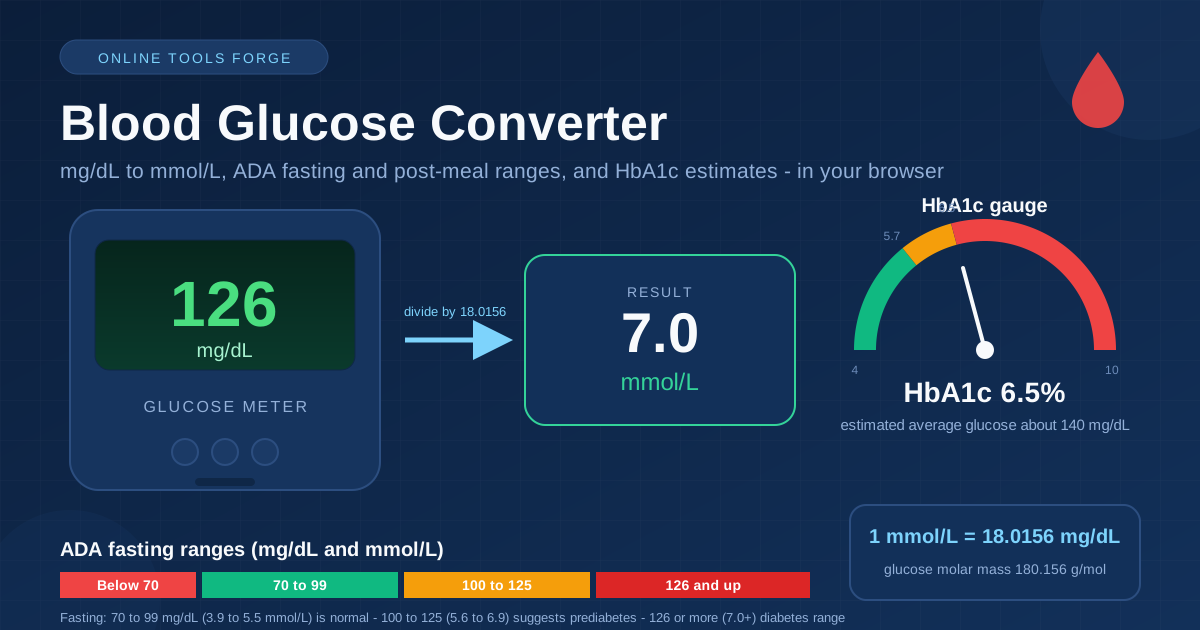
Table of Contents
Blood Glucose Converter: Read mg/dL and mmol/L With Confidence
Blood glucose numbers do not travel well. Meters sold in the United States report readings in milligrams per deciliter (mg/dL), where a typical fasting value looks like 95. Most of the rest of the world uses millimoles per liter (mmol/L), where the same reading shows as 5.3. The scales differ by a factor of about eighteen, and every traveler with diabetes meets this wall sooner or later — a pharmacy in Berlin, a clinic in Tokyo, or a research paper quoting thresholds that look impossibly small next to the numbers on your meter.
The free Blood Glucose Converter closes that gap in seconds. Type a value in either unit and it converts to the other using the precise chemical factor. It also classifies readings against American Diabetes Association (ADA) ranges for fasting, post-meal, and random contexts, estimates HbA1c from average glucose with the ADAG study formula, and runs entirely client-side, so your health numbers never leave your browser.
Why Use Blood Glucose Converter?
- Exact two-way conversion. Converts mg/dL to mmol/L and back using 18.0156 — the true molar-mass factor — not the rough "divide by 18" shortcut common online.
- Context-aware classification. A value of 130 means something different before breakfast than two hours after lunch; pick the context and the matching ADA thresholds apply.
- HbA1c estimation built in. Connects the three-month lab marker to daily meter readings via the ADAG relationship.
- Reference table included. Side-by-side ADA bands in both units — no hunting through guideline PDFs.
- Private by design. 100% client-side: no account, no upload, nothing stored.
- Free and mobile friendly. Works the same on a phone or a laptop.
Key Features
| Feature | What it does | Why it matters |
|---|---|---|
| Two-way conversion | Switches any value between mg/dL and mmol/L instantly | Compare a foreign meter, app, or report against your own numbers |
| Reading context classifier | Applies ADA fasting, post-meal, or random thresholds | The same number can be normal or concerning depending on timing |
| eAG / ADAG estimate | Converts between HbA1c percentage and estimated average glucose | Bridges the lab marker and everyday readings |
| ADA reference ranges | Shows classification bands for fasting and post-meal readings | Immediate context instead of a bare number |
| Client-side processing | All math runs in the browser with no network calls | Sensitive data stays on your device |
Two details matter most: the conversion uses 18.0156 mg/dL per mmol/L rather than a rounded constant, and classifications update the moment you change the reading context, so fasting and post-meal results are never judged by the wrong yardstick. The interface stays minimal, which counts when checking values in a stressful moment.
How to Use
- Open the Blood Glucose Converter in your browser. No sign-up or download is needed.
- Enter your glucose value and select the unit your meter or lab report uses — mg/dL or mmol/L.
- Choose the reading context: fasting, post-meal, or random. This tells the tool which ADA thresholds to apply.
- Read the converted value and its classification side by side. For the longer-term picture, enter an average glucose to see the estimated HbA1c, or the reverse.
- Cross-check the displayed ADA reference table, then copy the value into your log or travel notes.
Two Units, Two Worlds
The factor of eighteen comes from chemistry. mg/dL measures the mass of glucose in a fixed volume of blood, while mmol/L counts molecules. Moving between mass and molecule count requires the molar mass of glucose: 180.156 grams per mole. One millimole per liter therefore weighs 180.156 milligrams per liter — a deciliter being a tenth of a liter — so 1 mmol/L equals 18.0156 mg/dL. That is why 126 mg/dL converts to almost exactly 7.0 mmol/L, and why 5.5 mmol/L comes out at about 99 mg/dL.
Context changes the interpretation; the ADA publishes separate thresholds:
- Fasting (no food for at least 8 hours): 70–99 mg/dL (3.9–5.5 mmol/L) is considered normal; 100–125 mg/dL (5.6–6.9 mmol/L) falls in the prediabetes range; 126 mg/dL (7.0 mmol/L) or higher on a confirmatory test is in the diabetes range.
- Post-meal (about 2 hours after eating): below 140 mg/dL (7.8 mmol/L) is considered normal; 140–199 mg/dL (7.8–11.0 mmol/L) suggests a prediabetes-level response; 200 mg/dL (11.1 mmol/L) or higher is in the diabetes range.
HbA1c turns these snapshots into a moving picture. The ADAG study established a linear relationship between HbA1c and estimated average glucose (eAG): eAG in mg/dL = 28.7 × HbA1c − 46.7. For an HbA1c of 7.0%, that gives 28.7 × 7.0 − 46.7 = 154.2 — an estimated average glucose of about 154 mg/dL, or roughly 8.6 mmol/L. In reverse, 140 mg/dL maps to an HbA1c of about 6.5%.
Important: this tool is not medical advice. It is a unit converter and calculator, not a diagnostic device. Its classifications are general population references, not your individual targets or treatment plan. Always interpret readings — especially converted ones — with a qualified healthcare professional, and never change treatment based on a web tool.
Practical Use Cases
Traveling With a Meter
You land in Tokyo with a meter set to mg/dL, and the local pharmacy quotes everything in mmol/L. A quick conversion keeps the conversation grounded: your usual 110 mg/dL fasting reading is about 6.1 mmol/L, stated without doing arithmetic while jet-lagged. The same applies in reverse for visitors to the United States.
Reading Foreign Research and Apps
International studies, CGM apps, and diabetes communities often quote targets in mmol/L. When a European guideline says "keep post-meal values below 7.8," converting to the familiar "below 140" makes the advice concrete; the reference table lets you sanity-check any figure at a glance.
Understanding Lab Reports
If a lab uses a different unit than your home meter, results can look alarming or reassuring purely because of the scale. Converting the lab value into your meter's unit gives a like-for-like comparison, and the eAG estimate shows whether a new HbA1c percentage matches your logbook averages.
Supporting a Loved One as a Caregiver
Caregivers juggle a relative's meter, a clinic portal, and educational material from different countries. A shared instant converter removes one source of confusion and helps you phrase questions precisely: "his fasting reading is 118 mg/dL, which the chart calls prediabetes range — is that expected?"
Best Practices
- Confirm which unit your meter uses before converting. Guessing the unit is the most common way to misread glucose by a factor of eighteen.
- Never change medication based on a conversion alone. Conversions translate units; they do not validate a reading or replace clinical judgment.
- Log readings consistently in one unit, and annotate any temporary switch so later comparisons stay meaningful.
- Round sensibly. mmol/L values use one decimal place; treat 6.9948 as 7.0.
- Use the right context when classifying. Fasting thresholds applied to post-meal readings label normal results as problems.
- Treat HbA1c estimates as approximations. ADAG is a population average; anemia and similar conditions can shift real values.
Ready to Convert Your Next Reading?
Whether you are packing for a trip, decoding a lab report, or comparing an international app against your meter, the Blood Glucose Converter delivers an exact answer, an honest classification, and an HbA1c estimate in one private, browser-based page. Bookmark it before your next appointment.
Related Tools You Might Like:
- BMI Calculator — check your body mass index alongside your glucose goals.
- Calorie Calculator — estimate daily energy needs to support your eating plan.
- Water Intake Calculator — work out a sensible daily hydration target.
Happy converting — and safe, well-informed travels!
Frequently Asked Questions
Q: Why are mg/dL numbers always so much larger than mmol/L numbers?
A: Because the two units measure different things — mass per volume versus molecule count per volume. Dividing mg/dL by 18.0156 (approximately 18) gives mmol/L, so a "big" number like 180 mg/dL is simply 10.0 mmol/L.
Q: The tool uses 18.0156, but I have always divided by 18. Does it matter?
A: For everyday readings the difference is negligible — a few tenths of a mg/dL. Glucose's molar mass is 180.156 g/mol, so 18.0156 is the precise factor; the rounded 18 is fine for mental math, while the tool uses the exact value for accuracy at extreme readings.
Q: Can the Blood Glucose Converter diagnose diabetes or prediabetes?
A: No. The classifications are general ADA reference ranges for education only. Diagnosis requires laboratory tests and a healthcare professional. Use the tool to understand numbers, not to label yourself.
Q: How accurate is the HbA1c estimate from average glucose?
A: It is based on the ADAG study formula, an average across large populations. Individual HbA1c can deviate due to red blood cell turnover, anemia, or hemoglobin variants, so treat it as an approximation and rely on laboratory values for clinical decisions.
Q: Does the converter store or send my readings anywhere?
A: No. All calculations run client-side in your browser, and nothing is uploaded, logged, or saved. Closing the tab erases everything you entered.