Buddhist Era Converter: Turn Thai Years (พ.ศ.) into CE Years in Seconds
Free Buddhist Era (พ.ศ.) to Gregorian (CE) converter. Convert Thai Buddhist years and full dates to AD years and back — always exactly 543 years apart, 100% client-side.
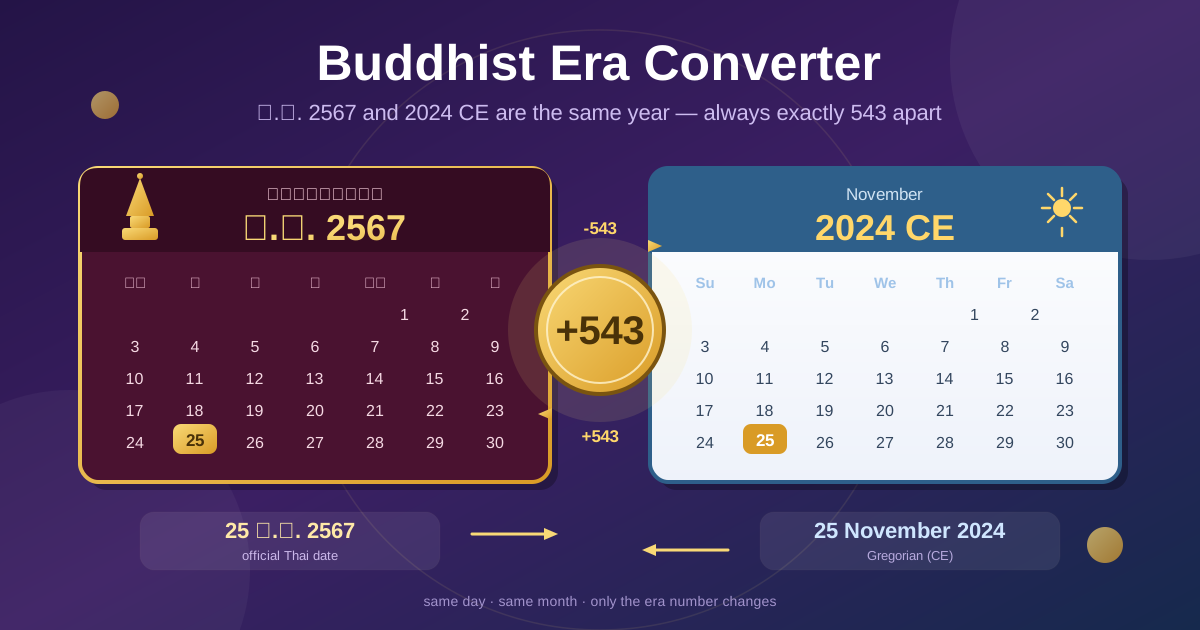
Table of Contents
Buddhist Era Converter: Turn Thai Years (พ.ศ.) into CE Years in Seconds
If you have ever held a Thai contract, invoice, or copy of a national ID card, you have met dates like "25 พฤศจิกายน 2567" and paused. That is not a typo and not a date from the future. It is a Buddhist Era (พ.ศ., short for พุทธศักราช) year, and it corresponds to 2024 CE. Our Buddhist Era Converter resolves this instantly, translating พ.ศ. years into Gregorian (ค.ศ./CE) years and back with the exact 543-year offset — right in your browser.
The mismatch trips up far more than curious travelers. Accounting software rejects Thai invoice dates as invalid; HR systems flag "2567" as an impossible birth year. The reverse happens too: a Thai reader scanning "2024" on an English lease must stop and do the math. Manual arithmetic sounds easy — add 543, subtract 543 — but under time pressure it is exactly where mistakes are born.
Why Use the Buddhist Era Converter?
- It eliminates arithmetic under pressure. One subtraction sounds trivial — until you are signing a lease and second-guess the offset. The converter answers in one glance, every time.
- It converts in both directions. Buddhist Era to Gregorian and back from the same input box — no mode to fumble for.
- It handles full dates, not just years. Enter a full Thai date such as 25 พฤศจิกายน 2567 and the tool parses the Thai month name, returning the full date in the other era.
- The math is fixed and provable. The two eras are always exactly 543 years apart — no lookup tables, no edge cases for modern dates.
- It is 100% client-side. Conversion happens in your browser; contract dates and ID numbers never leave your device.
- It is free and frictionless. No sign-up, no limits, no installs. Open the page, convert, move on.
Key Features
| Feature | What It Does | Why It Matters |
|---|---|---|
| Two-way พ.ศ. ↔ ค.ศ. conversion | Convert Buddhist Era years to Gregorian years and back | One tool covers both directions |
| Fixed +543 offset | Applies the exact constant separating the eras | Correct results for every modern year |
| Full-date conversion | Parses Thai month names such as พฤศจิกายน (November) | Contracts carry full dates, not just years |
| Day, month, year output | Returns a complete readable date in the target era | Drop the result straight into a form or letter |
| 100% client-side processing | Everything runs in your browser | Sensitive dates stay private on your device |
The full-date support matters more than it looks: most legal documents carry day, month, and year, and matching Thai month names by hand is slow and error-prone. Since day and month are identical in both eras, only the year changes — every result is verifiable against a known pair such as 2567 = 2024.
How to Use the Buddhist Era Converter
- Open the tool. Open the Buddhist Era Converter page in any modern browser.
- Pick your direction. Enter a พ.ศ. year to get ค.ศ., or a CE year to get พ.ศ. — both directions work in the same field.
- Enter the year or full date. Type the year alone, or paste a full date including the Thai month name, such as 25 พฤศจิกายน 2567.
- Read the result. The converted day, month, and year appear immediately — for that example, 25 November 2024.
- Sanity-check and continue. Verify against a known pair (2567 ↔ 2024), then convert the next date — there are no limits.
Why 543?
The Buddhist Era does not count from the birth of Christ, as the Gregorian calendar does. It counts from the passing — the parinibbana — of Gautama Buddha, which Thai tradition places in 543 BCE, so the Buddhist Era year number runs exactly 543 ahead of the Common Era number: BE = CE + 543, and CE = BE − 543. The years 2567 BE and 2024 CE describe the same twelve months.
Two clarifications make the system click. First, day and month never change. 25 พฤศจิกายน 2567 and 25 November 2024 are the same physical day; only the era label differs. There is no calendar shift as in lunar-to-solar conversions, and since 1941 Thailand has started its year on 1 January, so modern dates line up perfectly.
Second, mind the edge cases. Pre-1941 documents may reflect the old Thai new year in April, and older records sometimes use other eras such as the Rattanakosin Era (ร.ศ.), which fall outside the +543 rule.
Where will you meet each system? The Buddhist Era dominates Thai domestic life — ID cards, house books, contracts, invoices and receipts, newspapers, school certificates, government forms. The Gregorian year (ค.ศ.) dominates international contexts: passports show both, multinational contracts dual-date clauses, and software defaults to CE. Neither label is wrong — they are two names for the same timeline, which is why confusion flourishes at the boundary.
That confusion produces classic century mix-ups. Seeing "2567", a Western reader assumes a distant future; seeing "2500" on a Thai certificate, they might imagine the twenty-fifth century when it is really 1957.
Practical Use Cases
Reading Thai Contracts and Invoices Abroad
Freelancers, importers, and landlords routinely receive Thai paperwork — tax invoices, service agreements, lease contracts — with every date in พ.ศ. Before filing an invoice in foreign accounting software or disputing a payment term, convert the dates so your records match the source. A one-year error on a payment deadline is an expensive discovery.
Immigration and Visa Paperwork
Visa applications, work permits, and embassy questionnaires often demand a specific era: Thai-side forms ask in พ.ศ., while consular forms frequently want CE. Convert each date into the era the form requires before writing anything, and double-check birth dates and entry stamps — those fields are cross-checked against passport records.
Booking and Reservation Systems
Hotel confirmations, tickets, and reservations generated inside Thailand may print พ.ศ. dates while the platform stores CE. When a booking says 3 มีนาคม 2569, confirm it means 3 March 2026 before rearranging a trip. The same applies to warranty and expiry dates on Thai-issued cards.
Genealogy and History Research
Family historians working with Thai registers and certificates constantly bridge the two eras. Converting ancestors' life events from พ.ศ. into CE lets you align Thai records with foreign censuses, military files, and newspapers — a document dated 2500 BE, once translated to 1957, suddenly fits the broader story.
Best Practices
- State the era explicitly. When you write or issue a date, label it พ.ศ. or CE rather than relying on context — a four-digit year alone is genuinely ambiguous.
- Watch two-digit years. Shorthand like "67" could be 2567 BE or 2067 CE. Convert to full four-digit years before storing or comparing anything.
- Verify before you sign. Convert every date on a contract or form and confirm they match your expectations. Thirty seconds of checking beats months of dispute.
- Remember the pre-1941 quirk. For historical dates before 1941, the Thai new year began in April, and older records may use other eras. Apply the +543 rule only to modern dates.
- Keep one era inside your systems. Store dates in CE in databases, and display พ.ศ. only in Thai-facing output. Mixing eras in raw data breeds long-term bugs.
- Re-read the document after converting. A single converted date can change the meaning of a clause — a delivery window, an age limit, a validity period. Convert all of them, then read again with fresh eyes.
Convert Thai Dates with Confidence
The two calendars sit a fixed 543 years apart — yet that constant hides in contracts, invoices, IDs, and visas where mistakes are costly. The Buddhist Era Converter closes the gap in one glance, both ways, for years and full dates alike, entirely on your own device. Open it now and never pause at a Thai date again.
Related Tools You Might Like
- Date Format Converter — Rearrange dates between DD/MM/YYYY, MM/DD/YYYY, ISO 8601, and other formats once the era is settled.
- Unix Timestamp Converter — Translate dates into machine-friendly Unix time and back for developers and log analysis.
- Thai Postcode Lookup — Find Thai postal codes by province, district, and sub-district for accurate addressing.
Happy converting!
Frequently Asked Questions
Q: Is the offset always exactly 543 years?
A: Yes, for all modern dates. The Buddhist Era year equals the CE year plus 543, without exception after Thailand standardized its calendar in 1941; only pre-1941 records, when the Thai new year began in April, need extra care.
Q: Do the day and month change when I convert a date?
A: No. Both eras describe the same days and months; only the year number differs. 25 พฤศจิกายน 2567 and 25 November 2024 are the same day, so only the year changes.
Q: What does พ.ศ. actually stand for?
A: พ.ศ. abbreviates พุทธศักราช, meaning Buddhist Era. It counts years from the passing of Gautama Buddha, placed by Thai tradition in 543 BCE; ค.ศ. (คริสต์ศักราช) is the Common Era of the Gregorian calendar.
Q: Why does Western software keep rejecting Thai dates?
A: Most software assumes the Gregorian calendar and validates year ranges. A year like 2567 sits far outside the expected range, so the date looks invalid or futuristic. Convert to CE before entering it into international systems.