Canal Boat Cost Calculator: Plan Your Narrowboat Budget Before You Buy
Use the free Canal Boat Cost Calculator to estimate annual narrowboat living costs — mooring, licence, insurance, diesel, pump-out, blacking, safety certificate and maintenance reserve — with a clear monthly breakdown.
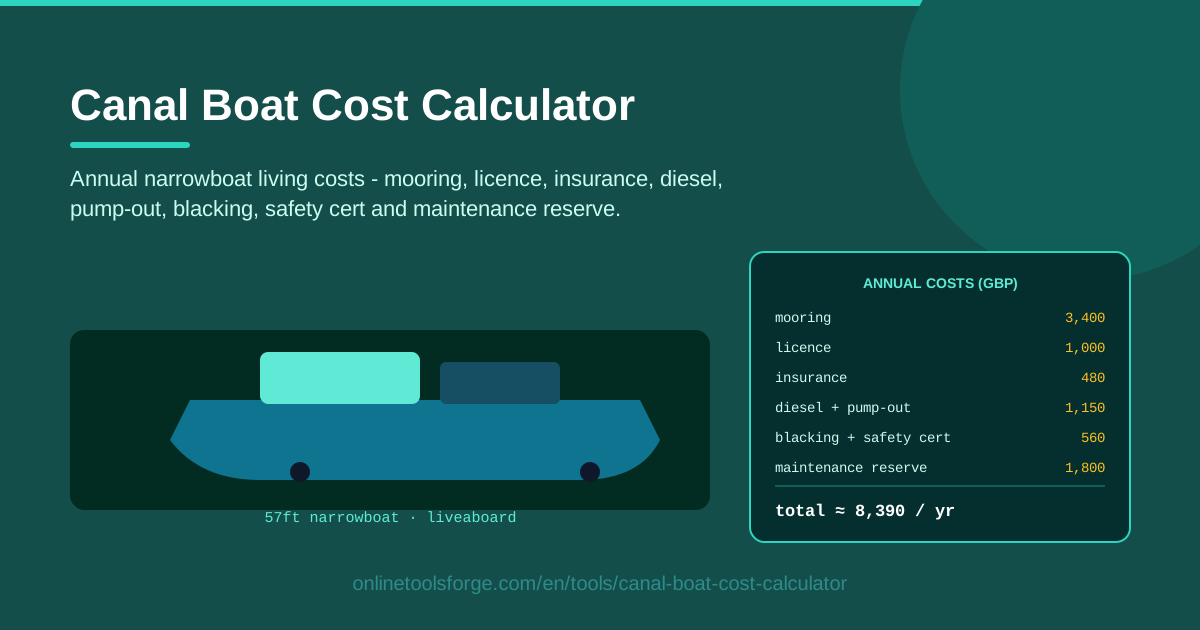
Table of Contents
Living aboard a narrowboat is one of the most romantic ideas in Britain: waking to herons on the towpath, moving house by turning an ignition key, and leaving steep rents behind. But the romance comes with a price list far longer than the boat brochure admits. That is why we built the Canal Boat Cost Calculator, a free browser-based tool that estimates your true annual narrowboat living costs — mooring, licence, insurance, diesel, pump-out, hull blacking, safety certificate and maintenance reserve — and turns it all into a monthly figure you can plan around.
Most budgeting advice stops at "moorings and diesel." In reality a canal boat behaves like a house and a car fused together, with recurring costs that never appear in the brochure — and when two or three land in the same quarter, they can wreck an otherwise sensible budget.
The Canal Boat Cost Calculator puts every major cost line on one screen. Pick a usage preset, enter your boat size and mooring type, and it produces an itemised annual total plus a monthly breakdown in seconds — entirely client-side, no sign-up required.
Why Use Canal Boat Cost Calculator?
- It surfaces the costs first-timers forget. Pump-outs, blacking, safety certificate renewals and a maintenance reserve are missing from most back-of-envelope budgets — together they total thousands of pounds a year.
- Usage presets do the estimating. Pick cruiser or continuous cruiser and the tool tailors diesel and cruising costs to how you plan to live.
- The monthly breakdown matches real life. Few people budget in annual sums; a monthly figure can be tested directly against your salary, pension or savings.
- It makes the mooring factor explicit. Mooring is the biggest line in most budgets and varies hugely by region — a visible assumption is one you can challenge.
- Instant and private. Everything runs client-side in your browser: no uploads, no account, and results update as you tweak the numbers.
- Better decisions before you spend. A realistic annual figure is the difference between affordable and an expensive lesson.
Key Features
| Feature | What it does |
|---|---|
| Annual cost estimate | Combines mooring, licence, insurance, diesel, pump-out, blacking, safety certificate and maintenance reserve into one yearly total |
| Usage presets | Cruiser and continuous cruiser modes tailor diesel and cruising costs to your style of boating |
| Boat size and mooring inputs | Scales costs by boat length and mooring type, from full-service marina to basic mooring |
| Itemised cost lines | Shows each category separately so you can question assumptions line by line |
| Monthly breakdown | Converts the annual estimate into a monthly amount for real-world budgeting |
| Client-side engine | All calculations run in your browser — fast, private and available offline once loaded |
- The itemisation is the point. Two boats with identical totals can hide different risks: one a big mooring fee and modest maintenance, the other the reverse. Separate lines show what is negotiable and what is fixed.
- The maintenance reserve deserves attention. It looks like padding, but it keeps a failed alternator or battery bank from becoming a crisis.
How to Use Canal Boat Cost Calculator
- Pick your usage preset. Choose cruiser if the boat sits on a mooring and is used for holidays, or continuous cruiser if you plan to live aboard and keep moving. This drives diesel and cruising-related costs.
- Enter boat size and mooring type. Longer boats cost more to moor, licence, black and insure, so enter the length you are considering and the kind of mooring you want.
- Review each cost line. Work down the list — mooring, licence, insurance, diesel, pump-out, blacking, safety certificate, maintenance reserve — and replace defaults with real quotes wherever you have them.
- Read the monthly breakdown. Does this figure fit alongside your other commitments? It is the number that decides whether liveaboard life feels comfortable or stressful.
- Adjust and compare scenarios. Change region, switch presets or lengthen the boat, then recalculate. Comparing scenarios in minutes beats weeks of forum reading.
The Costs Nobody Puts in the Brochure
Mooring: the biggest line, and the most regional. A full-service marina berth within commuting distance of London can cost several times more than a basic mooring on a quiet northern canal. Facilities — electricity, water, laundry, on-site pump-out, security — push prices up further. Before you fall in love with a boat, fall in love with a mooring and get a written quote; waiting lists in popular areas are real.
Licence: priced in bands. Every boat on Canal & River Trust waters needs a licence, banded by boat length, with a separate continuous cruiser licence for boats without a home mooring. It is a legal requirement, not an optional extra — which is why the calculator includes it automatically.
Insurance: small but unavoidable. Third-party cover is cheap and required by most marinas and by the CRT for continuous cruisers; comprehensive cover that specifies your equipment costs a little more but protects a significant asset.
Diesel: propulsion is only half the story. A cruiser doing a few weekends a year burns surprisingly little; a liveaboard heating through winter can burn more diesel in the stove than in the engine. This is where the usage preset earns its keep — January continuous cruising looks nothing like July holiday cruising.
Pump-out and blacking: the unglamorous cycles. A liveaboard empties the holding tank every one to two weeks at a fee each time — small sums that quietly become a three-figure annual total. Hull blacking is needed every two to three years, whether a boatyard slips the boat or you do it yourself.
Safety certificate: the four-year check-up. The Boat Safety Scheme certificate is required for licensing and renewed every four years. Spread the survey fee across the years in between, and keep a contingency for remedial work — older boats often need small fixes to pass.
The maintenance reserve is not optional. Engines, batteries, alternators, stern glands, pumps and roofs all fail eventually, usually at the worst moment. A common rule of thumb is to set aside five to ten per cent of the boat's value each year. Skipping this reserve is the most common way new liveaboards get caught out.
Practical Use Cases
Planning a Liveaboard Switch
You rent a flat and want to know whether a boat would genuinely cost less. Enter your candidate boat length with a marina mooring and the cruiser preset, then switch to continuous cruiser and compare. Many find the monthly figure beats the rent — but only once pump-outs, blacking and the reserve are included, exactly what a naive comparison misses.
Marina Mooring Versus Continuous Cruising
Put a full-service marina scenario side by side with a continuous cruiser licence. The mooring saving is dramatic, but diesel, laundry, water access and travel costs rise. Running both scenarios in minutes shows which trade-offs suit your working life — something no single forum post can answer for you.
Budgeting Your First Boat Purchase
If you are saving for a first boat, the calculator reveals the running cost of each length you are considering. A 57-foot boat may cost little more to buy than a 45-footer, but noticeably more to moor, licence and black each year — useful knowledge before you start viewing.
Retirement Planning on the Cut
For a pension-funded liveaboard, the monthly breakdown is the key output. Test it against your pension and savings drawdown, add a margin for winter, and you have an honest answer about sustainability before you sell the house.
Best Practices
- Pad the maintenance reserve. If the calculator suggests £1,200 a year, saving £1,500 turns an emergency into an inconvenience.
- Price the mooring before buying the boat. In popular areas, mooring availability — not boat choice — is the real constraint. Get quotes and join waiting lists early.
- Re-run the costs yearly. Fuel, licence and mooring prices move; refreshing your numbers keeps the budget honest.
- Keep a repair log. Record every job and every pound. After two or three years you will know your boat's real costs better than any tool — and can feed those numbers back in.
- Overestimate winter. Heating, pump-outs and condensation all spike between November and March. Budget for the hard months, not the average.
- Treat the monthly figure as a standing order. Move that amount into a boat account every month; costs arrive in lumps, and the saving habit smooths them.
Planning a move aboard, or simply curious what life on the cut really costs? Run your own numbers with the Canal Boat Cost Calculator — free, instant, and the quickest way to turn a dream into a budget you can defend.
Related Tools You Might Like:
- Yacht Hull Speed Calculator — check how fast a hull can travel efficiently before planning long cruises.
- Monthly Budget Calculator — fit your boat costs into an overall household budget.
- Loan Calculator — work out repayments if you are financing the purchase.
Happy boating!
Frequently Asked Questions
Q: How much does it cost to live on a narrowboat each year? A: It depends mainly on your mooring and how much you cruise, but the honest total covers far more than mooring and diesel: licence, insurance, pump-outs, blacking, safety certificate renewals and a maintenance reserve all belong in it. The calculator gives a personalised annual and monthly figure in under a minute.
Q: Is continuous cruising cheaper than a marina mooring? A: On paper, usually yes — a continuous cruiser licence costs far less than a residential marina berth. In practice you spend more on diesel and travel, and CRT rules require you to genuinely keep moving. Run both scenarios through the calculator to compare.
Q: How often do I need to black the hull and renew the safety certificate? A: Hull blacking is typically needed every two to three years, and the Boat Safety Scheme certificate is renewed every four. The calculator spreads both across the months so neither arrives as a surprise.
Q: Does the calculator store my data or need an account? A: No. Everything runs client-side in your browser: no sign-up, no uploads, nothing stored. Your numbers stay on your device, and you can recalculate as often as you like.