Cost of Living Calculator: Compare 66 Cities and Find the Salary You Really Need
Compare housing, food, transport, and healthcare costs across 66 cities with the free Cost of Living Calculator, and see the equivalent salary you need to keep your lifestyle - 100% offline.
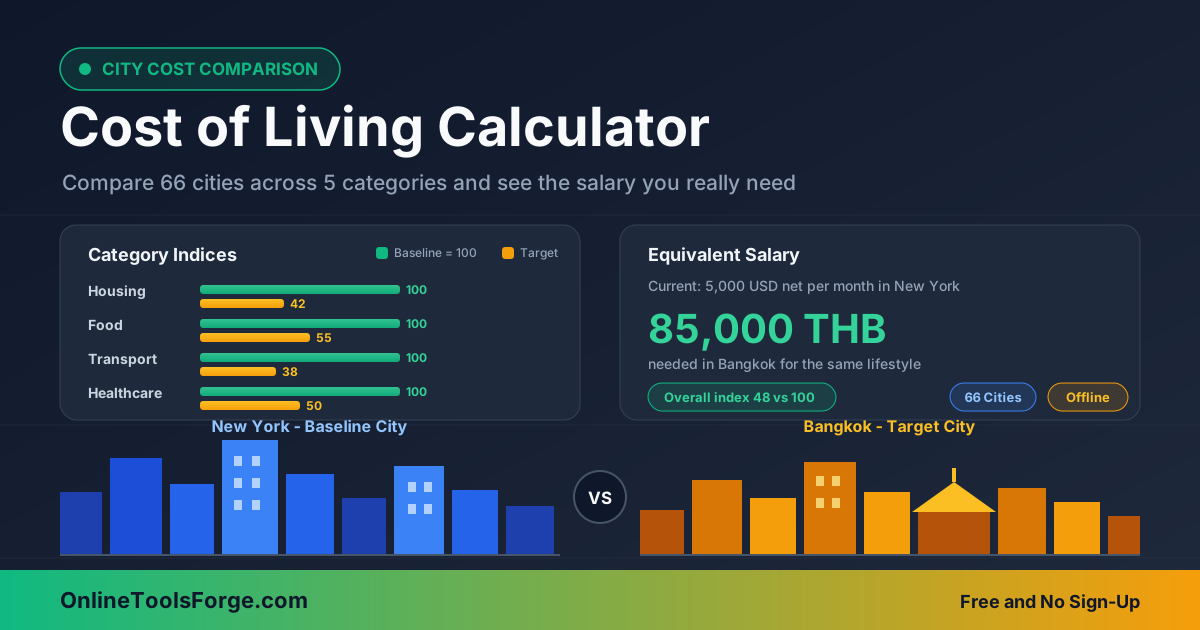
Table of Contents
Cost of Living Calculator: Compare 66 Cities and Find the Salary You Really Need
A job offer in another city, a retirement plan abroad, or a daydream about remote work somewhere cheaper all hit the same wall: what does life actually cost there? A cheap apartment next to expensive healthcare and taxi fares can flip the math. The free Cost of Living Calculator replaces guesswork with weighted, category-by-category numbers for 66 cities worldwide.
Pick your current city and the one you are considering. The tool scores both across five categories - housing, food, transport, healthcare, and other everyday costs - and converts your salary into the equivalent needed in the target city to keep the same lifestyle, in the local currency. This guide explains how the indices work.
Why Use the Cost of Living Calculator?
- A single percentage hides what matters. A city 12% cheaper overall may be 40% cheaper on housing but double on healthcare. Per-category indices show where each city is a bargain and where it bites.
- The salary number is the decision number. Enter your monthly net salary and the tool translates it into the concrete figure you would need in the target city, in its local currency.
- 66 cities, one methodology. The same scoring applies from New York to Bangkok to Berlin, so comparisons are fair instead of anecdotal.
- Currency conversion is built in. Comparing Barcelona with Bangkok normally means juggling exchange rates; here it is apples to apples.
- 100% offline and private. Every calculation runs client-side - no account, no upload, and your salary never leaves your device.
- Fast enough for a shortlist. Five candidate cities take minutes, not an afternoon of spreadsheet work.
Key Features
| Feature | What It Does |
|---|---|
| 66 cities | Compare major cities worldwide with one consistent methodology |
| Five cost categories | Housing, food, transport, healthcare, and other daily expenses, scored apart |
| Weighted overall index | Housing 0.35, food 0.25, transport 0.15, healthcare 0.10, other 0.15 |
| Baseline vs target view | Each category indexed against your baseline city, which is set at 100 |
| Equivalent salary | Your monthly net salary translated into the target-city figure, FX included |
| 100% offline | All math runs client-side - nothing is sent to a server |
- Instant feedback. Change either city or the salary and every number updates on the spot.
- Weighted the way budgets behave. Housing and food dominate household spending, so they dominate the score.
How to Use the Cost of Living Calculator
- Choose your baseline city. Where you live now; every category here becomes the reference point, set at 100.
- Choose the target city. Pick the place you are considering from the 66 available options.
- Read the category indices. Housing at 130 means about 30% higher housing costs than at home; food at 70 means about 30% cheaper groceries.
- Enter your monthly net salary. Recommended: the tool shows the equivalent net income needed in the target city, in its own currency.
- Compare and copy. Note the difference, copy the summary, then reset and try the next candidate.
How Cost Indices Work
Each category in your baseline city is anchored at 100 - relative scores, not price lists. A housing index of 130 means housing in the target city costs about 30% more than at home; a food index of 70 means groceries run about 30% cheaper.
The overall index blends the five categories with fixed weights: housing 0.35, food 0.25, transport 0.15, healthcare 0.10, and other 0.15. Housing leads because shelter is the biggest, least compressible line in most budgets. Food ranks second as the largest recurring cost. So cities diverge mostly through housing: half-price rent moves the overall index far more than half-price coffee.
Enter a salary and the tool converts it to a common currency, scales it by the ratio of the two overall indices, and expresses the result in the target city's currency. It answers one precise question: what net income buys my current lifestyle there? The fixed-spending-mix assumption makes it a clean benchmark for negotiating a relocation package or remote-work salary.
One nuance: the housing index blends rental and ownership costs, which can move in opposite directions. Renters should treat it as a directional signal and verify with live listings; buyers should run the numbers through the Rent vs Buy Calculator, because the rent-versus-purchase trade-off differs hugely between markets.
Two honest limits remain. Taxes - income brackets, social security, sales taxes - differ enormously between countries and are not modeled, which is why comparisons use net figures. The healthcare index measures typical out-of-pocket costs, not quality, waiting times, or insurance availability. Treat it as the first filter, then add tax research and first-hand accounts.
A Worked Example: Barcelona to Bangkok
Suppose you earn 4,200 EUR net per month in Barcelona, and a remote role lets you live anywhere. Against the New York baseline, Barcelona's overall index sits around 56 and Bangkok around 48 - Bangkok is roughly 14% cheaper than Barcelona overall. The tool converts your salary (about 4,560 USD), scales it by 48 over 56, and lands near 3,910 USD, or about 139,000 THB at 35.5 baht to the dollar. That is the net income that buys your Barcelona lifestyle in Bangkok.
The category rows explain why: apartments and street food cost far less, while cars and imports erase part of the savings. Lean toward driving and imports and your real number runs higher - the breakdown matters more than the headline.
Practical Use Cases
Weighing a Remote-Work Relocation Offer
A remote offer that lets you live anywhere is a portfolio of city choices. Compare the equivalent-salary figures for your top three candidates and you instantly see which city stretches your income furthest, and how big a pay cut each move can absorb.
Planning an Expat Move to Thailand or Beyond
The London-to-Bangkok or Berlin-to-Chiang-Mai move is common, and naive assumptions about it fail. The indices show housing and food falling sharply while imported goods and vehicles do not, so you can budget for the life you will actually live.
Setting Compensation Bands for a New Office
HR teams hiring across borders need defensible salary bands fast. Comparing the new location against headquarters with one weighted methodology yields a transparent multiplier you can show candidates and finance.
Budgeting for Retirement Abroad
Retirees live on relatively fixed income, so the question is whether a pension covers a specific lifestyle. Enter the monthly net pension as the salary, and the equivalent figure says whether each candidate city is comfortable, tight, or out of reach.
Best Practices
- Match the tool to your spending mix. The weights reflect a typical household; if rent eats half your income, re-weight mentally toward housing.
- Read both cities, not just the difference. Two cities can share an overall index while one is housing-expensive and the other healthcare-expensive.
- Factor FX volatility. Earning in one currency and spending in another means exchange-rate swings can move your income more than the cost gap does.
- Remember what sits outside the index. Taxes and healthcare quality are not modeled; use net figures and research both separately.
- Treat it as a shortlisting tool. Verify finalists with live listings and a scouting trip - indices are averages.
- Revisit annually. Prices and exchange rates drift; rerun the comparison before any major commitment.
Compare Cities Before You Commit
Relocation is one of the few decisions where minutes of arithmetic can save thousands per year. Open the Cost of Living Calculator, set your baseline, drop in your salary, and see what your lifestyle really costs in the city you are dreaming about.
Related Tools You Might Like:
- Inflation Calculator - see how rising prices erode the salary you just benchmarked
- Currency Converter - check today's rate before translating a salary across borders
- Rent vs Buy Calculator - decide whether renting or buying makes sense in your target city
Happy calculating!
Frequently Asked Questions
Q: What does an index of 100 mean in the Cost of Living Calculator?
A: Each category in your baseline city is anchored at 100. A housing index of 130 in the target city means housing there costs about 30% more than at home; a food index of 70 means groceries cost about 30% less.
Q: Which city is used as the baseline?
A: New York is the global reference point, with every category at 100. Because all 66 cities share this baseline, any two can be compared on consistent footing.
Q: Does the equivalent salary include taxes?
A: No. The comparison works with net (after-tax) figures: you enter a monthly net salary and receive a net equivalent. Tax brackets, social security, and VAT differences are not modeled, so research the tax side separately.