Darts Checkout Calculator: Finish 501 Like a Pro
Get the fastest dart checkout routes for any score from 2 to 170, with T20 finishes, Bull options, and alternate routes. Free darts finishing chart in your browser.
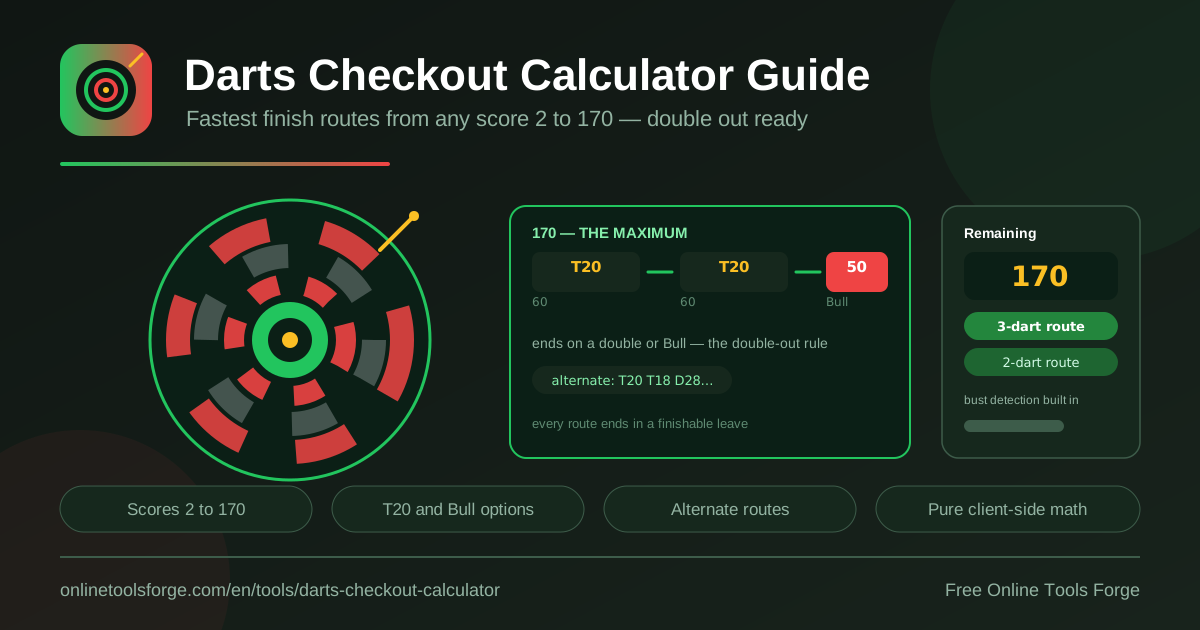
Table of Contents
Every darts player eventually hits the same wall: the scoring is fine, but the finishing is a guess. You sit on 110, step to the oche, and suddenly the arithmetic feels heavier than the darts. The free darts checkout calculator removes that guesswork, suggesting the fastest legal route from any remaining score so you can throw with a plan instead of a prayer.
The tool is pure client-side math in your browser — no signup, no downloads, no waiting. Enter any remaining score from 2 to 170 and it instantly suggests checkout routes using singles, doubles, trebles, the outer 25, and the Bull 50. It shows three-dart and two-dart options, offers alternate route suggestions, and respects the double-out rule on every single combination.
Why does this matter? In 501, the standard darts game, you cannot simply land on zero. The final dart must hit a double, which is why 170 is the maximum three-dart checkout (T20, T20, Bull) and why knowing that 32 finishes 16, D8 wins legs. A darts finishing chart you actually use speeds up legs, prevents busts, and turns checkout pressure into routine.
Why Use the Darts Checkout Calculator?
- Double-out rule built in. Every suggested route ends on a double or the Bull, so nothing you memorise turns out to be illegal under 501 rules.
- Fewer darts per leg. The tool prioritises three-dart and two-dart finishes, so you take legs out in the shortest possible visit rather than wandering to an awkward double.
- Alternate routes on demand. When your D16 misbehaves but your D20 is on fire, backup suggestions give you a plan B with zero mental arithmetic.
- Bust-aware combinations. Routes never leave you on 1, on 0 without a double, or in any other impossible position, which quietly trains good habits.
- You learn while you look up. Repeated checks on 100, 96, 81, and 40 burn the standard finishes into memory until you no longer need the chart.
- Instant, private, and free. Everything is computed in your browser with instant client-side math — nothing uploaded, no account required.
Key Features
| Feature | What it does |
|---|---|
| Score input 2 to 170 | Enter any legal remaining score and get routes instantly |
| Full board coverage | Routes use singles, doubles, trebles, the outer 25, and the Bull 50 |
| Double-out enforcement | Every route finishes on a double or the Bull, as 501 demands |
| Two-dart and three-dart routes | See whether you can take the leg now or need a setup dart first |
| Alternate suggestions | Get backup finishes when your favourite double goes missing |
| Bust-aware combinations | Suggested routes avoid impossible or bust-prone positions |
| Instant client-side math | Results appear immediately, computed entirely on your device |
Three details worth highlighting:
- The Bull is a double. The inner Bull scores 50 and can close a leg, which unlocks routes like 170 (T20, T20, Bull) and 90 (Bull, D20).
- Setup darts are part of the plan. For scores that cannot be taken out immediately, routes deliberately leave a favourite number, such as 32 for D16.
- Parity is handled for you. Finishing usually means leaving an even number, and the suggested routes do that thinking automatically.
How to Find Your Checkout
- Open the tool. Load the darts checkout calculator on your phone, tablet, or desktop — it is ready the moment the page loads.
- Enter your remaining score. Type in any number from 2 to 170, whatever the chalkboard says is left on your leg.
- Read the primary route. The fastest checkout appears first, with every dart spelled out as a single, double, treble, 25, or Bull.
- Scan the alternates. If the main path relies on a double you do not trust tonight, pick a backup route that suits your form.
- Throw with a plan. Step to the oche knowing exactly where all three darts are going — no hesitation, no mid-visit maths, no bust.
Double-Out Rules and Famous Finishes
The double-out rule is what makes 501 checkout maths a genuine skill. Your final dart must land in any double ring segment or the inner Bull 50, which counts as double 25. Bust conditions follow directly: if a dart takes you below two, leaves you on 1, or reaches zero without a double, the visit is a bust and your score reverts to what it was. That is why 2 is the smallest possible checkout (D1) and why scores like 169, 168, 166, 165, 163, 162, and 159 are nicknamed bogey numbers — no legal three-dart finish exists for any of them.
At the very top of the range sits the 170 checkout, the maximum possible on three darts:
170 remaining — the nine-dart finish closer
T20 (60) → T20 (60) → Bull (50)
Alternate: none — T20, T20, Bull is the only route
Below that, the classic finishes are worth memorising outright. One hundred is the bread-and-butter T20, D20. Thirty-two is the textbook 16, D8. Forty is simply D20. The bigger tourists include 121 (T20, 11, Bull), 96 (T20, D18), and 81 (T19, D12). Learn these and mid-range checkouts become automatic rather than improvised.
The other half of finishing well is leaving yourself a finishable number. Try to depart each visit on an even score that sits on a comfortable double — 32, 40, and 36 are favourites. Two-dart versus three-dart thinking matters too: with two darts in hand your maximum finish is 110 (T20, Bull), while three darts lift the ceiling to 170. Route choice can absorb risk as well. On 100 with three darts you can play T20, D20 for the fast finish, or the safer 20, T16, D16 if the treble feels brave tonight.
Practical Use Cases
League Night Quick Checks
Between legs at league night, nobody wants to squint at a laminated chart. Pull up the tool, punch in 121 or 141, and confirm the route before your next visit. Those five-second checks are the difference between a composed T20, 17, Bull out-shot and a panicked dart at whatever double looks closest.
Practice Session Drills
Turn checkout practice into a structured routine. Pick classic finishes — 40, 32, 81, 96, 100, 121, 141, 170 — look each one up, then throw it until you hit it three times. The alternate route suggestions double as drill variety: one night work the primary path, the next night work the backup, so match-night surprises disappear.
Learning the Standard Chart
The fastest way to internalise a darts finishing chart is to guess first and verify second. Before entering a score, call the route out loud — 68 should be T20, D4 — then check the tool. Every correction sticks, and within a few sessions you will answer before the screen does.
Pub Games With Friends
Pub darts runs on friendly arguments, and the calculator settles them instantly. Can 159 be checked out? No — it is a bogey number. What about 155? Yes: T19, T16, Bull. Keep the phone by the board and every debate ends in seconds, with the double-out rule enforced by the tool rather than by whoever argues loudest.
Best Practices
- Leave favourite doubles. Route your setup darts toward 32, 40, or 36 so the pressure dart is one you have actually practised.
- Know the bogey numbers. 169, 168, 166, 165, 163, 162, and 159 cannot be finished — score safely and move on.
- Trust your form, not just the chart. On a bad D16 night, take the alternate route to a double that is actually working.
- Drill 32 and 40 daily. Most legs are won on the small doubles; ownership of 16, D8 and D20 converts more visits than any treble.
- Think in visits, not darts. Plan where all three throws should land before you step up, then adjust only after each dart lands.
- Check before you chalk. A two-second lookup beats a busted visit every single time.
Ready to stop guessing at doubles? Open the darts checkout calculator, type in your remaining score, and walk to the oche with the finish already mapped out. It is free, instant, and entirely in your browser — the same maths the pros run through their heads, handed to you on a plate.
Related Tools You Might Like:
- Dice Roller — settle who throws first without hunting for a die.
- Coin Flipper — the traditional way to decide the bull-off.
- Countdown Timer — time your practice sets and keep drills honest.
Game on!
Frequently Asked Questions
Q: What is the highest checkout in darts? A: The maximum three-dart checkout is 170, finished T20, T20, Bull. It is famously the only route to that score and often the closer of a nine-dart leg.
Q: Why must a 501 leg finish on a double? A: Standard rules require the final dart to land in a double or the inner Bull 50, which counts as double 25. Reaching zero any other way is a bust and your score reverts.
Q: Which scores cannot be checked out? A: Below 170, the impossible scores are 169, 168, 166, 165, 163, 162, and 159. Scores under 2 are also unfinishable, since the smallest checkout is 2 via D1.
Q: Does the Bull count as a double for finishing? A: Yes. The inner Bull scores 50 and acts as double 25, so it can close a leg, while the outer bull scores 25 and is treated as an ordinary segment.
Q: Is the darts checkout calculator free to use? A: Completely. It runs instant client-side math in your browser with no signup, no downloads, and nothing sent to a server — just enter a score from 2 to 170 and get your routes.