Height Converter: Convert cm, Feet and Inches Instantly
Convert height and length between centimeters, meters, millimeters, feet, inches, and yards instantly, with an all-units table and copy support. Free, accurate, and 100% client-side.
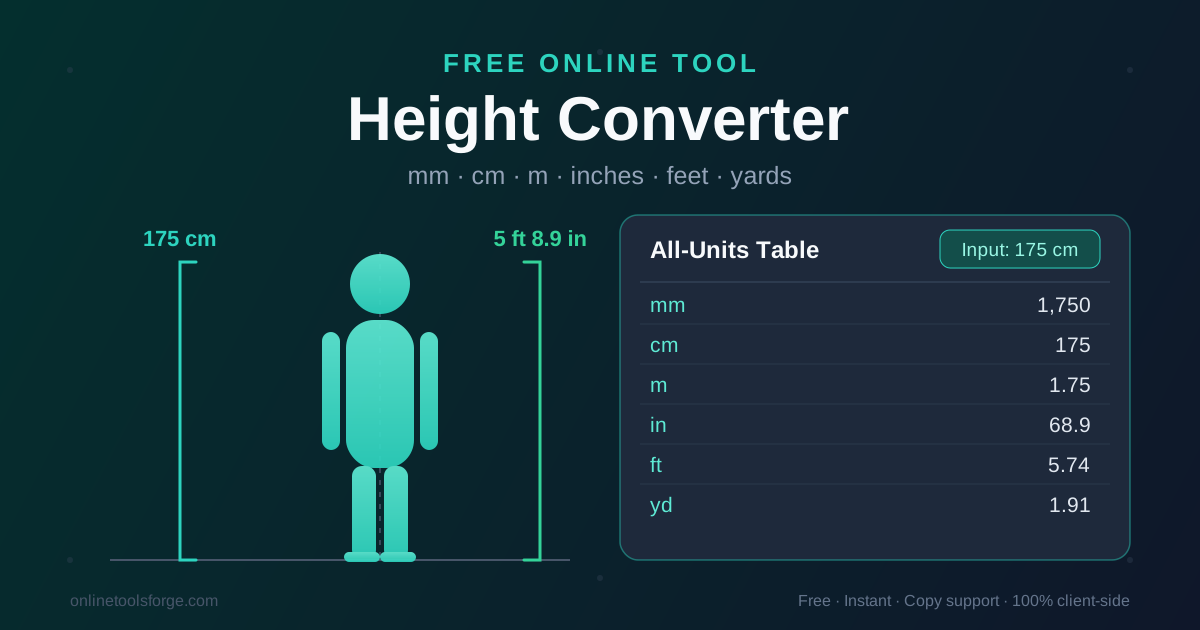
Table of Contents
Height Converter: Convert cm, Feet and Inches Instantly
Height is one of those measurements the world never agreed on. In Thailand, Japan, and most of Europe, your medical chart reads 170 cm. Cross the Atlantic, and the same person stands 5 feet 7 inches tall. Forms, size guides, product listings, and sports profiles mix these systems constantly, and converting by hand invites mistakes. The free Height Converter ends that friction: type a value in any unit and see every other unit instantly.
The tool covers the six units of daily life: millimeters (mm), centimeters (cm), meters (m), inches (in), feet (ft), and yards (yd). Enter 175 cm and you immediately get 1,750 mm, 1.75 m, 68.9 in, and 5.74 ft in a single all-units table, with one-click copy throughout. Everything is computed 100% client-side in your browser, so nothing you type ever leaves your device.
This guide covers the exact conversion factors, quick mental shortcuts for human heights, and when precision really matters.
Why Use the Height Converter?
- All six units at once. One input produces mm, cm, m, in, ft, and yd simultaneously — no dropdown juggling.
- Start from any unit. There is no fixed input side — type millimeters, yards, or anything else, and the table recomputes instantly.
- Copy anything with one click. Grab a single value or the whole table and paste it into a form, spreadsheet, or message.
- Private by design. The conversion runs entirely in your browser (100% client-side), so your measurements, including health data, stay on your device.
- No installation or account. Nothing to download and no sign-up wall — it works the same on phone and desktop.
- Built for real-world heights. The units match what medical forms, stores, and sports stats actually ask for.
Key Features
| Feature | What it does |
|---|---|
| Six-unit support | mm, cm, m, in, ft, and yd, with centimeters as the base unit |
| All-units table | Every keystroke updates a table showing your value in all six units |
| Any-unit input | Type into any field and the rest recalculate — fully bidirectional |
| Instant results | No convert button; values update live as you type |
| Copy support | Copy a single result or all conversions with one click |
| 100% client-side | All math happens locally in your browser, no server round-trip |
The all-units table doubles as a sanity check — with 175 cm showing 68.9 in and 5.74 ft side by side, an impossible conversion stands out immediately. Any-unit input removes the source-and-target dance — just fill in the field you already have. And copy support transfers exact values into forms and reports without retyping.
How to Use
- Open the tool at Height Converter in any modern browser.
- Enter your value in whichever unit field you have — for example, type 175 into the cm field.
- Read the all-units table, which fills in every equivalent instantly.
- Copy the value you need, or copy the entire table for your records.
- Edit or clear the input to run the next conversion — there is no reset step.
The Exact Conversion Factors
Height conversions feel arbitrary until you anchor them to one fact: since the 1959 international yard and pound agreement, 1 inch is defined as exactly 2.54 centimeters — not approximately, exactly. Every other relationship follows:
- 1 ft = 12 in, so 1 foot equals 12 × 2.54 = 30.48 cm exactly.
- 1 yd = 3 ft = 36 in, so 1 yard equals 91.44 cm exactly.
- 1 m = 100 cm = 1,000 mm, so 1 cm equals about 0.3937 in.
Shortcut 1: cm to inches — divide by 2.54. 175 ÷ 2.54 = 68.9 in. For a rough estimate, multiply by 0.4 instead: 175 cm ≈ 70 in — fine for a conversation, not for a form.
Shortcut 2: the two-step ft-in method. People are quoted as mixed units like "5 ft 8 in", not decimal feet. Step one: divide cm by 30.48 for total feet — 175 ÷ 30.48 = 5.7415. Step two: keep the whole number as feet and multiply the fraction by 12 — 0.7415 × 12 ≈ 8.9. Result: 175 cm = 5 ft 8.9 in. The reverse is easier still: feet × 30.48 plus inches × 2.54, so 5 ft 8 in = 152.4 + 20.32 = 172.72 cm.
When precision matters: medical records, BMI, pediatric dosing, and growth percentiles deserve the exact 2.54 factor with one final rounding. Aviation is similar: altitudes are flown in feet while many runway lengths are published in meters. For clothing, furniture, or settling who is taller, one decimal is plenty.
Practical Use Cases
Medical Forms and BMI Entries
Health calculators are inconsistent — one asks for cm, the next for feet and inches. When a BMI form demands centimeters but your physical recorded 5 ft 8 in, the converter returns 172.72 cm in one step, and copying it removes any typo risk.
Online Shopping Across Regions
A desk listed at 180 cm is 70.9 in; a 65-inch TV measures 165.1 cm diagonally; a US clothing chart quotes feet while the EU version uses centimeters. One entry answers every version of the question — no eyeballing whether something will fit.
Sports Stats and Fitness Tracking
Athlete listings are a unit maze: an NBA prospect at 6 ft 6 in is 198.1 cm on an international roster, while a high-jump best of 1.92 m reads as 6 ft 3.6 in. The all-units table lets you compare rosters and training logs without stopping to compute anything.
Kids' Growth Charts
Pediatric growth charts plot centimeters (sometimes millimeters), while grandparents abroad think in feet and inches. A toddler at 92 cm is 3 ft 0.2 in — instant translation for the family group chat. Keeping checkups in one consistent unit makes trends easier to spot over time.
Best Practices
- Round only at the end. Convert with the exact factor (2.54) and round the final result once; chaining rounded intermediates compounds the error.
- Keep feet and inches as mixed units for people. "5 ft 8.9 in" is how humans are described; 5.74 ft is correct but reads awkwardly.
- Double-check mm vs cm on medical forms. 175 cm is 1,750 mm — a factor-of-ten slip on an intake form can change a dosage calculation.
- Preserve the original unit of record. Conversions are copies: if a chart says 170 cm, that stays 170 cm, with the converted value written alongside.
- Use the all-units table as a sanity check. Scan every row before trusting one number — a value off by ten times means the wrong field was filled.
- Copy the full table when documenting — storing every unit makes future conversions trivially reproducible.
Start Converting Heights Today
Stop guessing how many inches are in your height or which centimeter value belongs on a form. The Height Converter is free, instant, and completely private — one value in, all six units out, ready to copy wherever you need it.
Related Tools You Might Like:
- Unit Converter — convert length, mass, volume, area, and more in a single tool.
- Weight Converter — switch between kilograms, pounds, and ounces for the other half of every health form.
- Temperature Converter — translate Celsius, Fahrenheit, and Kelvin just as instantly.
Happy converting, and measure with confidence!
Frequently Asked Questions
Q: How many centimeters is 5 feet 7 inches?
A: Multiply 5 by 30.48 and 7 by 2.54, then add: 152.4 + 17.78 = 170.18 cm — so 170 cm and 5 ft 7 in describe essentially the same person.
Q: Is 1 inch always exactly 2.54 cm?
A: Yes. The 1959 international yard and pound agreement defined the inch as exactly 2.54 centimeters, which also fixes the foot at 30.48 cm and the yard at 91.44 cm.
Q: What is 175 cm in feet and inches?
A: Divide 175 by 30.48 for 5.7415 total feet; keep the 5, then multiply 0.7415 by 12 for about 8.9 inches. So 175 cm = 5 ft 8.9 in.
Q: Is my height data uploaded anywhere when I use the tool?
A: No. The converter runs 100% client-side: every calculation happens on your device, and nothing you type is transmitted to a server.