Hijri Gregorian Converter: Convert Islamic AH Dates to CE and Back
Convert Islamic calendar dates (AH) to Gregorian (CE) and back with weekday and Hijri month names, plus an Islamic New Year reference table. Free and 100% client-side.
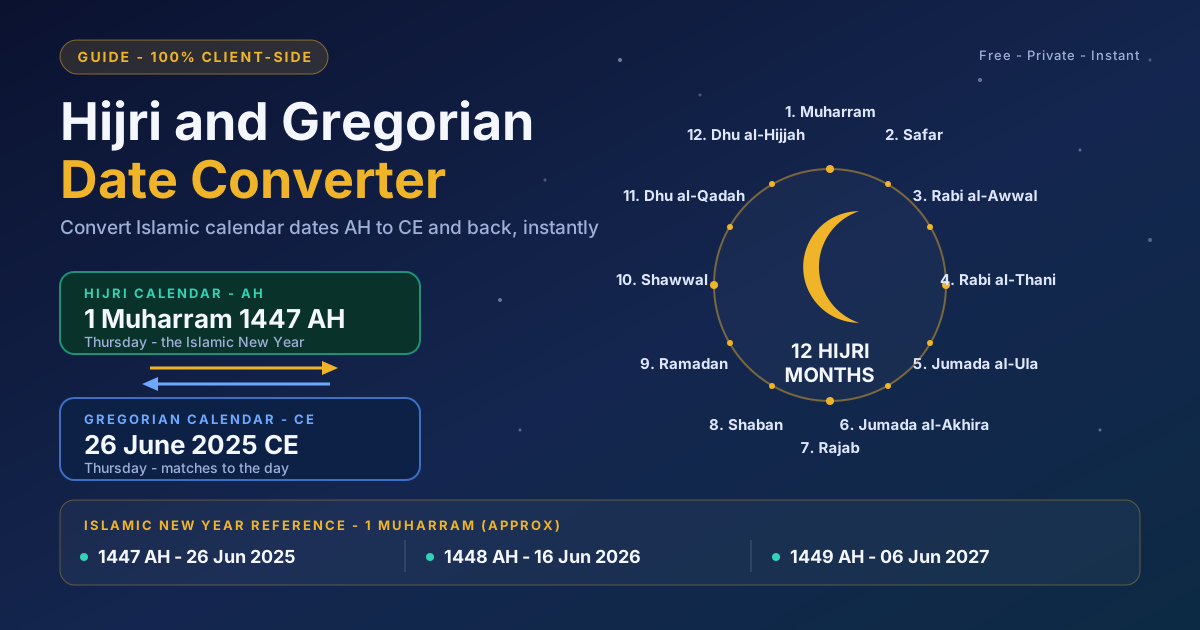
Table of Contents
Hijri Gregorian Converter: Convert Islamic AH Dates to CE and Back
Two calendars, one moment in time. A date written as 15 Ramadan 1447 AH and a Gregorian date describe the same day — but only if you can translate between the two systems. Our Hijri Gregorian Converter does exactly that: it converts any Islamic calendar date to its Gregorian (CE) equivalent, or works backwards from a Gregorian date to Hijri, with the weekday and Hijri month name.
The need comes up often: Ramadan and the two Eids follow the Hijri calendar and land on a different Gregorian date every year, contracts in many Gulf countries carry dual dates, and family records mix the two systems. Without a reliable converter, even "when is Islamic New Year this year?" becomes guesswork.
The converter is free, needs no sign-up, and runs entirely in your browser — no date you enter leaves your device. This guide covers how to use it, how the Hijri calendar works, and where a two-way converter fits into everyday planning.
Why Use the Hijri Gregorian Converter?
- Two-way conversion in one place. Convert Hijri (AH) to Gregorian (CE) or the reverse without switching tools — one interface handles both directions instantly.
- Weekday and month names included. Every result shows the weekday and the Hijri month name, from Muharram to Dhu al-Hijjah — a readable date, not bare numbers.
- Input validation built in. Days outside 1-31 and months outside 1-12 are rejected before converting, so typos cannot produce silently wrong results.
- Islamic New Year reference table. A built-in table lists upcoming 1 Muharram dates, so planning around the Islamic New Year takes seconds.
- 100% client-side and private. All calculations run locally in your browser — nothing is uploaded or logged, which matters when dates concern personal or religious matters.
- Free, fast, and mobile-friendly. No account, no installation — it loads in seconds on phone or desktop.
Key Features
| Feature | What It Does |
|---|---|
| AH to CE conversion | Turns any Islamic date into its Gregorian equivalent instantly |
| CE to AH conversion | Works backwards from a Gregorian date to the Hijri calendar |
| Weekday display | Shows the day of the week for every converted date |
| Hijri month names | Names the month, from Muharram to Dhu al-Hijjah |
| Day and month validation | Rejects days outside 1-31 and months outside 1-12 before converting |
| Islamic New Year table | Lists upcoming 1 Muharram dates for quick planning |
| Client-side processing | Computes everything in your browser with no data transmission |
- One interface, both directions. Cross-checking a date against a document in the other calendar takes a single glance, and the attached weekday and Hijri month name matter when an event is defined by month and day — such as the Day of Arafah on 9 Dhu al-Hijjah.
How to Use the Hijri Gregorian Converter
- Open the tool. Navigate to the Hijri Gregorian Converter page.
- Pick a direction. Enter your date in either the Hijri (AH) fields or the Gregorian (CE) fields — day, month, and year.
- Check the inputs. The tool validates the day (1-31) and month (1-12) before converting.
- Read the result. The converted date appears immediately, together with the weekday and the Hijri month name.
- Use the reference table or repeat. Scroll to the Islamic New Year table for upcoming 1 Muharram dates, or clear the fields and convert another date.
How the Hijri Calendar Works
The Hijri calendar — also called the Islamic calendar — is a purely lunar calendar. Its twelve months follow the phases of the moon rather than the seasons: each month begins around the time a new crescent becomes visible and lasts 29 or 30 days, so twelve lunar months total roughly 354 or 355 days — about 11 days shorter than the 365-day Gregorian year.
That gap means every Hijri date drifts about 11 days earlier in the Gregorian year. Ramadan, for example, does not sit in one season: over roughly 33 years it travels through the entire Gregorian year. It also means a Hijri date needs its era to be unambiguous.
AH stands for Anno Hegirae, "in the year of the Hijra." The Hijri calendar counts years from the Hijra, the migration of the Prophet Muhammad and his followers from Mecca to Medina in 622 CE. The Gregorian side uses the parallel label CE (Common Era).
The twelve Hijri months are Muharram, Safar, Rabi al-Awwal, Rabi al-Thani, Jumada al-Ula, Jumada al-Akhira, Rajab, Shaban, Ramadan, Shawwal, Dhu al-Qadah, and Dhu al-Hijjah. Four are traditionally sacred months — Dhu al-Qadah, Dhu al-Hijjah, Muharram, and Rajab — while Ramadan holds its own status as the month of fasting, ending with Eid al-Fitr at the start of Shawwal.
One detail surprises many first-time users: the same Hijri date can fall on different Gregorian days in different countries. A month officially begins when the new crescent is sighted, so calculated calendars like the one behind this tool give one consistent answer, while communities announcing month starts from observation may begin a day earlier or later.
A worked example makes this concrete. Using the calculated calendar, 1 Muharram 1447 AH corresponds to Thursday, 26 June 2025 CE — the Islamic New Year for 1447. Reversing direction, 26 June 2026 CE lands near 11 Muharram 1448 AH, since 1 Muharram 1448 falls around 16 June 2026. The same Gregorian date sits elsewhere in the Hijri calendar every year.
Practical Use Cases
Islamic Holiday Planning: Ramadan and Eid
Families, employers, and schools must anticipate Ramadan and the two Eids even though their Gregorian dates change yearly. Convert the expected 1 Ramadan or 1 Shawwal dates to build rosters, school calendars, and bookings — then confirm final dates locally as moon-sighting announcements arrive.
Contracts, Invoices, and Official Documents in the Gulf
In Saudi Arabia and several neighboring countries, official paperwork often carries a Hijri date. If an invoice reads 20 Rajab 1447 or a tenancy expires on 1 Dhu al-Hijjah 1448, you need the Gregorian equivalent to align it with your deadlines — and the reverse conversion when a counterpart requires the AH date.
Genealogy and Family History Research
Birth records, marriage certificates, and gravestones across the Muslim world often use Hijri dates. Converting them to Gregorian lines family events up with civil records, and the weekday output helps spot transcription errors.
Travel During Hajj Season
Hajj culminates between 8 and 13 Dhu al-Hijjah. Pilgrims, agencies, and airlines need those dates in Gregorian terms to book flights and accommodation, and anyone in Saudi Arabia that period should expect heavy demand.
Best Practices
- Confirm important religious dates locally. The official start of Ramadan or Eid follows local moon sighting and may differ from the calculated date by a day — treat the conversion as the plan, the local announcement as the decision.
- Always state the era on documents. Write "1447 AH" or "2025 CE" rather than a bare year; with two calendars in play, an unlabeled year is ambiguous by definition.
- Beware year-only conversions. A Hijri year spans parts of two Gregorian years, so converting "1447" without a month and day produces a range, not a date.
- Cross-check high-stakes dates both ways. For legal or financial deadlines, convert in one direction and back again; a mismatch reveals an input typo immediately.
- Expect a one-day tolerance. If a converted date is off by a day from an announcement, it is usually the moon-sighting difference, not an error.
Convert Your First Hijri Date Today
Whether you are scheduling around Ramadan, deciphering a Gulf invoice, or tracing an ancestor's record, the Hijri Gregorian Converter turns a two-calendar puzzle into a one-click answer — free, instant, and entirely on your device.
Related Tools You Might Like:
- Date Format Converter — Reformat any date between common international formats.
- Buddhist Era Converter — Convert between Buddhist Era (BE) and Gregorian years.
- Timezone Converter — Translate a moment in time across world time zones.
Happy converting!
Frequently Asked Questions
Q: What do AH and CE mean?
A: AH stands for Anno Hegirae, counting years from the Hijra, the migration from Mecca to Medina in 622 CE. CE stands for Common Era, the label for Gregorian years.
Q: Why does the Hijri year have only about 354 days?
A: Twelve lunar months of 29 or 30 days total roughly 354 to 355 days, about 11 days shorter than the Gregorian year — which is why Islamic dates move earlier each Gregorian year.
Q: Why do Hijri dates sometimes differ by a day between countries?
A: A Hijri month begins when the new crescent is sighted, and conditions vary by location and weather. Calculated calendars give one consistent answer, while local observation can shift a month's start by a day.
Q: Is my date data sent to a server?
A: No. The tool runs 100% client-side in your browser, so any date you enter never leaves your device.