Life Expectancy Calculator: Estimate Your Remaining Years
Estimate remaining life expectancy from age, sex, smoking, weight range, and exercise using a bundled actuarial table. Private, instant, and fully offline in your browser.
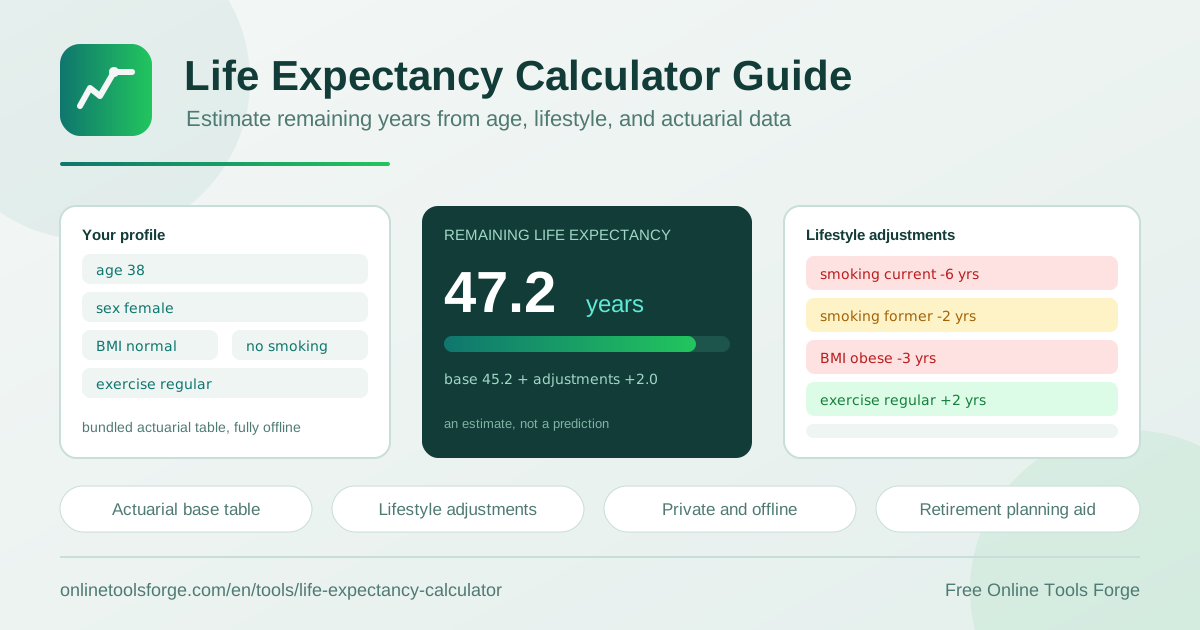
Table of Contents
Most of us have wondered, at least once, how long we might live. Nobody can see the future, but actuaries have spent more than a century turning mortality records into actuarial life tables — statistics that estimate the average number of years a person has left at any given age. The life expectancy calculator brings that methodology into your browser, estimating your remaining years from five simple inputs: age, sex, smoking status, BMI range, and exercise frequency.
Everything happens on your own device. The tool bundles its actuarial base table, works completely offline, and stores nothing — no accounts, no uploads, no tracking. You get an instant, private estimate you can use as a planning reference or as a quiet motivator for healthier habits.
This guide explains how the calculator works and how to turn the result into genuinely useful decisions.
Why Use the Life Expectancy Calculator?
How you estimate matters almost as much as the estimate itself. Here is what makes this tool a sensible starting point:
- Private by design. Your age, sex, and lifestyle answers never leave the browser. There is no server call at all, so sensitive health details stay with you.
- Fully offline. The actuarial table ships with the tool, so it works without an internet connection — on planes, in clinics, or anywhere privacy matters.
- Instant results. Adjustments apply the moment you pick an answer, so you can compare scenarios — smoker versus former smoker, regular versus no exercise — in seconds.
- Grounded in real data. The base numbers come from a bundled actuarial life table, the same family of tables the insurance industry relies on.
- Transparent math. Every adjustment is shown, so you can see exactly how smoking, weight, and exercise shifted the result instead of trusting a black box.
- An honest frame. Results are presented as population averages, not fate — an estimate to plan with, not a prediction to fear.
Key Features
The calculator asks for five inputs and returns one number, but every input does real work in the math:
| Feature | What it does |
|---|---|
| Age and sex | Selects your base remaining years from the bundled actuarial life table |
| Smoking status | Applies the largest lifestyle adjustment: never, former, or current |
| BMI range | Classifies weight as underweight, normal, overweight, or obese |
| Exercise frequency | Credits regular activity or penalizes a sedentary routine |
| Remaining years result | Shows the adjusted estimate instantly, with each adjustment listed |
- Adjustments are meaningful. Current smoking subtracts about six years, former smoking about two, and obesity about three; regular exercise adds roughly two, while no exercise subtracts about two.
- Ranges, not false precision. BMI bands and activity categories match how population research actually groups outcomes.
How to Estimate Life Expectancy
Getting your estimate takes under a minute:
- Open the calculator. Visit the life expectancy calculator page. It loads instantly and needs no sign-in.
- Enter your age and sex. These select your row in the actuarial base table, which anchors the whole estimate.
- Choose your smoking status. Pick never, former, or current — and be honest, because smoking carries the single largest adjustment.
- Select your BMI range. Choose underweight, normal, overweight, or obese, whichever is closest to where your weight falls today.
- Pick your exercise frequency and read the result. Choose regular, sometimes, or none. The tool applies every adjustment and shows your estimated remaining years immediately.
How Actuarial Tables and Adjustments Work
An actuarial life table is a grid built from mortality records: for every age and sex, it lists the average number of additional years a person can expect to live. In a typical table, a 40-year-old woman starts with roughly 45 remaining years and a 40-year-old man near 41. Notably, remaining life expectancy at 70 is still substantial — those who reach 70 have already survived many risks, and the table typically grants them 15 or more years.
The table provides the population baseline. Your lifestyle inputs then shift the estimate:
Base at 40, female:  45.0 years remaining
Current smoker:      -6.0 years
Obese:               -3.0 years
Regular exercise:    +2.0 years  →  result: 38.0 years
Why is the smoking penalty so large? Smoking damages nearly every organ system and is strongly linked to heart disease, stroke, and several cancers, which is why current smokers lose around six years in the model. Former smokers carry a smaller residual penalty of about two years, reflecting the well-documented recovery that follows quitting.
Weight matters too, which is why the tool asks for a BMI range: underweight and obese carry penalties, normal is neutral, and overweight sits between. Exercise runs the other way — regular activity earns roughly a two-year bonus, a sedentary routine costs about the same, and occasional activity lands somewhere in the middle.
One caution deserves emphasis: these are population averages. Genetics, blood pressure, sleep, stress, and access to medical care vary enormously between individuals, and the tool does not capture them. Treat the output as a statistically informed ballpark, never a countdown.
Practical Use Cases
A remaining-years estimate becomes most valuable when you connect it to real decisions:
Planning a Retirement Savings Horizon
Retirement math depends heavily on how long retirement lasts. If a 45-year-old estimates 40 remaining years, planning to 90 is prudent. A lower estimate opens a double conversation: review the savings plan, and ask what would move the health number upward. Plan past your personal estimate anyway — running out of years beats running out of money.
Preparing for Insurance Conversations
Life insurance pricing is built on exactly the factors this tool measures. Knowing where you stand helps you anticipate quotes: a current smoker should expect materially higher premiums, and the gap between the base table and your adjusted figure explains why insurers ask these questions. It also shows whether quitting before applying could improve your pricing tier.
Finding Motivation for Lifestyle Change
Abstract advice like exercise more rarely changes behavior, but concrete numbers often do. Watching the estimate rise when you switch from current smoker to former, or from no exercise to regular, turns healthy choices into something measurable. Some people re-run the tool quarterly as a lightweight progress check.
Understanding Annuity Math
Annuities pay less per month to buyers expected to live longer, because insurers spread pooled longevity risk across many people. Running your own estimate makes that trade-off visible: a healthier profile means smaller payments stretched across more expected years. That is the mechanism behind differing quotes.
Best Practices
- Answer honestly. The estimate is only as good as its inputs, and the person most tempted to fudge a question is often the one who most needs the honest number.
- Treat it as an estimate, not a verdict. The output is a population average plus adjustments; it cannot foresee accidents, genes, or future medicine.
- Re-run it after life changes. Quitting smoking, moving to a new BMI band, or building an exercise habit can all shift the inputs — and the result shows the progress.
- Plan past the number. For financial decisions, add a buffer of several years; outliving your savings is a more common risk than people assume.
- Keep the perspective. The goal is clarity, not anxiety — use the result as one input among many in your planning.
Start Planning With Your Own Numbers
Numbers beat guesses when it comes to the future. Open the life expectancy calculator, answer five quick questions, and see your estimated remaining years — instantly, privately, and entirely offline. Then act on what you see: pad your retirement plan, prepare for an insurance decision, or pick one habit that would move the number in the right direction.
Related Tools You Might Like:
- BMI Calculator — classify your weight before choosing a BMI range.
- BMR and TDEE Calculator — estimate daily calorie needs that support a healthy weight.
- Heart Rate Zone Calculator — train in the right zones to build a lasting exercise habit.
Live well!
Frequently Asked Questions
Q: Is the result a prediction of when I will die?
A: No. The tool produces a statistical average drawn from an actuarial life table plus lifestyle adjustments. Many people live far longer or shorter than their estimate; treat the number as a planning reference, not a fate.
Q: How accurate is the life expectancy calculator?
A: It is directionally useful rather than precisely accurate. The base table reflects real mortality data and the adjustments mirror well-documented population effects, but genetics, medical history, and environment are not modeled. Expect a reasonable ballpark.
Q: Why does it ask for BMI ranges instead of exact weight and height?
A: Population research groups outcomes into bands, so the range format matches how the underlying evidence works. It also keeps the tool honest — a two-decimal BMI would imply a precision the science does not support.
Q: Does anything I enter get stored or sent anywhere?
A: No. The calculation runs entirely in your browser using a bundled table. Nothing is transmitted, logged, or saved, and the tool keeps working offline.
Q: Can my estimate improve over time?
A: Yes. The most dramatic single change is quitting smoking, which replaces the current-smoker penalty with the smaller former-smoker adjustment and allows substantial recovery over time. Reaching a normal BMI range and exercising regularly improve the figure further.