Child Height Predictor: Estimate Adult Height From Parents
Predict adult height from parents heights using the mid-parental formula with a percentile range. Free, private, and instant in your browser.
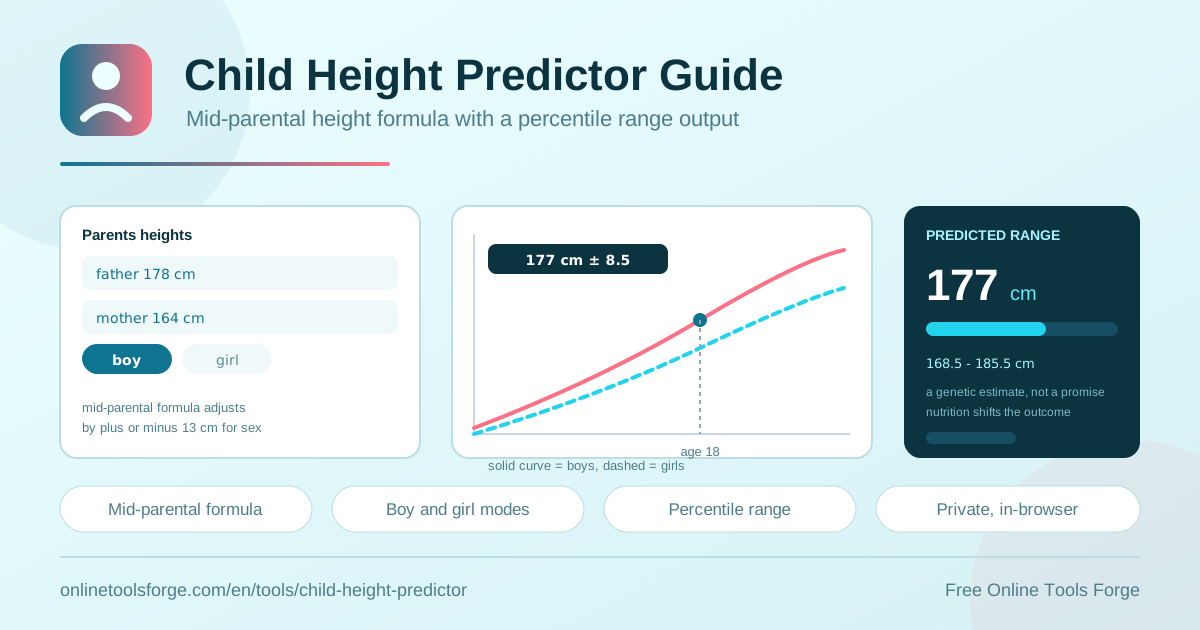
Table of Contents
Every parent eventually asks the same question: how tall will my child be? No tool sees the future with perfect precision, but decades of pediatric research offer a dependable starting point. The mid-parental height method takes the heights of both parents and projects an adult height estimate for a boy or a girl, complete with a realistic range instead of a single overconfident number. Our free child height predictor puts this standard pediatric formula in your browser, with answers in seconds.
What makes the approach so trusted is its pedigree. The mid-parental formula grew out of research by child development scientist James Tanner, whose growth standards still shape modern pediatrics, and clinicians worldwide use the same calculation as a screening baseline during checkups. Because adult height is strongly heritable, the average of the two parents heights explains most of the variation between families.
Like every calculator on this site, the tool runs entirely in your browser. Nothing you type is uploaded, stored, or shared, so you can experiment with different scenarios freely and privately.
Why Use the Child Height Predictor?
- Clinician-approved math. The tool applies the same mid-parental formula pediatricians use as a first-line growth screen, so your result matches the calculation a doctor would sketch on paper.
- A range, not a promise. Instead of one number, you get a plus-or-minus band that honestly reflects the natural variability of human growth.
- Instant answers. Enter two heights, choose boy or girl, and the prediction appears immediately with no sign-up and no waiting.
- Complete privacy. All math happens locally on your device; nothing is transmitted anywhere.
- Free and unlimited. No accounts or paywalls — run as many projections as you like for every child in the family.
- A great conversation starter. The estimate gives you a shared, factual baseline for discussing growth with your partner, your child, or your pediatrician.
Key Features
| Feature | What it does |
|---|---|
| Father height input | Enter the father height in centimeters |
| Mother height input | Enter the mother height in centimeters |
| Boy or girl toggle | Selects the sex-specific adjustment the formula requires |
| Mid-parental calculation | Applies the Tanner formula: add 13 cm for boys, subtract 13 cm for girls |
| Predicted range | Shows the adult height estimate with a plus-or-minus band |
A few details worth knowing:
- Metric inputs keep the math consistent with the clinical literature, which reports the formula in centimeters.
- Switching between boy and girl recalculates instantly, so you can compare a brother and sister projection side by side.
- Everything happens on the same page — there is nothing to install and no result to wait for.
How to Predict Adult Height
- Open the tool. Visit the child height predictor — it loads instantly on any phone, tablet, or computer.
- Enter the father height. Type the father height in centimeters into the first field.
- Enter the mother height. Add the mother height in centimeters to the second field.
- Choose boy or girl. The toggle tells the formula which sex adjustment to apply.
- Read the prediction. The tool displays the predicted adult height together with a plus-or-minus range, giving you a realistic window rather than a false single number.
The Mid-Parental Height Formula Explained
The method behind the tool is the mid-parental height formula, often credited to James Tanner. The idea is simple: average the two parents heights, then shift that midpoint up or down depending on whether the child is a boy or a girl. For a boy, add 13 cm to the average. For a girl, subtract 13 cm. That adjustment mirrors the typical adult height difference between men and women across large populations, and it is the only sex-specific step in the whole calculation.
Here is a worked example:
Father 180 cm + Mother 165 cm = 345 cm combined
Average = 345 / 2 = 172.5 cm mid-parental height
Boy: 172.5 + 13 = 185.5 cm, range roughly 175.5 to 195.5
Girl: 172.5 - 13 = 159.5 cm, range roughly 149.5 to 169.5
Why report a range instead of a single figure? Genetics set a midpoint, not a destination. Adult height varies with nutrition, sleep, activity, and plain biological chance, and the classic guidance pairs the mid-parental estimate with a band of roughly plus or minus 10 cm — about four inches — inside which most children land. A single number invites false precision; a band invites healthy expectations.
It is just as important to know what the estimate cannot account for. The formula captures the strong genetic contribution to height, but it assumes decent nutrition and general health along the way. It cannot see the timing of puberty, where an early or late bloomer may drift off their curve before catching up. It cannot detect chronic illness, certain medications, or sustained undernutrition, all of which can pull a child below their genetic potential.
This is where pediatricians step in. Doctors use the same mid-parental formula as a screening baseline, comparing a child position on the growth chart with the predicted band. A child who tracks persistently below or above that band raises a flag that prompts a closer look — not a diagnosis in itself. Think of the formula as a compass for deciding when growth deserves professional attention.
Practical Use Cases
Curious Parents Planning Ahead
Expecting a baby and daydreaming about the future? Run the numbers before the birth and tuck the result into the baby book. Many parents enjoy revisiting the projection at each birthday and watching how their child moves within the predicted band.
Pediatric Growth Discussions
Bring the estimate to your next checkup. When you and the pediatrician share the same baseline, conversations about percentiles and growth curves become far more concrete, and questions about whether a child is on track get clearer answers.
Genetics Classroom Demos
Teachers love this formula because it makes heredity tangible. Students can measure their parents, compute a predicted height, and compare it with real growth — a memorable, personal demonstration of polygenic inheritance in action.
Comparing Sibling Projections
Run the tool twice for the same parents, once as a boy and once as a girl, and the 26 cm spread between the two results becomes a concrete illustration of how sex shapes the same genetic inheritance.
Best Practices
- Measure accurately. Measure both parents without shoes, standing tall against a wall, in the morning when the spine is at its longest.
- Use current measurements. Fresh measurements beat remembered figures or heights quoted with heels on.
- Treat the band as healthy. Anything inside the predicted range is a normal outcome; resist reading too much into a single centimeter.
- Watch the trend, not the moment. One measurement means little; consistent growth along a percentile line is the real signal.
- Feed the potential. Balanced nutrition, adequate sleep, and regular activity help a child reach the height their genes allow.
- Escalate real concerns. If growth consistently falls outside the predicted band, loop in a pediatrician rather than a search engine.
Try the Child Height Predictor Today
Curiosity is free, and so is the answer. Head to the child height predictor, enter two heights, and get a pediatric-grade adult height estimate with its range in seconds — privately, right in your browser.
Related Tools You Might Like:
Happy growing!
Frequently Asked Questions
Q: How accurate is the child height predictor?
A: The mid-parental formula is a well-established screening estimate, not a guarantee. Most children finish inside the predicted range, though nutrition, health, and puberty timing can shift the outcome.
Q: Why do boys and girls get different results from the same parents?
A: The formula adds 13 cm to the parents average for a boy and subtracts 13 cm for a girl, reflecting the typical adult height difference between men and women.
Q: Can a child end up taller than both parents?
A: Yes. The estimate is a genetic midpoint with a range around it, so children can land above the band, especially with excellent nutrition and health during the growing years.
Q: What units does the tool use?
A: The tool takes the father height and mother height in centimeters, matching the metric units used in the pediatric literature.
Q: Is any data sent to a server?
A: No. The calculator runs entirely in your browser, and nothing you enter is uploaded, stored, or shared.