Race Time Predictor: Turn One Recent Race Into Your Next Marathon Plan
The Race Time Predictor turns a recent race result into finish-time forecasts from 5K to marathon, with equivalent paces, split scenarios, and training-pace zones.
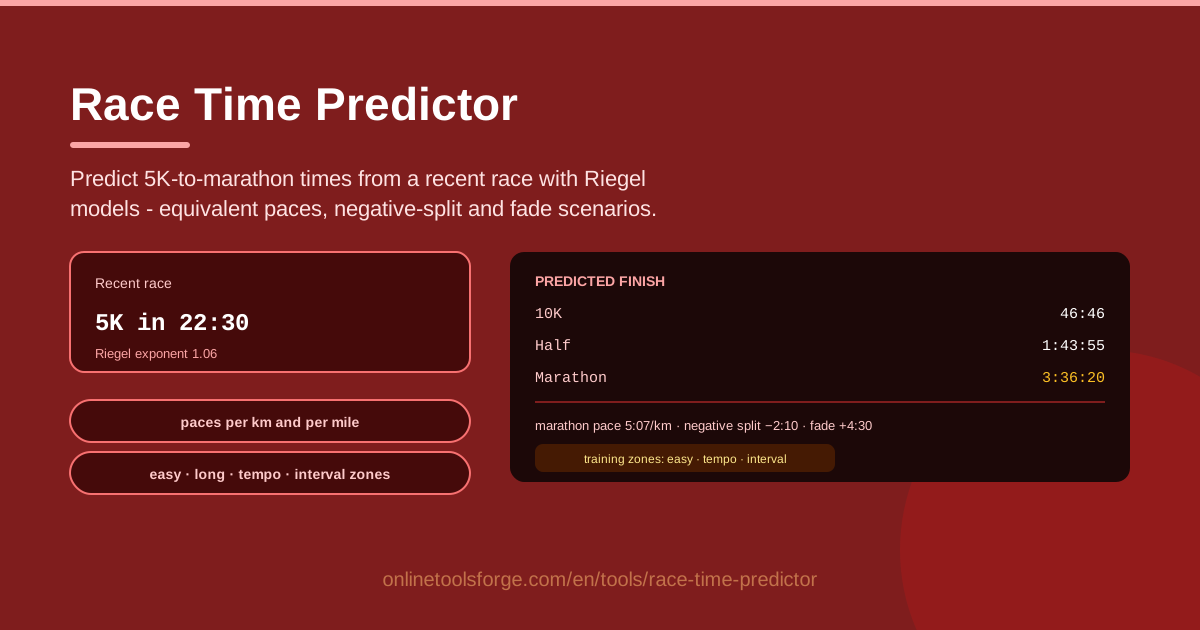
Table of Contents
Every runner knows the moment: you cross a finish line and immediately wonder what it means. You just ran a half marathon in 1:47 — what could you run for a full marathon in twelve weeks? What pace should your easy runs be? Guessing produces overambitious goals and pacing plans that fall apart. The Race Time Predictor answers those questions with math instead of hope.
The tool takes one recent race result and runs it through Riegel exponent models. In seconds you get predicted finish times from 5K to marathon, equivalent paces per kilometre and per mile, side-by-side negative-split and fade scenarios, and training-pace zones for easy, long run, tempo, and interval days. Everything runs client-side, so your racing history never leaves your device.
Why Use Race Time Predictor?
- Set goals from evidence, not vibes. A projection anchored to a current race reflects the runner you are today, not two years ago.
- Pick a marathon target you can hold. The half-marathon-to-marathon gap reality-checks optimistic goals before race day.
- Get paces in both units. Every prediction shows pace per kilometre and per mile, metric or imperial.
- Build your training week from one input. Easy, long run, tempo, and interval paces fall straight out of your result.
- Track fitness between races. Re-run the numbers after each block and watch your projections move.
Key Features
| Feature | What it does |
|---|---|
| Recent race input | Enter the distance and finish time of a recent hard race |
| Riegel predictions | Projects finish times across distances from 5K to marathon |
| Equivalent paces | Shows pace per kilometre and per mile for each predicted distance |
| Split scenarios | Compares negative-split and fade outcomes for your target race |
| Training-pace zones | Derives easy, long run, tempo, and interval paces from your result |
| Client-side math | All calculations run in your browser — instant, private, no signup |
Predictions update as you type, so you can test how a different result changes the projection. The further the target sits from the source race, the wider the estimate becomes.
How to Use Race Time Predictor
- Enter a recent race. Pick a hard result from the last four to six weeks: distance and finish time. A 10K or half marathon gives the most reliable marathon projections.
- Read the predicted times. Scan the projections from 5K through marathon to see where your current fitness lands.
- Study the equivalent paces. Note the per-kilometre and per-mile pace at your goal distance — these go into your watch.
- Compare split scenarios. Set the negative-split version against the fade version to see what pacing discipline is worth in minutes.
- Note your training zones. Write down the easy, long run, tempo, and interval paces for your next block.
Riegel Models and Their Honest Limits
The engine is the Riegel formula: your predicted time for a longer distance equals your known time multiplied by the ratio of distances raised to an exponent. At exactly 1.00 the model would assume you can hold the same pace forever, which no human can. Peter Riegel settled on roughly 1.06 for trained runners, the family this predictor uses. The gap between 1.00 and the effective exponent is a fade tax — the cost of holding speed as distance grows.
Why does the tax grow with distance? Fueling: glycogen stores cover roughly 90 minutes of hard running, so anything longer becomes an eating-and-drinking problem as much as a fitness one. Pacing error: long races offer more chances per kilometre to lose time to crowds, wind, or hills, and small mistakes compound. Muscular endurance: holding race effort for three hours stresses tendons in ways a 40-minute effort never does. A marathon projection from a 10K is therefore wider than one from a half marathon.
The split scenarios make this concrete. A negative-split race — second half slightly faster than the first — is how most personal records are set, because it spends glycogen evenly instead of front-loading it. The fade scenario models the common outcome: going out too hot. Seeing both side by side prices each strategy in minutes — cheaper than learning it at kilometre 36.
Equivalent paces turn prediction into a plan. For each distance the tool gives pace per kilometre and per mile, so you can convert straight into split targets: what the watch should read at 10K of a half, at mile 20 of a marathon, at every interval. Rounding to something memorable — 5:30 per kilometre, say — holds up better under fatigue than a stopwatch fraction.
Training zones come from the same race pace. Easy runs sit well below it to build aerobic base without recovery debt. Long-run pace lands between easy and marathon effort. Tempo clusters near 10K-to-half-marathon effort, where lactate threshold improves. Intervals run faster than 5K pace for top-end speed. One result, four purposeful paces.
One rule above all: predict from a recent race, not an old PR. A 5K personal best from three years ago describes a different athlete. The model is only as honest as the result you feed it.
Practical Use Cases
First Marathon Goal Setting
You ran a 1:52 half marathon in cool spring weather. Enter it and the predictor projects a marathon around 4:05 to 4:15, depending on your fade margin. That number reshapes the block: long runs capped near 5:50 per kilometre, and a race plan built on 5:50-to-6:00 kilometres rather than the 5:15 of your old 10K. Realistic goals finish races.
Half Marathon Pacing Plan
Targeting a sub-1:45 half? The tool hands you the pace per kilometre and per mile, so the plan writes itself: pass 10K around 49:30 on negative-split pacing, hold through 15K, then spend what is left over the final five. The fade scenario — going out 15 seconds per kilometre too fast — projects closer to 1:48, a strong case for discipline at the start.
Interval Pace Targets for Track Work
Predictions are not only for race day. From a recent 10K of 46:00, the interval zone lands near 4:10-to-4:15 per kilometre — quicker than 5K race effort. Your Tuesday session now has a target: 6 × 800 metres at that pace with equal jog recovery. Tempo and easy days get their own numbers too.
Tracking Fitness Between Races
Race every six to eight weeks and run the predictor after each one. A projected marathon moving from 4:20 to 4:08 across a block tells you the training worked — and whether your goal-race target is safe or needs adjusting. No lab, no lactate meter, just the same distance re-measured with honest effort.
Best Practices
- Predict from a hard recent effort. A race you genuinely raced, within six weeks, gives the most honest projection.
- Adjust for weather and hills. Heat, wind, or a lumpy course can cost minutes; the model assumes near-ideal conditions.
- Round goals conservatively. If the projection says 1:44:30, train for 1:45 — finishing inside a round number beats missing it.
- Race to the plan, not the prediction. The number sets your pace band before the gun; after that, execute.
- Re-run it after every key race. Fresh input, fresh zones, honest training paces.
- Use the zones, not just the headline. Most of the value lives in the daily paces, not the screenshot.
Before your next start line, spend two minutes with the Race Time Predictor. Enter your latest result, collect your projected times, paces, and zones, and let the next block begin from evidence. It is free, instant, and entirely browser-based.
Related Tools You Might Like:
- VO2 Max Calculator — estimate your aerobic ceiling and see how it frames every prediction.
- Interval Timer — run your sessions at exactly the paces the predictor gives you.
- Bicycle Gear Calculator — cross-training cyclists can dial in gearing with the same precision.
Happy racing!
Frequently Asked Questions
Q: How accurate is a race time prediction? A: With a recent, all-out race result, projections within 2-4% of reality are common for trained runners — a couple of minutes at half marathon distance. Accuracy drops as the gap between source and target grows, and every projection assumes decent weather and a fair course.
Q: Can I predict a marathon from a 5K? A: You can, but treat it as a wide estimate. The longer the projection, the more the Riegel exponent does the work, and factors the model cannot see — fueling practice, long-run volume — start to matter more. A half marathon result is far more trustworthy.
Q: Do I need an account, and is my data stored? A: No account and no storage. All math runs client-side in your browser; your race results never leave your device.