Macro Calculator: Turn Calorie Targets into Protein, Carb, and Fat Grams
Calculate daily calorie, protein, carbohydrate, and fat targets from body weight, activity level, and goal using the Mifflin-St Jeor equation. Free, private, and 100% client-side.
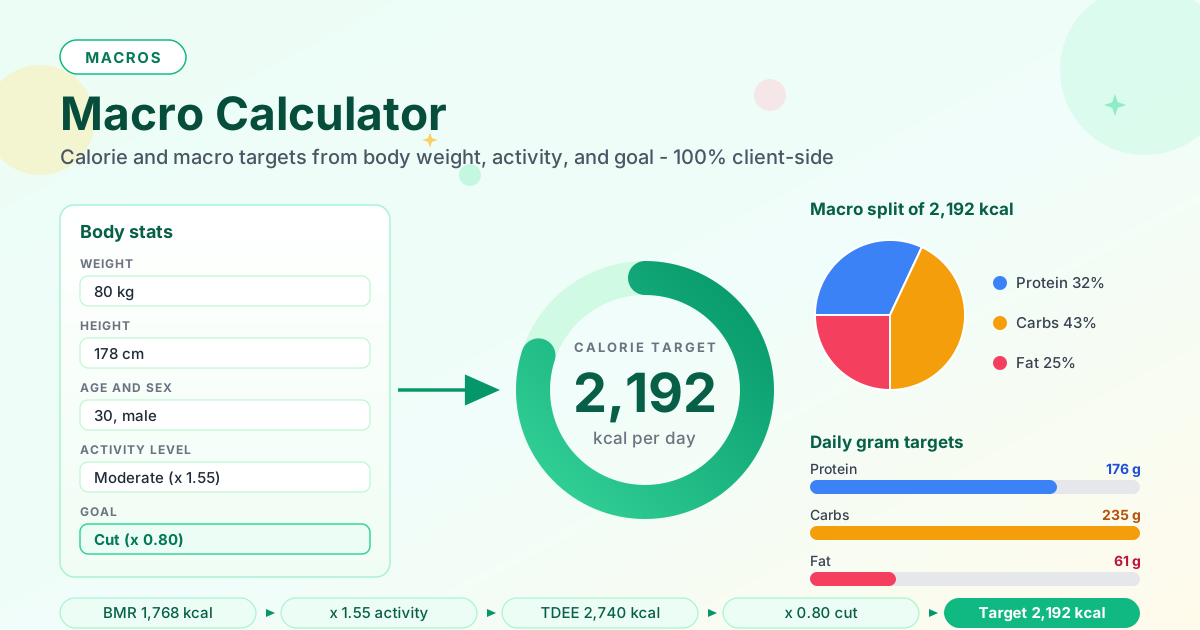
Table of Contents
Macro Calculator: Turn Calorie Targets into Protein, Carb, and Fat Grams
Calories decide whether your weight moves; macros decide what it is made of. Two people eating the same 2,200 kcal can end up in very different places depending on where those calories come from. Protein, carbohydrate, and fat are the levers that turn a calorie number into a body-composition outcome.
Our free Macro Calculator does the conversion in one screen. Enter body weight, height, age, sex, activity level, and goal, and it estimates your BMR with the Mifflin-St Jeor equation, scales that into a calorie target for cutting, maintaining, or bulking, and splits it into protein, carb, and fat grams. Everything runs in your browser — nothing is uploaded or stored.
This guide walks through the pipeline with a fully worked example.
Why Use Macro Calculator?
- Targets turn goals into grams. "Eat better" is not a plan; 176 g protein, 235 g carbs, and 61 g fat is.
- Goal-aware protein. Protein rises to 2.2 g per kg when cutting and 1.8 g per kg otherwise, because needs shift with your goal.
- The Mifflin-St Jeor equation. The formula most dietitians recommend for healthy adults, more accurate than older Harris-Benedict versions.
- Private by design. Every calculation runs client-side; nothing you type ever leaves your device.
- Instant, copyable results. The Copy button hands you the full breakdown for any tracking app.
Key Features
| Feature | What it does |
|---|---|
| Mifflin-St Jeor BMR | Resting metabolism from weight, height, age, and sex. |
| 5 activity levels | Multiplies BMR by 1.2-1.9 for daily expenditure. |
| 3 goal presets | 20% deficit to cut, 10% surplus to bulk, no change to maintain. |
| Protein by body weight | 2.2 g/kg when cutting, 1.8 g/kg otherwise. |
| Carbs fill the remainder | Fat takes 25% of calories; carbohydrates absorb the rest. |
| Built-in validation | Sensible input ranges catch typos before results appear. |
- The summary card shows BMR and TDEE alongside the target; Reset clears the form in one click.
How to Use the Macro Calculator
- Enter your stats. Age, sex, height, and current weight in kilograms drive the BMR estimate.
- Choose your activity level. Match a typical week, not your best week — honesty matters most here.
- Select your goal. Cut, maintain, or bulk; the calorie adjustment and protein multiplier apply automatically.
- Read your targets. You get BMR, TDEE, daily calories, and protein, carb, and fat grams — a complete plan in four numbers.
- Copy and start tracking. Paste into your food logger and recalculate whenever weight or routine changes.
Mifflin-St Jeor to Macros
The pipeline is simple: body stats to BMR, BMR to TDEE, TDEE to calories, calories to macros.
Step 1: BMR from the Mifflin-St Jeor Equation
Basal metabolic rate (BMR) is the energy you burn at complete rest:
- Men: BMR = 10 × weight(kg) + 6.25 × height(cm) − 5 × age + 5
- Women: BMR = 10 × weight(kg) + 6.25 × height(cm) − 5 × age − 161
The only difference is the final constant. Weight dominates — each kilogram adds about 10 kcal per day — so targets should move as your weight does.
Step 2: TDEE with Activity Multipliers
BMR is your baseline, not your budget. TDEE multiplies it by an activity factor:
| Level | Description | Multiplier |
|---|---|---|
| Sedentary | Little or no exercise | 1.2 |
| Light | Exercise 1-3 days/week | 1.375 |
| Moderate | Exercise 3-5 days/week | 1.55 |
| Active | Exercise 6-7 days/week | 1.725 |
| Very active | Hard daily training | 1.9 |
Step 3: Goal Adjustments
Your goal sets the calorie target. Cutting applies 0.8 — a 20% deficit, the firm end of the 15-20% range most coaches recommend. Bulking applies 1.1 — a 10% surplus big enough to grow on without dieting the excess off later. Maintenance is TDEE unchanged.
Step 4: Protein First
Protein is set first because its job is clearest: building and keeping muscle. Research supports roughly 1.6-2.2 g per kg daily for hard-training people — enough to maximize growth in a surplus and defend lean mass in a deficit, when muscle-breakdown risk peaks. The calculator uses 1.8 g/kg for maintenance and bulking, and 2.2 g/kg for cuts.
Step 5: Splitting the Rest between Carbs and Fat
With protein locked, fat takes 25% of total calories — enough for hormones and vitamin absorption — and carbohydrates fill whatever remains, since they cheaply fuel training and are the easiest macro to adjust.
A Fully Worked Example
Take an 80 kg male, 178 cm, age 30, training moderately (3-5 days a week), cutting:
- BMR = 10 × 80 + 6.25 × 178 − 5 × 30 + 5 = 1,768 kcal/day
- TDEE at moderate (1.55) = 1,767.5 × 1.55 ≈ 2,740 kcal/day
- Calorie target for a cut (× 0.8) ≈ 2,192 kcal/day
- Protein at 2.2 g/kg = 80 × 2.2 = 176 g (32% of calories)
- Fat at 25% of calories = 2,192 × 0.25 ÷ 9 ≈ 61 g (25%)
- Carbs fill the remainder: (2,192 − 176 × 4 − 61 × 9) ÷ 4 ≈ 235 g (43%)
Six inputs, one complete day of eating — the same arithmetic the tool runs instantly.
These formulas are population averages, not medical advice. Pregnancy, chronic conditions, medications, and a history of disordered eating all change the picture; if any apply, set targets with a doctor or registered dietitian.
Practical Use Cases
Muscle Gain Phases
The 10% surplus keeps a bulk productive without banking fat, while 1.8 g/kg protein feeds recovery. Recalculate as the scale climbs; every kilogram gained raises BMR and protein.
Fat-Loss Cuts
Cutting is where macro precision pays: a 20% deficit that keeps strength in the gym, with raised protein protecting the muscle you are dieting to reveal. Judge results by the weekly trend.
Maintenance Breaks
Planned maintenance phases — two to four weeks at TDEE — keep long cuts livable and composition stable while diet fatigue fades.
Athletic Season Prep
Heavy training loads justify the very-active multiplier. Preseason, a small surplus builds the base; in-season, maintenance keeps energy high; a short pre-selection cut uses the full deficit with maximum protein.
Best Practices
- Weigh your food. Eyeballed portions drift by hundreds of calories; a kitchen scale makes gram targets real.
- Recalculate every 4-6 weeks. A 2-3 kg change on the scale moves calories and protein enough to matter.
- Prioritize protein on imperfect days. When the plan slips, hit the protein number first and let carbs and fat flex.
- Adjust by results, not formulas. If two honest weeks show no trend, move calories 100-200 kcal and re-measure.
- Treat the carb-fat split as movable. The 25% fat floor is a default, not a law.
Set Your Macro Targets Today
Six inputs, one gram-level plan: Mifflin-St Jeor for BMR, activity multipliers for TDEE, a goal adjustment for calories, and a protein-first macro split. Open the Macro Calculator, enter your stats, and turn your goal into three numbers you can hit starting with your next meal.
Related Tools You Might Like:
- BMR & TDEE Calculator — the BMR and TDEE pipeline in detail, with more goal presets.
- BMI Calculator — see where your weight sits on the standard BMI ranges.
- Calorie Calculator — a quick calorie-only estimate without the macro breakdown.
Eat with intent — may your protein always hit and your scale always trend.
Frequently Asked Questions
Q: What equation does the Macro Calculator use?
A: The Mifflin-St Jeor equation, which estimates BMR from weight, height, age, and sex. It is the formula most widely recommended for healthy adults, tracking measured metabolism more closely than Harris-Benedict.
Q: Why is protein higher when I choose cut?
A: In a deficit the body breaks down muscle for energy more readily, and higher protein counteracts that. The tool uses 2.2 g per kg when cutting versus 1.8 g per kg otherwise, both inside the 1.6-2.2 g/kg range supported by research.
Q: Is my body data sent anywhere?
A: No. The calculator runs entirely in your browser, so your weight, height, and age never leave your device.