Mulch Calculator: How Many Bags or Bulk Cubic Meters Your Garden Bed Really Needs
The free Mulch Calculator turns your garden-bed area and depth into an exact bag count or bulk cubic meters, with a bag-versus-bulk cost comparison and coverage chart.
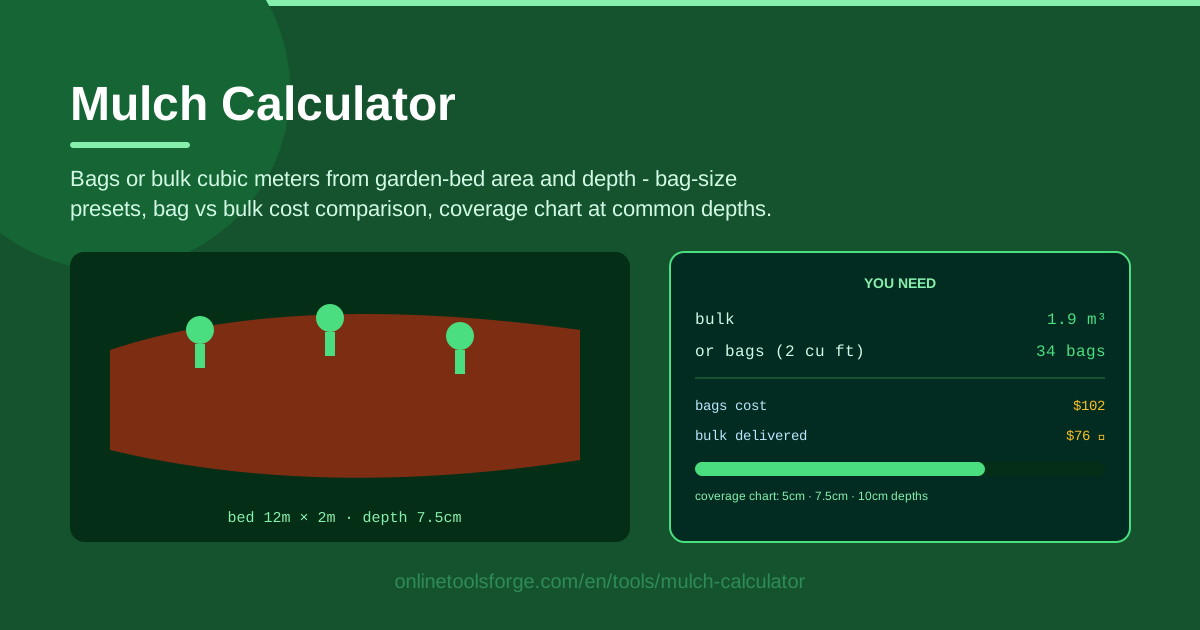
Table of Contents
Mulch is the quiet workhorse of every garden bed: it smothers weeds, holds moisture through hot spells and keeps soil temperature steady. The frustrating part is that mulch is sold in units nobody thinks in — bags in liters, bulk in cubic meters, beds in square meters — so converting by feel ends in a half-covered bed or a pile of leftover bags. The free Mulch Calculator from Online Tools Forge turns your bed area and chosen depth into exact numbers, whether you shop by the bag or order by the truckload.
Enter your garden-bed area and the depth you want to apply, and the tool computes the total mulch volume instantly. It then translates that volume into a bag count for the bag-size presets you select, shows the same requirement as bulk cubic meters for loose or tote delivery, and prices both options side by side so you can see which way of buying is genuinely cheaper. A coverage chart at common depths rounds out the picture.
Everything runs client-side in your browser: no signup, no uploads, results updating as you type — exactly what you want while pacing out a bed or standing in the mulch aisle.
Why Use Mulch Calculator?
Guessing mulch quantities costs money in both directions — short orders stall the job, oversized orders waste it. Here is what the calculator fixes:
- Stop guessing bag counts. Retail bags range from 25 to 80 liters. The tool converts your exact volume into a whole-bag count for the preset you choose, always rounding up so you never return for one missing bag.
- Bag vs bulk savings. This is where budgets are won or lost. Bags are convenient but often cost two to three times more per cubic meter than delivered mulch, and the built-in comparison shows the real crossover point for your project.
- Coverage chart at common depths. See how far a given volume spreads at 5, 7.5 and 10 centimeters — perfect for topping up a bed that thinned over winter.
- Depth-aware math. Dropping from 10 cm to 7.5 cm cuts your order by a quarter, and the tool makes that trade-off visible before you pay.
- Handles any bed shape. Measure an awkward bed in sections, add the areas, and the totals stay exact.
- Private and instant. Pure client-side math means nothing is uploaded and nothing slows you down.
Key Features
Everything the Mulch Calculator does fits on one screen:
| Feature | What it does |
|---|---|
| Garden bed area input | Enter your bed area in square meters, built from one or several measured sections. |
| Depth selection | Set the application depth in centimeters to control how much volume the project needs. |
| Bag-size presets | Match the retail bags sold near you so the tool reports a realistic bag count. |
| Bulk volume result | The same requirement expressed in cubic meters for loose or bulk-bag orders. |
| Bag vs bulk cost comparison | Enter your local prices and see which buying method wins at your exact volume. |
| Coverage chart | A quick-reference guide to area covered at common depths. |
| Client-side math | All calculations run in your browser — no uploads, no accounts. |
A few of these deserve a closer look:
- The bag-size presets cover common retail volumes, so the difference between a 25 liter and a 60 liter bag is never lost in translation.
- The cost comparison works both ways: if you already have a bulk quote, you can see how many bags it would take to make delivery worthwhile.
- The coverage chart doubles as a top-up planner when you only need a few extra centimeters over an existing layer.
How to Use Mulch Calculator
- Measure your bed area. Multiply length by width for each rectangular bed and add the results. Split L-shaped or curved beds into rectangles and sum the sections.
- Pick your depth. Most beds work well at 5 to 10 centimeters; the section below explains which end of that range suits your mulch type.
- Choose a bag size. Select the preset matching the bags sold near you, or skip straight to the bulk cubic meter figure if you plan a delivery.
- Compare bag vs bulk cost. Enter the bag price and the bulk price per cubic meter, then let the comparison name the cheaper option at your volume.
- Order with a margin. Round up and add roughly 5 percent for settling and uneven spreading, then place the order with confidence.
Depth, Bags and the Bulk Point
Why 5 to 10 centimeters is the range. Below about 5 cm, mulch lets light reach weed seeds and dries too fast to protect roots. Push past 10 cm and air and water struggle to reach the soil, shallow roots grow up into the layer, and bark can stay damp enough to rot. In practice, fine mulches around annuals sit happily at 5 to 7.5 cm, standard shrub borders look right at 7.5 cm, and coarse bark chips on paths or under hardy trees take the full 10 cm.
The volume math behind the tool. Mulch volume is simply area multiplied by depth. A 20 square meter bed at 7.5 cm needs 20 × 0.075 = 1.5 cubic meters. Since one cubic meter equals 1,000 liters, bag counts follow directly: 1,500 liters is 60 bags of 25 liters or 30 bags of 50 liters. The calculator runs this conversion for any area, depth and bag size you enter, always rounding up to whole bags.
When bulk beats bags. Bags win on convenience — buy a few today, carry them to the back garden, open them only as needed. Per cubic meter, though, bags are usually the pricier option, often by a factor of two or more. Loose delivery or a one-cubic-meter bulk tote almost always wins once a project needs more than roughly 10 to 15 bags — about 0.3 to 0.5 cubic meters. The exact crossover depends on delivery fees, which is why the calculator takes your real local prices instead of a rule of thumb.
What the coverage chart is for. The chart answers the reverse question: given a volume, how far does it go? One cubic meter covers about 20 square meters at 5 cm, around 13 at 7.5 cm, and 10 at 10 cm. That makes it easy to check whether last season's half-empty bags will finish a top-up, or how much of a long border one delivery will reach.
Practical Use Cases
Spring bed refresh
A 20 square meter front border has thinned to 3 cm over winter and needs topping back up to 7.5 cm — roughly 1 cubic meter of extra mulch. That is 40 bags of 25 liters, or one bulk tote to share with a neighbor. Entering the area and depth confirms the order size in seconds and shows whether the tote or the pallet of bags is cheaper this year.
Playground safety surface
Play areas need far deeper material than flower beds. Certified play bark or engineered wood fiber is typically laid 15 to 30 cm deep, following the manufacturer's fall-height guidance. A 12 square meter zone at 20 cm needs 2.4 cubic meters — 96 bags of 25 liters. At that scale the bulk comparison is not optional; it is usually the difference between a reasonable and a painful budget.
Tree ring mulching
A ring around a young tree with a one-meter radius covers about 3.14 square meters. At 5 cm depth that is roughly 0.16 cubic meters, or 6 to 7 bags of 25 liters. Enter the ring's area as a single number and the calculator does the rest — while the golden rule stands no matter the math: keep mulch a hand-width away from the trunk.
Community garden planning
Twelve plots of 4 square meters each give 48 square meters to cover. At 7.5 cm the group needs 3.6 cubic meters — the equivalent of 144 small bags, which is firmly bulk-delivery territory. Comparing one delivered order against bag prices lets the committee set a fair per-plot share and order once instead of twelve times.
Best Practices
- Order about 5 percent extra. Settling, uneven ground and spillage eat into every order; a small surplus beats a second delivery fee.
- Keep mulch off trunks and stems. Build a donut, not a volcano — mulch piled against bark invites rot and pests.
- Measure odd beds in sections. Two or three summed rectangles beat one bad guess every time.
- Compare delivered bulk prices locally. Delivery fees vary wildly by supplier and distance, so enter real quotes rather than averages.
- Refresh lightly and often. A yearly 5 cm top-up beats burying plants under a deep layer once every three years.
- Write your numbers down. Keep the area and depth in a garden journal so next season is a two-minute job.
Open the Mulch Calculator, type in your bed's area and depth, and you will know your exact bag count, bulk volume and the cheaper way to buy before your coffee cools. It is free, instant and runs entirely in your browser — no account required.
Related Tools You Might Like:
- Paver Calculator — size the paving for the paths around your beds.
- Unit Converter — switch between square meters, liters, cubic meters and more.
- Decking Calculator — trading lawn for a deck? Board count in seconds.
Happy gardening!
Frequently Asked Questions
Q: How many mulch bags do I need for 20 square meters? A: At the standard 7.5 cm depth you need 1.5 cubic meters — 60 bags of 25 liters or 30 bags of 50 liters. Enter your real area and depth in the Mulch Calculator for a count rounded up to whole bags.
Q: What depth should I enter in the Mulch Calculator? A: Use 5 to 7.5 cm for fine mulches and routine refreshes, and 7.5 to 10 cm for coarse bark around shrubs, trees and paths. Playground surfaces are the exception, typically needing 15 to 30 cm per the material's safety specification.
Q: When does bulk mulch beat buying bags? A: Usually once you need more than about 10 to 15 bags, or roughly 0.3 to 0.5 cubic meters. Bags cost more per cubic meter, but bulk adds a delivery fee — enter your local prices in the comparison and let the numbers decide.
Q: Does the Mulch Calculator store or upload my measurements? A: No. Every calculation runs client-side in your browser. Your dimensions and prices never leave your device, and the tool even works offline once the page has loaded.