Fiscal Quarter Calculator: Map Any Date to the Right Fiscal Quarter
Fiscal Quarter Calculator maps any date to its fiscal quarter for calendar or custom fiscal-year start months, showing quarter dates, days remaining, and a full FY-to-Gregorian crosswalk.
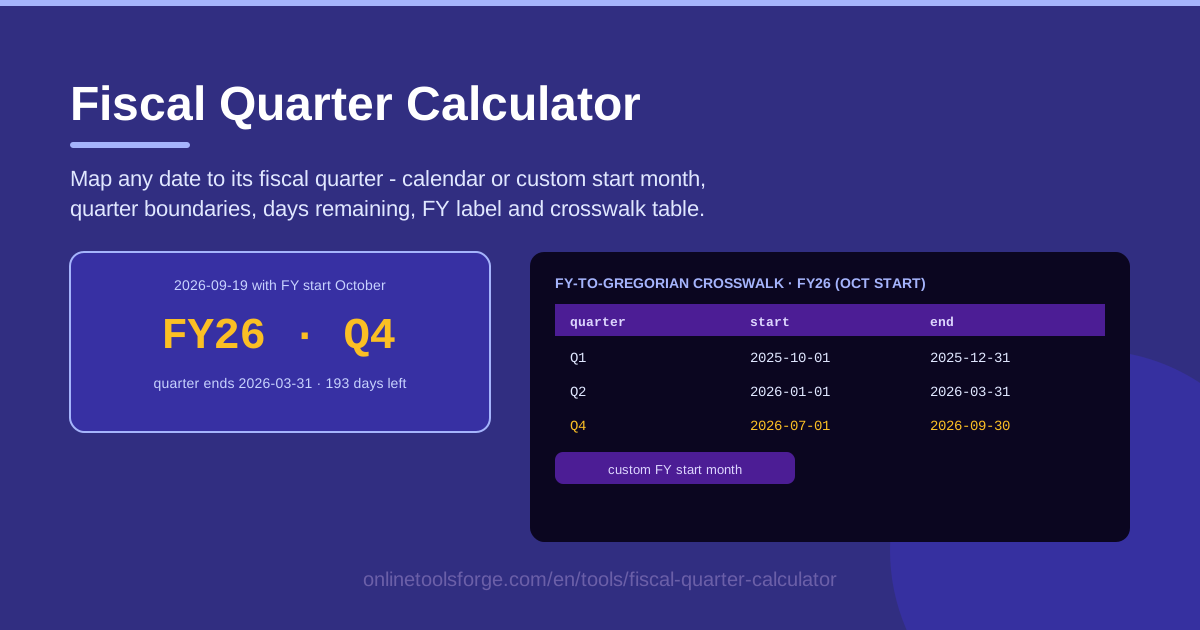
Table of Contents
Ever been handed a report stamped "FY26 Q3" with no idea which months it covers? You are in good company. The Fiscal Quarter Calculator clears it up in seconds: enter any date, choose the month your fiscal year starts, and instantly see the quarter it belongs to, its start and end dates, the correct FY label, and how many days remain before it closes.
The root is simple: fiscal years do not all start in January. The US federal government runs October to September, the UK starts in April, and Thailand also begins in October. Many companies pick a start month that fits their business rhythm, so the same Tuesday in June can be Q2 for one organization and Q3 for another.
Why Use Fiscal Quarter Calculator?
- October-start fiscal years trip everyone up. Under the US federal and Thai October start, June belongs to Q3, not Q2, and FY26 has been running since the previous October.
- Manual quarter math invites mistakes. With a custom start month every boundary is offset from the calendar, and people attach those boundaries to the wrong year.
- Deadline planning needs days remaining. Knowing you are "in Q2" means little until you know only nine weeks remain before it closes.
- International teams live on different fiscal calendars. A London partner, a Bangkok ministry, and your headquarters can sit in different quarters on the same day.
- FY labels are ambiguous. Depending on the organization, FY26 can mean a year that starts in 2025 or one that starts in 2026.
Key Features
| Feature | What it does |
|---|---|
| Any-date input | Enter any calendar date and find the fiscal quarter it belongs to |
| Custom FY start month | Use January for the calendar year or pick any month as the fiscal-year start |
| Quarter start and end dates | Shows the exact first and last day of the current fiscal quarter |
| Days remaining | Counts the days left until the quarter closes for deadline planning |
| Fiscal-year label | Displays the correct FY label, such as FY26, for the chosen date |
| FY-to-Gregorian crosswalk | Maps every fiscal quarter to its Gregorian start and end dates in one table |
| Client-side math | Runs entirely in your browser — no account, no upload |
- The crosswalk is the workhorse. It answers every "which quarter is that?" question for the whole fiscal year in one view.
- Switching start months is instant. Move from January to October and the quarter, label, boundaries, and countdown all recalculate immediately, entirely client-side.
How to Use Fiscal Quarter Calculator
- Enter a date. Pick today, a contract date, or any future deadline you want to check.
- Set the fiscal-year start month. Leave January for the calendar year, or select October, April, or whichever month your organization uses.
- Read the quarter and fiscal-year label. The result shows where the date lands, such as FY26 Q3, plus the quarter's first and last day.
- Check the days remaining. The countdown shows exactly how many days are left until the quarter ends — your real deadline runway.
- Use the crosswalk table. Review all four quarters with their start and end dates, then copy the table into your planning docs.
Fiscal Years Do Not Start in January
Governments moved their fiscal years for practical reasons. The US federal year starts October 1 so Congress can pass spending bills before money flows; the year begun October 1, 2025 is federal FY26, ending September 30, 2026. The UK starts its tax year in April, Thailand runs October 1 to September 30, Australia uses July, and many Japanese companies use April.
Quarter boundaries follow from the start month, but the year labels are where people slip. With an October-start FY26, the mapping looks like this:
| Fiscal quarter | Gregorian dates |
|---|---|
| FY26 Q1 | Oct 1, 2025 – Dec 31, 2025 |
| FY26 Q2 | Jan 1, 2026 – Mar 31, 2026 |
| FY26 Q3 | Apr 1, 2026 – Jun 30, 2026 |
| FY26 Q4 | Jul 1, 2026 – Sep 30, 2026 |
Notice the twist: half of FY26 happens during calendar 2025. Start the year in April instead, and a January date lands in Q4 of the previous fiscal year — arithmetic the calculator automates for any start month.
Most organizations name the fiscal year after the year in which it ends — the US federal year spanning October 2025 to September 2026 is FY26 — while others use the starting year, and UK writing splits the label as FY26/27. So "FY26" can begin in 2025 or 2026 depending on the speaker. Confirm the convention and attach the Gregorian dates.
Days remaining turns a quarter into a planning tool: on March 15, 2026, a January-start organization is still in Q1, but only sixteen days remain before it closes. Paste the crosswalk into a wiki so everyone shares one definition of each quarter.
Practical Use Cases
Contract Deadline Checks
A vendor agreement may require reports within 30 days of each fiscal quarter's end. If the client's fiscal year starts in October, the Q2 report is due within 30 days of March 31 — not June 30. The calculator gives you the quarter end and the countdown, so you file on time.
Budget Planning Cycles
Finance teams draft next year's budget two or three quarters early. For an April-start fiscal year, work on FY27 often starts in late 2025. Use the crosswalk to see when each planning quarter opens, and let the countdown keep approvals off the quarter-end pile-up.
Grant Reporting Windows
Public grants typically demand quarterly reports on the funder's fiscal calendar, not yours. A Thai ministry or US federal agency on an October start expects Q1 data covering October through December. Map those windows before accepting the award.
International Team Coordination
A Bangkok office, a UK partner, and a US headquarters can each sit in a different fiscal quarter on the same day. When a shared roadmap says "by end of Q2," pin each entity's crosswalk to the project page so Q2 stops meaning three different things.
Best Practices
- Confirm your organization's fiscal-year start month in writing. A two-minute check with finance prevents a quarter of mislabeled reports.
- Label reports with the FY, not the calendar year. "FY26 Q2 (Jan–Mar 2026)" cannot be misread; "Q2 report" alone can.
- Plan quarter-ends early. Start close work two to three weeks ahead, using the days-remaining figure as your alarm.
- Share the crosswalk table. Paste it into wikis and charters so every stakeholder maps quarters to real dates.
- Re-run the tool when the start month changes. Refresh saved tables rather than editing them by hand.
Whether you are closing the books, chasing a contract deadline, or decoding a colleague's "FY26 Q4" reference, the Fiscal Quarter Calculator turns guesswork into a ten-second lookup. Try it at Fiscal Quarter Calculator — enter a date, set your start month, and see the whole fiscal year laid out.
Related Tools You Might Like:
- Cron Parser — decode and preview cron schedules for recurring jobs
- Timezone Converter — line up quarter-close deadlines across offices
- Week Number Calculator — convert dates to ISO week numbers for reporting
Happy planning!
Frequently Asked Questions
Q: What exactly is a fiscal quarter? A: One of four three-month blocks that make up a fiscal year. If the year starts in January, quarters match the calendar, Q1 covering January through March. With any other start month the blocks shift, and the tool shows the shifted dates.
Q: Why is June in Q3 when my fiscal year starts in October? A: Q1 of an October-start year runs from October 1 to December 31, so January through March is Q2, April through June is Q3, and July through September is Q4. Your quarter depends entirely on where the year begins — hence the correct start month matters.
Q: What does FY26 actually mean? A: Usually it means the fiscal year ending in 2026, so an October-start FY26 runs from October 1, 2025 to September 30, 2026. Some organizations label years by the starting year, and UK-style writing splits the label as FY26/27. Pair the label with its Gregorian dates from the crosswalk.