Pool Volume Calculator: How Many Gallons Does Your Pool Really Hold?
The free Pool Volume Calculator computes pool water volume in gallons and liters for rectangular, circular, oval, and kidney pools, with pump turnover time and chlorine dosing estimates.
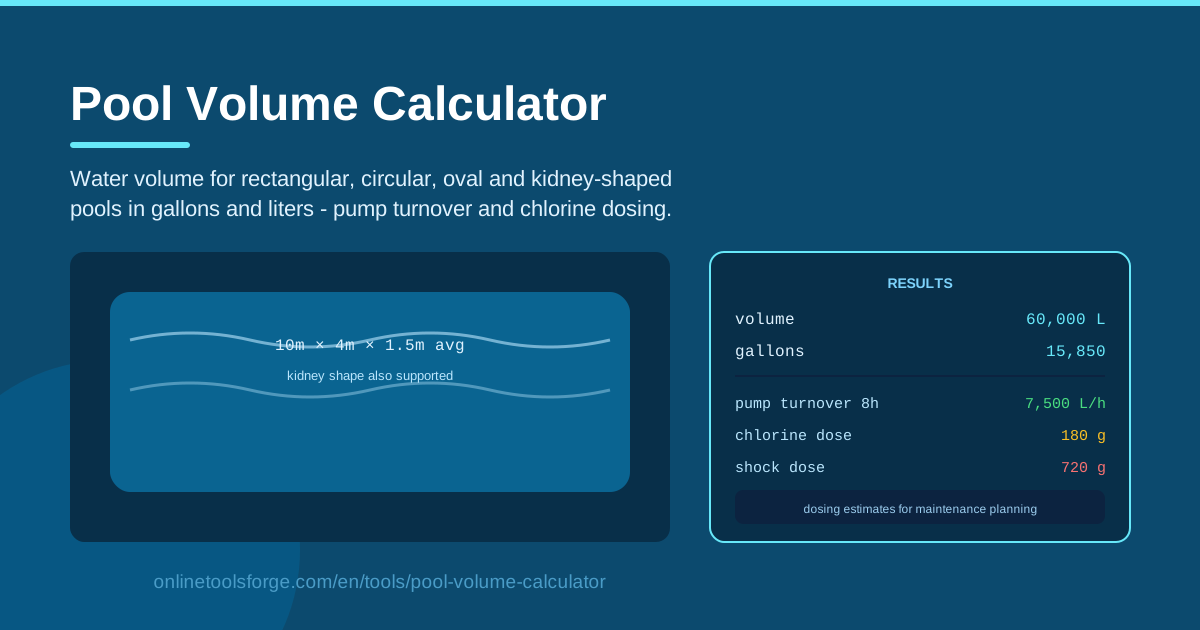
Table of Contents
Ask ten pool owners how much water their pool holds and you will get nine shrugs and one confident guess. Yet that single number — pool volume — controls nearly everything: the chlorine dose, the pump run time, the cost of a refill, even the algaecide you add during a heatwave.
That is why we built the Pool Volume Calculator. Choose your shape — rectangular, circular, oval, or kidney — enter a few dimensions, and it instantly computes volume in gallons and liters, estimates pump turnover, and provides chlorine dosing figures. Everything runs in your browser: nothing to install, no sign-up.
Below: how to use the calculator, how the math works for each shape, and what to do with the number.
Why Use Pool Volume Calculator?
Here is why knowing your pool's volume changes how you maintain it:
- Every chemical dose depends on it. Chlorine, shock, and pH adjusters are dosed per 10,000 gallons or 1,000 liters — if your volume estimate is off by 30%, every dose is too.
- It sets your pump schedule. Filtration advice is built on turnover — circulating the whole pool once — impossible to judge without a volume figure.
- It prevents under- and over-dosing. Under-dosing invites algae; over-dosing wastes chemicals, irritates skin, and corrodes equipment.
- It makes refill costs predictable. Water is billed by volume, so an accurate figure lets you price a drain-and-refill before opening a valve.
- It guides equipment purchases. Pumps, heaters, and salt chlorine generators are sized by volume and flow rate — a good figure stops you overpaying for oversized gear.
- It takes seconds and costs nothing. Four shapes, a few dimensions, and you have gallons, liters, turnover, and dosing estimates.
Key Features
The workflow stays simple while the tool handles the geometry that trips people up.
| Feature | What it does |
|---|---|
| Multiple pool shapes | Handles rectangular, circular, oval, and kidney-shaped pools |
| Gallons and liters output | Shows water volume in US gallons and liters at once |
| Pump turnover estimate | Estimates how long your pump needs to circulate the full volume once |
| Chlorine dosing estimate | Suggests chlorine quantities scaled to your computed volume |
| Runs in the browser | Entirely client-side; nothing leaves your device |
Worth highlighting:
- The kidney shape is handled for you. It applies the average-width method to these awkward curves instead of a hand-drawn rectangle approximation.
- Dual units by default. Labels may quote liters, your bill cubic meters, and charts gallons; seeing both prevents mix-ups.
- Average-depth friendly. For sloped floors, enter the average depth and the calculator handles the rest.
How to Use Pool Volume Calculator
A trustworthy number takes about a minute:
- Pick your pool shape. Select rectangular, circular, oval, or kidney; the calculator asks only for the dimensions that shape needs.
- Enter your dimensions. Measure length, width, or diameter and the water depth — for a sloped floor, use the average of the shallow and deep ends.
- Read gallons and liters. Your dimensions become total volume in both units, matching whichever system your labels use.
- Check the pump turnover estimate. Compare it with your pump's flow rate to see whether your run schedule filters the whole pool.
- Plan chlorine dosing. Use the estimate as a starting point, then fine-tune with a test kit.
Why Every Pool Chore Starts With Volume
Pool volume is geometry: surface area times average depth, calculated differently for each shape.
Rectangular pools are the easiest: multiply length by width, then by average depth. Multiply cubic feet by 7.48 for US gallons (about 28.3 liters per cubic foot). A 20-by-10-foot pool averaging 4 feet deep holds roughly 5,985 gallons, or 22,650 liters.
Circular pools use pi times the radius squared, times average depth. Measure the diameter at water level and halve it; a 16-foot round pool averaging 4 feet deep holds about 6,030 gallons.
Oval pools combine the two: area equals pi times the long radius times the short radius, again multiplied by average depth. Longest length and widest width at water level are accurate enough.
Kidney-shaped pools defeat simple formulas. The trick is average width: measure the width at each rounded end and the narrow middle, average the three, then treat the pool as a rectangle of that width times its overall length. The result typically lands within a few percent of the true figure.
Average depth on sloped floors matters most. If your pool steps from a 3-foot shallow end to an 8-foot deep end, the average is 5.5 feet — not 8, not 3. Measure the water depth, not the wall height, and split the difference.
Gallons versus liters trips up more owners than any formula: one US gallon is 3.785 liters; one cubic meter is 1,000 liters (about 264.2 gallons). A packet dosed per 1,000 liters used in a pool misread as 1,000 gallons is four times too weak — hence the dual units.
Pump turnover is the time needed to push a volume equal to the entire pool through the filter once. Aim for one turnover every 8 hours: a 12,000-gallon pool needs about 25 gallons per minute; double the volume and the flow or run time doubles too.
Chlorine dosing per volume is where numbers become water quality, but volume is only half the equation. Sunlight, temperature, and swimmer load change real demand, so treat the estimate as a first dose, confirm with a test kit, and add chemicals one at a time.
Practical Use Cases
Chemical Dosing Schedules
Your pool computes to 13,500 gallons, but you follow labels written for a 10,000-gallon pool — under-dosing chlorine by 35%, which explains the stubborn algae on the steps. Multiply every label dose by 1.35 and your test results finally hold steady.
Pump Replacement Sizing
A 15,000-gallon pool targeting an 8-hour turnover needs roughly 31 gallons per minute of real flow, so an efficient pump matched to your volume beats an oversized model that costs more daily.
Fill Cost Estimation
A 45,000-liter refill is simply 45 cubic meters — multiply by your local rate and you know the cost before the hose goes in.
Seasonal Opening and Winterizing
Spring opening means balancing fresh water, closing requires precise winterizing doses; both anchor on the same volume figure, re-checked after liner replacement.
Best Practices
A few habits keep both your volume figure and your water trusted:
- Measure actual water depth, not wall height. Pools are rarely filled to the brim; a few inches can shift the total by hundreds of gallons.
- Dose in stages. Add half the calculated dose, circulate, retest, then top up if needed.
- Re-check after resurfacing. New liners can sit deeper or shallower; re-measure and update your records.
- Keep a volume note taped to the pump. Write the gallons, liters, and average depth on waterproof tape so everyone doses from the same number.
- Confirm units on every label. Liters, gallons, cubic meters — check which one the product chart assumes before dosing.
- Re-test after big top-offs. Tap water brings its own pH and hardness, so treat a large refill as a mini rebalance.
Opening for the season, replacing a pump, or tired of eyeballing chlorine? Start with the number everything else depends on. Open the Pool Volume Calculator, pick your shape, and get gallons, liters, turnover, and dosing estimates in under a minute — free, in your browser.
Related Tools You Might Like:
- Fish Tank Glass Thickness Calculator — size aquarium glass safely if you keep fish as well as swimmers.
- Unit Converter — convert gallons, liters, feet, and meters for any label or spec sheet.
- Paint Calculator — estimate paint for pool-side walls, fences, and refresh projects.
Swim happy — and dose by the numbers!
Frequently Asked Questions
Q: How accurate is the pool volume calculator? A: For rectangular, circular, and oval pools with careful measurements, results land within a few percent. Kidney pools use the average-width approximation, so refine with water-meter readings if needed.
Q: How do I handle a pool with a deep end? A: Measure depth at the shallow and deep ends, add them, and divide by two. On long gradual slopes, average three or four readings.
Q: Does it work for above-ground and round pools? A: Yes. Above-ground rectangles use the same math as in-ground pools, and the circular option covers round ones — measure from the water line, since these pools are rarely filled to the rail.
Q: Can the chlorine dosing estimate replace a test kit? A: No. Volume tells you how much product a target concentration requires, but sunlight, temperature, and swimmers change demand — use it as a starting dose and verify with a test kit.