Golf Handicap Calculator: Work Out Your World Handicap System Index the Right Way
Use the free Golf Handicap Calculator to turn your scorecards into a World Handicap System index, with score differentials, the lowest-N selection table, net double bogey caps, and a course handicap converter.
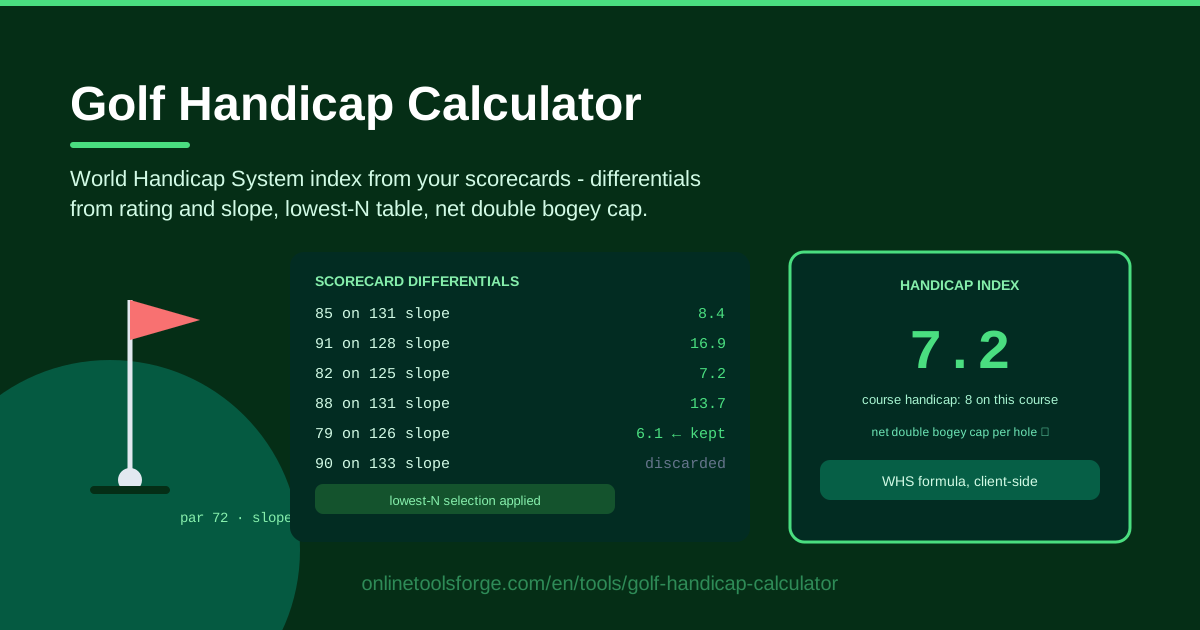
Table of Contents
Every golfer eventually asks the same question: what is my handicap, really? Since golf adopted the World Handicap System (WHS), the answer is calculated identically in over eighty countries — yet the math still trips up experienced players. The free Golf Handicap Calculator takes the guesswork out: enter your scorecards and it computes score differentials, applies the lowest-N selection table, caps holes at net double bogey, and converts the result into a course handicap for your next round.
A calculator helps because WHS scoring is strict about details: you need the course rating and slope for your tees, an adjusted gross score where blow-up holes are reined in, and an average of only your best differentials. This guide covers both halves — how to use the tool, and how each part of the system works.
Why Use Golf Handicap Calculator?
- It does the WHS math instantly. Score differentials from course rating and slope are calculated for every round, with no formulas to remember.
- The lowest-N selection table is built in. Only a set number of best differentials count depending on how many scorecards you have — the tool applies it for you.
- Blow-up holes cannot wreck your round. Each hole is capped at net double bogey, producing a fair adjusted gross score.
- You get a course handicap, not just an index. The converter translates your index into strokes received on a specific course and set of tees.
- It rewards potential instead of punishing bad days. Because the system averages your lowest differentials, one terrible round will not drag your index down.
- Everything runs client-side. Your scores stay in your browser; nothing is uploaded or stored anywhere.
Key Features
| Feature | What it does |
|---|---|
| Scorecard entry | Add rounds with your gross score plus the course rating and slope rating from the card. |
| Score differentials | Converts each round into a standardized differential for comparing rounds on different courses. |
| Lowest-N selection table | Picks which differentials count toward your index based on how many scorecards you have entered. |
| Net double bogey cap | Limits any hole to par plus two plus any handicap strokes received, producing your adjusted gross score. |
| Course handicap converter | Turns your handicap index into a course handicap for the course and tees you are about to play. |
| Client-side calculation | All math happens in your browser — fast, private, and free. |
The sorted differential list shows at a glance which rounds are pulling your index down, and the converter accepts any course rating and slope, so you can check your course handicap before leaving the clubhouse.
How to Use Golf Handicap Calculator
- Enter your scorecards. For each round, type your gross score plus the course rating and slope rating printed on the card for the tees you played.
- Review your score differentials. Each round is converted into a differential, showing how well you played relative to the course difficulty.
- Apply the lowest-N selection table. Based on the number of scorecards entered, the tool selects the correct number of lowest differentials and averages them into your index.
- Check the net double bogey caps. Any hole above par plus two (plus strokes received) is capped, keeping one bad hole from dominating.
- Convert to a course handicap. Enter the rating and slope of your next course and read off the strokes you will receive.
How the World Handicap System Works
The whole system rests on one number per round: the score differential. It equals your adjusted gross score minus the course rating, multiplied by 113 (the standard slope), divided by the slope rating of the tees you played. A differential of 10.0 means you played ten strokes better than a scratch golfer would score on that course.
Why slope makes courses comparable. Slope rating describes how much harder a course plays for a bogey golfer than for a scratch golfer. A slope-135 layout punishes higher handicappers far more than a gentle 113 parkland course, so dividing by slope puts every round on the same ruler.
The lowest-N selection and why bad rounds get discarded. WHS never averages all of your differentials. A table maps the number of scorecards you hold to how many lowest differentials count: with a full record of 20 scores, your best 8 are averaged, multiplied by 0.96. A handicap should reflect demonstrated potential — the golfer you are on a good day — not an average dragged down by rain-soaked Saturdays and three-putted greens.
The net double bogey cap. Before any differential is calculated, your raw round becomes an adjusted gross score: no hole may count for more than par plus two, plus any handicap strokes you receive on that hole. One stroke on a par 4 means your maximum there is a 7, so a single quadruple cannot misrepresent a solid round.
Course handicap conversion. An index is portable; a course handicap is what you play off. It derives from your index, the slope of the tees in play, and the difference between course rating and par. The same index might give you 14 strokes on one course and 17 on a tougher one — which is the point.
Minimum scorecards. You need at least 54 holes — say three 18-hole rounds or six 9-hole rounds — before an index can be established; with fewer than 20 scorecards, fewer differentials count. The lowest-N table handles these partial records automatically.
Practical Use Cases
Getting Your First Official Index
New golfers often have a pile of scorecards and no idea what to do with them. Enter recent rounds from rated courses, using the correct rating and slope from each card, and the calculator shows whether you have reached the minimum for an index — and what it would be today.
Tracking Improvement Across a Season
Post each round as the season progresses and watch your differentials trend downward. Because the lowest-N table updates automatically, you can see exactly when a good stretch of golf actually lowers your index, and by how much.
Preparing for a Tournament Entry
Entry forms usually ask for a current handicap index, and sometimes your course handicap for the venue. Run your scorecards through the tool the week before the event, then use the converter for the tournament tees so you arrive with defensible numbers.
Comparing Scores Across Courses
Shot 92 on a slope-140 championship layout and 88 on an easy municipal? Raw scores favor the second round; the differentials will probably say the opposite. Entering both reveals which round was genuinely stronger.
Best Practices
- Post every honest round, good or bad. The system is built on complete records; cherry-picking distorts your index.
- Copy the course rating and slope straight from the scorecard, not from memory — even neighboring tees can differ by several strokes.
- Update after each good round. One strong differential can move your index immediately, so stale numbers cost you strokes.
- Score hole by hole whenever possible so the net double bogey cap is applied accurately rather than estimated.
- Treat the calculator as a guide, then verify with your federation, since official indexes come from authorized associations.
- Enter 9-hole rounds consistently so the selection table treats every score the same way.
Ready to see where your game really stands? Open the Golf Handicap Calculator, enter your recent scorecards, and get your World Handicap System index, your counting differentials, and your course handicap in under a minute — nothing leaves your browser.
Related Tools You Might Like:
- VO2 Max Calculator — estimate your aerobic fitness from a simple effort test.
- Race Time Predictor — project finish times at other race distances.
- Age Calculator — work out exact ages and date differences in seconds.
Happy golfing!
Frequently Asked Questions
Q: How many scorecards do I need before I have a handicap index? A: The World Handicap System requires a minimum of 54 holes — three 18-hole rounds, six 9-hole rounds, or a mix — and more differentials count as your record approaches 20 scores. The calculator applies the correct lowest-N table automatically.
Q: What exactly is a score differential? A: It is your adjusted gross score minus the course rating, multiplied by 113 and divided by the slope rating. It expresses the round in course-neutral terms so performances on different courses can be compared and averaged.
Q: Why is my index based on my best rounds instead of my average? A: The system measures demonstrated potential. Averaging everything would let a few bad-weather rounds distort your index, so only the lowest differentials from the selection table count.
Q: Does the net double bogey cap apply even if I never hole out? A: Yes. Every hole is capped at par plus two plus any strokes you receive, whether you picked up or carded a ten. That capped total is your adjusted gross score.