Tire Size Calculator: Compare Sizes and Avoid Speedometer Error
Compare two tire sizes with the Tire Size Calculator: overall diameter, section width, circumference, revolutions per mile, and speedometer error, for metric 225/45R17 and flotation 31x10.50R15 codes.
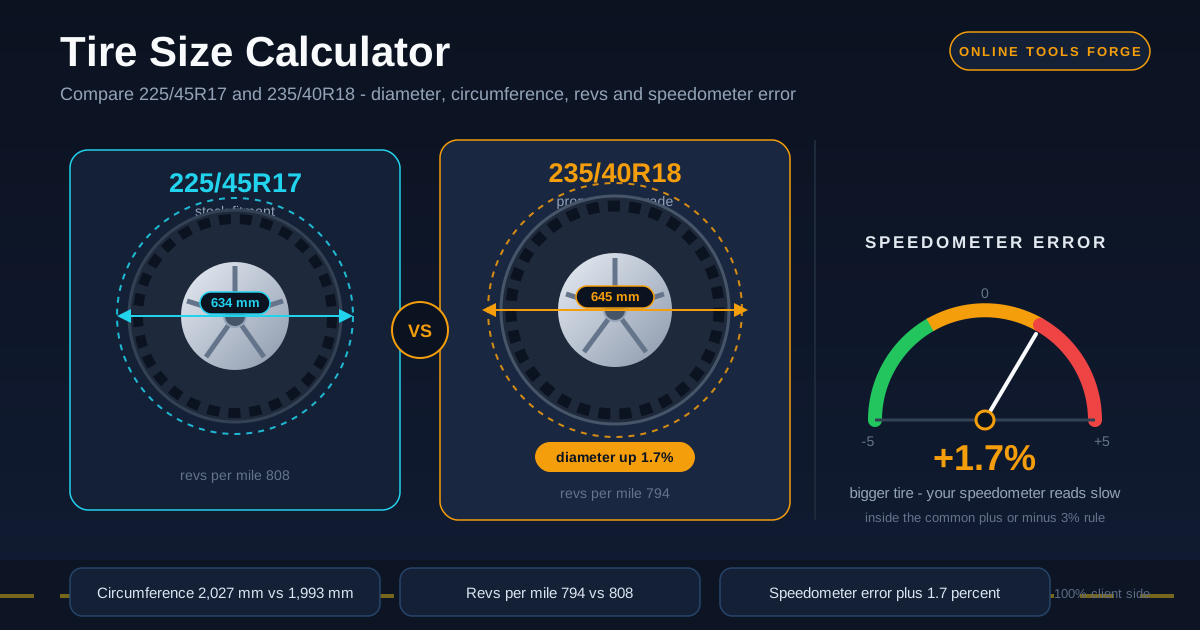
Table of Contents
Tire Size Calculator: Compare Sizes and Avoid Speedometer Error
New wheels transform the look of a car for relatively little money, and the tire shop will happily sell you a set that fills the arches beautifully. What the salesperson rarely mentions is the physics behind the sidewall: swapping to "nicer" wheels can quietly break your speedometer, skew your odometer, and rub your fenders on the first tight turn. The gap between a perfect fit and an expensive mistake is often a few millimeters of overall diameter.
The free Tire Size Calculator takes the guesswork out of that decision. Enter your stock size and the candidate — metric codes like 225/45R17 or flotation codes like 31x10.50R15 — and it instantly compares overall diameter, section width, circumference, revolutions per mile, and the resulting speedometer error, flagging anything outside the common diameter tolerance. Everything runs 100% in your browser — no sign-up, nothing leaves your device.
In this guide we walk through the tool step by step, decode what each number in a tire code means, and work the speedometer math with a real example.
Why Use Tire Size Calculator?
Here is what the tool brings:
- See the real diameter difference — Overall diameter drives clearance, gearing, and gauge accuracy; exact millimeter results replace showroom impressions.
- Predict speedometer error before you buy — A taller tire makes the speedometer read slow; a shorter one reads fast. Know the percentage before paying.
- Supports metric and flotation codes — Car sizes like 225/45R17 and light-truck sizes like 31x10.50R15 both parse automatically, no conversion chart needed.
- Check the 3% tolerance in one glance — A built-in diameter tolerance check warns when a candidate drifts outside the plus-or-minus 3% rule.
- Keep the decision private — Every calculation is client-side, so you can compare sizes on a phone outside the shop with nothing sent anywhere.
Key Features
The Tire Size Calculator compares exactly the numbers that matter for fitment:
| Feature | What It Does | Example |
|---|---|---|
| Metric code input | Parses width, aspect ratio, and rim diameter | 225/45R17 |
| Flotation code input | Parses diameter, width, and rim in inches | 31x10.50R15 |
| Overall diameter | Rim plus two sidewalls | 634.3 vs 645.2 mm |
| Section width | Contact patch width for both sizes | 225 vs 235 mm |
| Circumference | Distance covered per revolution | 1,993 vs 2,027 mm |
| Revolutions per mile | What sensors and the odometer count | 808 vs 794 |
| Speedometer error | Indicated vs true speed drift | plus 1.7% |
| Tolerance check | Warns beyond the 3% diameter rule | pass or warning |
- Two-way comparison — Either input can be the baseline: work forward from stock or backward from a dream size.
- Unit-friendly results — Diameters and widths appear in the units you shop in, handy when one code is metric, the other imperial.
How to Use
- Enter your stock size — Type the code from your current sidewall, for example 225/45R17, into the first field; this is the baseline your speedometer was calibrated against.
- Enter the candidate size — Type the size you are considering, such as 235/40R18, into the second field; both metric and flotation formats are accepted.
- Read the diameter comparison — The tool shows overall diameter for both sizes and the difference between them, the number that decides fitment.
- Check the speedometer error — See how far your indicated speed will drift and in which direction, plus the circumference and revolutions-per-mile changes.
- Respect the tolerance flag — If the difference exceeds the common 3% rule, look for a neighboring size before ordering.
Reading Tire Codes and the 3% Rule
Anatomy of a metric code
A code like 225/45R17 packs three measurements into a short string:
- 225 — the section width, the tire's sidewall-to-sidewall width in millimeters.
- 45 — the aspect ratio, sidewall height as a percentage of section width: 45% of 225 mm, about 101.3 mm.
- R17 — radial construction on a 17-inch rim, which is 431.8 mm.
Overall diameter is the rim plus two sidewalls: 431.8 + (2 × 101.3) = 634.3 mm. The aspect ratio is the part people misjudge — as rims grow, a lower aspect ratio keeps total diameter in check, which is how plus-sizing works.
Flotation codes
Trucks, SUVs, and off-road tires use a different dialect: 31x10.50R15 reads as roughly 31 inches of overall diameter and 10.50 inches of section width on a 15-inch rim. No aspect ratio is needed because the diameter is stated outright, and the calculator handles both grammars.
The 3% rule
Most fitment guides converge on one rule: keep the new overall diameter within about plus or minus 3% of stock. Inside that window, speedometer error stays minor, electronics tolerate the change, and fender clearance survives. Our worked pair — 634.3 mm versus 645.2 mm — differs by 10.9 mm, about 1.7%, comfortably inside.
Speedometer error math
The error is the ratio of the two diameters minus one:
error% = (new diameter / stock diameter - 1) x 100
error% = (645.2 / 634.3 - 1) x 100 = +1.72%
A bigger tire covers more ground per revolution, so the wheel turns more slowly than the car expects. The speedometer, which infers speed from wheel rotation, therefore reads low: when the dial shows 100 km/h you are actually traveling about 101.7 km/h. A smaller diameter does the opposite and reads high, which is annoying but safe; the under-read is the one to watch.
Clearance and gearing side effects
Diameter changes ripple beyond the gauge. A taller tire lifts the body slightly and can contact the fender liner at full lock; wider sections reach closer to suspension parts. Because the rolling radius grows, the final drive becomes taller: acceleration feels softer, revs sit lower at cruise, and one odometer mile now arrives slightly early — 794 revolutions instead of 808. These effects compound quickly past the 3% line.
Practical Use Cases
Plus-sizing decisions
The classic scenario: same overall diameter, larger rim, shorter sidewall, wider section. Comparing 225/45R17 against 235/40R18 is exactly this move — the calculator confirms the diameter stays within 2% and shows what you gain in stance and lose in cushioning.
Building a winter wheel set
Winter tires often go on a smaller, cheaper second set of wheels. Checking each set against the stock diameter keeps both configurations gauge-accurate, and the section-width comparison helps you pick a narrower patch for snow.
Correcting a known speedometer offset
If you already drive on oversized tires, the error reading tells you how much to adjust — or whether a GPS-verified recalibration is worth it. Converting corrected speeds between km/h and mph is a natural companion step for imported vehicles.
Shopping for used tires
Marketplace listings love rounded or mislabeled sizes. Before driving two hours for a "great deal," run both codes through the calculator to confirm the size matches your car and stays inside the tolerance you accept.
Best Practices
- Stay within the 3% diameter window — It is fitment's closest thing to a universal safety margin; treat a flag from the calculator as a hard question, not a suggestion.
- Check load rating and speed rating separately — Diameter compatibility does not make a tire structurally equivalent; the service description must still meet or exceed stock.
- Verify the actual measured diameter — Codes describe the mold, not the mounted tire; a tape measure across the fitted, inflated tire is the final word.
- Mind width and offset together — A wider section only fits if rim width and offset cooperate; plan a rubbing check at full steering lock.
- Match tires across each axle — Mixed circumferences confuse stability and ABS systems, so keep paired tires identical in size and wear.
Compare Before You Buy
Tire money is too easy to waste on a size that almost fits. Open the free Tire Size Calculator, punch in your stock code and the candidate, and know in seconds whether the swap keeps your speedometer honest — entirely in your browser, nothing to install.
Related Tools You Might Like:
- Speed Converter — Convert speedometer figures between km/h, mph, and knots when checking speedometer error.
- Unit Converter — Translate millimeter diameters and widths into inches for cross-checking flotation sizes.
- Pressure Converter — Switch tire pressures between kPa, psi, and bar for any wheel set.
Safe motoring, and measure twice before you mount!
Frequently Asked Questions
Q: What tire codes does the calculator accept?
A: Both common formats: metric codes such as 225/45R17, and flotation codes such as 31x10.50R15, which state diameter and width in inches. Enter each size in its own field and the tool normalizes the rest.
Q: What does the 3% rule actually protect?
A: It limits the change in overall diameter so speedometer and odometer error stay small, electronics keep seeing plausible wheel speeds, and gearing changes remain mild. Beyond roughly 3%, rubbing risks and electronic warnings grow quickly.
Q: My speedometer reads slow after an upgrade. Why?
A: Your new tires are taller than stock, so each revolution covers more ground than the car assumes. Because the speedometer derives speed from wheel rotation, it under-reports true speed — the calculator's error percentage says by exactly how much.