XML to XSD Generator: Infer a Schema From Instance Documents
Generate a W3C XML Schema (XSD) from any XML document with type detection, cardinality analysis, and attribute capture. Free schema inference in your browser.
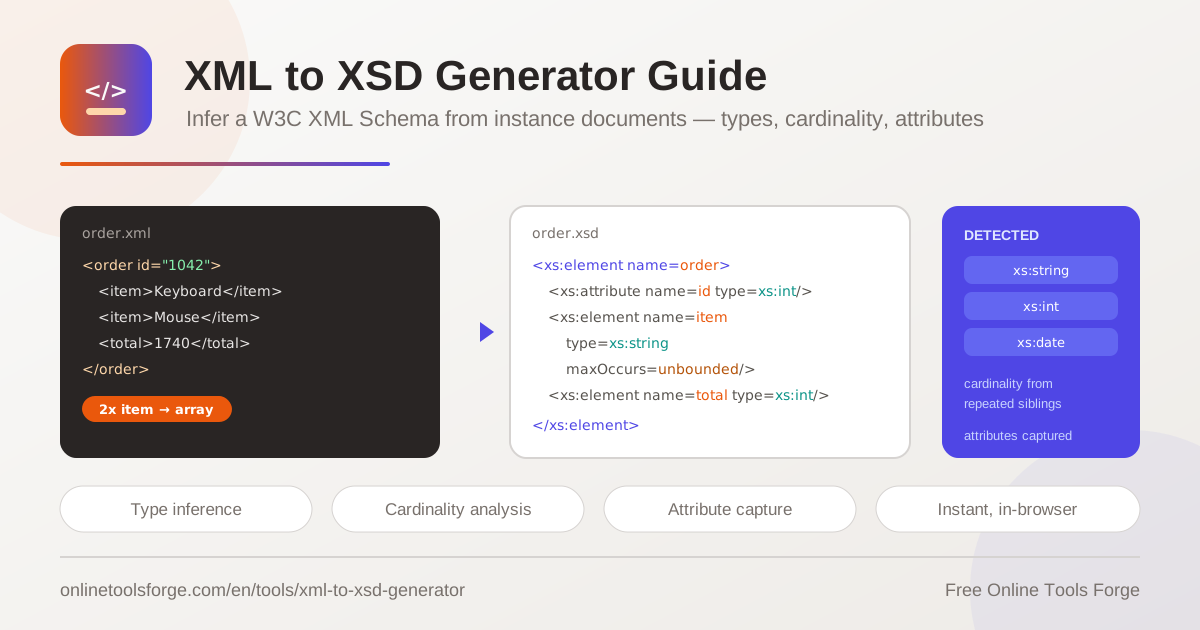
Table of Contents
XML instance documents arrive from everywhere: legacy SOAP endpoints, enterprise service buses, partner file drops, and databases that export structured feeds. Yet the schema that describes them — the W3C XML Schema (XSD) that defines which elements and types are allowed — is frequently missing, outdated, or locked away in a repository nobody can access. When you need to validate, map, or document that XML, you are stuck reverse-engineering the structure by hand.
The XML to XSD Generator solves this in seconds. Paste any XML instance document and the tool infers a well-formed XSD: it detects text types such as xs:string, xs:int, and xs:date, measures cardinality from repeated sibling elements, captures attributes as xs:attribute definitions, and handles deeply nested structures. Everything runs entirely in your browser, so sensitive payloads never leave your machine.
Why Use the XML to XSD Generator?
- Recover lost schemas instantly. When the original .xsd for a legacy interface has vanished, the generator rebuilds a working draft from sample messages, saving hours of manual analysis.
- Zero setup, zero signup. The tool is free and runs 100% in your browser: nothing to install, no account, and no upload step that could expose confidential data.
- Accurate type detection. Element values are classified into W3C built-in types, so <price>19.99</price> is typed correctly instead of falling back to a vague string.
- Cardinality without guesswork. Repeated sibling elements are emitted with maxOccurs="unbounded", capturing list-like structures a naive converter would flatten.
- Complete attribute capture. Attributes on any element become proper xs:attribute definitions with inferred types.
- A reliable starting point. The generated XSD is a strong draft to refine with business rules — far faster than writing one from an empty editor.
Key Features
| Feature | What it does |
|---|---|
| Paste-to-schema workflow | Accepts an XML instance document and produces a generated W3C XML Schema (XSD) ready to copy. |
| Text type detection | Classifies element content into xs:string, xs:int, xs:date, and related types based on observed values. |
| Cardinality analysis | Detects repeated sibling elements and marks them maxOccurs="unbounded" so lists are modeled correctly. |
| Attribute extraction | Converts each observed attribute into an xs:attribute definition with an inferred type. |
| Nested structure support | Recursively walks child elements to build nested complex types that mirror the document hierarchy. |
| Fully in-browser generation | All parsing and inference happens client-side; your XML never touches a server. |
A few details worth highlighting:
- The detector distinguishes integers, decimals, dates, and booleans before falling back to xs:string, so numeric and date fields arrive correctly typed.
- Inference is deterministic and runs locally, so you can tweak the XML and regenerate freely without a network round trip.
How to Generate an XSD
- Open the tool. Navigate to the XML to XSD Generator in any modern browser.
- Paste your XML. Copy a representative instance document into the input area — include optional fields, repeated rows, and every attribute you expect to support.
- Review the detected structure. The tool analyzes element nesting, text types, cardinality, and attributes as it walks the tree.
- Inspect the generated XSD. Study the xs:element and xs:complexType declarations, and note anything the sample could not reveal, such as enumerations or value ranges.
- Copy and refine. Copy the schema into your project, validate it against more samples, and add constraints where business rules demand them.
How Schema Inference Works
Schema inference is a structured walk over the XML tree, driven by four signals: structure, text content, repetition, and attributes.
First, the generator parses the document and visits every element, recording its name, its children, and the order in which children appear. Elements containing child elements become complex types; elements with only text become simple typed elements. Nesting is preserved, so an order containing repeated item children yields a complex type with an embedded repeatable element.
Next comes type detection. Each text value is tested against common patterns: pure digits map toward xs:int, decimal notation toward numeric types, ISO-style values such as 2026-09-18 toward xs:date, and anything else toward xs:string. A field like <total>1250.50</total> therefore comes out typed instead of generic.
Cardinality is derived from siblings. Two or more consecutive children sharing a name mark that element repeatable with maxOccurs="unbounded", while the minimum occurrence reflects whether the element ever appears in the sample.
<order id="1001">
  <item sku="A1" qty="2">Widget</item>
  <item sku="A2" qty="5">Gadget</item>
</order>
<!-- Inferred: <xs:element name="item" maxOccurs="unbounded"/> with <xs:attribute name="qty" type="xs:int"/> -->
Attributes are collected the same way: every attribute observed on an element is emitted as an xs:attribute with an inferred type, so metadata such as id or sku becomes part of the schema rather than lost.
Know the limits, too. Inference works from a single sample, so it cannot discover values that never appeared: an optional element absent from the document will not exist in the schema, and business constraints like enumerations or ranges are invisible to any instance-based analyzer. Treat the output as a high-quality draft, then harden it against real traffic.
Practical Use Cases
Integrating Legacy SOAP Feeds
An old SOAP service still returns XML, but its WSDL and schemas were lost years ago. Capture a few representative response envelopes, paste them into the generator, and you have complexType definitions for the payload within minutes. From there you can generate client stubs, wire up validation, or document the interface for the team inheriting it.
Documenting Lost or Missing Schemas
Many enterprise integrations outlive their documentation. When the only artifact is a folder of sample XML files, the generated XSD becomes living documentation: element names, nesting, types, and cardinality are spelled out in a format every XML tool can read.
Validating Partner XML Exports
Before ingesting a partner nightly export, convert a sample into a schema and run it through an XML validator. The inferred XSD catches structural drift immediately — a renamed element, a new required attribute, an unexpectedly repeated block — before malformed data reaches your staging tables.
Teaching XML Schema Concepts
Instructors and students can paste a small document, study the emitted schema, then modify the document and regenerate to see how repetition, attributes, and nesting reshape the output. It makes the mapping between instance and abstract schema concrete.
Best Practices
- Feed representative samples. Include optional fields, empty values, repeated blocks, and every attribute you know about; richer input produces a more complete schema.
- Use several documents. Infer from multiple real messages and merge the results, since no single document shows the full variability of a feed.
- Tighten types deliberately. If a field should be an enumeration or a constrained range, add those facets after generation rather than accepting defaults blindly.
- Validate round trips. Confirm the original document passes the generated schema, then run negative cases to confirm drift is actually rejected.
- Keep namespaces consistent. Match the target namespace in the XSD to the one used by your real messages, or validation will fail on prefix mismatches.
Start Inferring Schemas Today
Whether you are resurrecting a legacy SOAP interface, documenting a partner feed, or teaching XSD, the XML to XSD Generator turns sample XML into a working schema in one paste. It is free, requires no signup, and runs entirely in your browser — so the next time a schema goes missing, you are one document away from a replacement.
Related Tools You Might Like:
- XML Validator — check whether your documents conform to the generated schema.
- XML to JSON Converter — transform XML payloads into JSON for modern pipelines.
- XML Formatter — pretty-print and indent messy XML before analysis.
Happy inferring!
Frequently Asked Questions
Q: What is schema inference in the context of XML to XSD conversion?
A: Schema inference is the process of deriving a W3C XML Schema from one or more XML instance documents. The generator inspects element structure, text values, repetition, and attributes to produce an XSD that describes the observed shape.
Q: How accurate is the type detection in the generated XSD?
A: The detector classifies common value formats — integers, decimals, dates, strings — into matching built-in types like xs:int and xs:date. Accuracy depends on your sample, so providing varied values improves the result.
Q: Can the tool handle repeated elements and nested structures?
A: Yes. Consecutive sibling elements with the same name are emitted with maxOccurs="unbounded", and child elements are recursively converted into nested complex types that preserve the hierarchy.
Q: Does my XML data leave my computer when I use the generator?
A: No. All parsing and inference runs entirely in your browser and nothing is uploaded to a server, which makes the tool safe for internal or sensitive payloads.
Q: What should I do after generating an XSD from a sample document?
A: Treat the output as a draft. Validate it against additional real messages, add missing optional elements, and introduce enumerations and ranges where business rules apply.