555 Timer Calculator: Master Astable, Monostable, and E24 Timing Math
Free online 555 timer calculator. Compute astable frequency and duty cycle or monostable pulse width from R and C values, or reverse-solve R1/R2 from a target frequency with E24 standard values. 100% client-side.
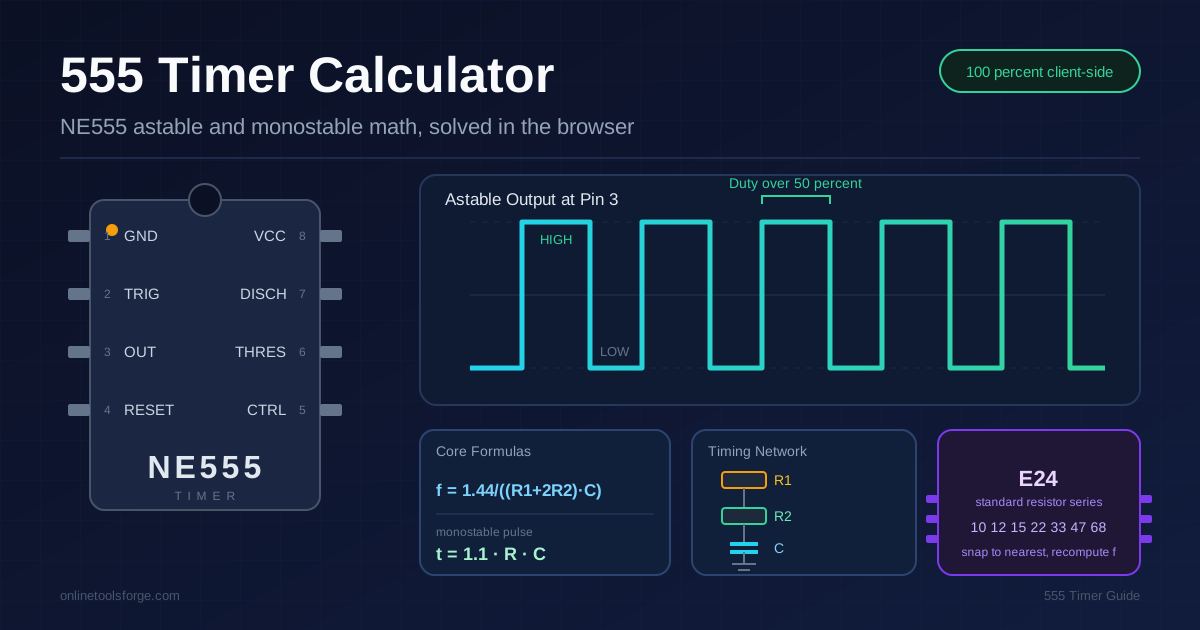
Table of Contents
555 Timer Calculator: Master Astable, Monostable, and E24 Timing Math
Few chips have earned their place in electronics history like the NE555. It has been in continuous production since 1972 — and its R/C math still trips people up more than five decades later. Whether you are blinking an LED or generating a tone, you must turn resistance and capacitance into frequency, duty cycle, or pulse width — and doing that by hand invites slip-ups.
The free 555 timer calculator handles that math in both directions. Forward mode turns R1, R2, and C into frequency and duty cycle, or R and C into a monostable pulse width. Reverse mode works backwards from a target frequency, snapping the result to real E24 standard resistors and reporting the actual frequency you will measure on the bench. Everything runs 100% client-side in your browser — no signup, no uploads, results updating as you type.
Why Use 555 Timer Calculator?
- Two directions, one tool: it also reverse-solves a target frequency into resistor values, where most designs begin.
- E24-aware reverse solving: instead of ideal values like 13.79 kΩ that no shop stocks, it snaps to values you can buy.
- Actual versus target readout: after snapping, it recomputes the real frequency and duty cycle.
- Honest duty cycle numbers: the classic astable circuit never drops below 50 percent.
- Instant and private: all math runs locally with live updates — no accounts, no uploads.
Key Features
| Feature | What It Does |
|---|---|
| Astable mode | Computes frequency and duty cycle from R1, R2, and C |
| Monostable mode | Computes output pulse width from a timing resistor and capacitor |
| Reverse solve | Turns a target frequency into the nearest E24 resistor pair |
| Actual vs target readout | Recomputes real frequency and duty cycle from the snapped values |
| Client-side operation | Runs entirely in the browser; nothing is sent to a server |
- Mode switching is immediate — compare astable and monostable behavior for the same parts in seconds.
- Flexible unit entry accepts ohms, kilohms, microfarads, or nanofarads.
How to Use
- Pick a mode. Open the 555 timer calculator and choose astable (free-running oscillator) or monostable (one-shot pulse).
- Run a forward astable calculation. Enter R1, R2, and C to instantly read frequency and duty cycle.
- Run a monostable calculation. Enter the timing resistor and capacitor to read the output pulse width.
- Reverse-solve from a target. Enter the frequency you want; the tool snaps both resistors to the nearest E24 values.
- Check the actual result and build it. Read the recomputed actual frequency and duty cycle, then order those exact parts.
Astable, Monostable, and the Math
The astable formula and the 50 percent problem
In astable mode the output flips continuously, and the frequency follows:
f = 1.44 / ((R1 + 2·R2)·C)
The capacitor charges through R1 + R2 toward two-thirds of the supply, then discharges through R2 alone down to one-third. Each leg takes 0.693·R·C (that is ln 2), so 1/0.693 ≈ 1.44. The duty cycle is (R1 + R2) / (R1 + 2·R2), always greater than 50 percent in the classic circuit: the high phase charges through more resistance than the low phase. Needing under 50 percent means adding a diode across R2 — the honest readout makes that limitation visible.
The monostable formula
In monostable mode a trigger on pin 2 produces a single pulse of width t = 1.1·R·C. The factor is ln 3: the pulse ends when the charging capacitor reaches the two-thirds threshold. It is simple, reliable, and independent of supply voltage.
A worked example
Take the classic blinker values R1 = 10 kΩ, R2 = 47 kΩ, C = 10 µF: f = 1.44 / ((10,000 + 94,000) × 0.00001) ≈ 1.38 Hz — a pleasant LED blink rate. Duty cycle is 57,000 / 104,000 ≈ 54.8 percent. In monostable mode the same parts give t ≈ 0.52 s.
Reverse solving with E24 snap
Designs usually start from a spec, not parts on hand. Need roughly 1 kHz? Enter 1,000 Hz and the calculator works backwards to ideal values, then snaps each to the nearest E24 value (10, 12, 15, 22, 33, 47, 68 across decades). Because 13.79 kΩ does not exist in a drawer, you get 12 kΩ and 47 kΩ, with the actual frequency recomputed — you know up front whether 982 Hz is close enough.
Practical notes that save headaches
Electrolytic capacitors — the usual choice below 100 Hz — carry ±20 percent tolerance and leakage, so a nominal 1 Hz blinker may run at 0.8 or 1.2 Hz. Noise on the internal divider also causes jitter; a 0.1 µF bypass capacitor on pin 5 plus supply decoupling firms up both thresholds.
Practical Use Cases
LED blinkers and flashers
The canonical 555 project. For a bicycle flasher or status indicator, astable mode gives direct control of blink rate, and E24 reverse mode goes from "I want 1.5 Hz" to buyable parts in one step.
Tone generators and audio experiments
Astable oscillators from hundreds of hertz to a few kilohertz drive small speakers for sirens, chimes, and Morse practice. Reverse-solving from a musical target makes a multi-tone organ easy from one 555 and a rotary switch.
Switch debounce and one-shot pulses
Mechanical switches bounce for milliseconds, confusing counters and microcontroller inputs. A monostable triggered by the switch emits one clean 50 ms pulse, swallowing every bounce; the same pattern stretches short sensor pulses for slower logic.
PWM-style hobby circuits
Motor speed controllers, LED dimmers, and small heater regulators often start as a 555 astable feeding a transistor. Frequency sets the feel while duty cycle sets the delivered power — the calculator shows both before you solder.
Best Practices
- Prefer film or C0G/NP0 capacitors for timing. Save electrolytics for when the math demands microfarads.
- Check duty with the actual E24 values. Snapped resistors shift frequency and duty cycle slightly.
- Add a 0.1 µF bypass capacitor on pin 5 and decouple the supply close to the chip.
- Keep timing resistors between roughly 1 kΩ and 1 MΩ. Below that wastes current; above it, leakage skews the math.
- Budget for electrolytic tolerance. The circuit should work even if C is 20 percent off.
- Verify on real hardware. A multimeter or scope confirms the assembled circuit.
Design Your Next 555 Circuit With Confidence
The 555 has survived fifty years by being cheap, rugged, and endlessly useful — but it does not forgive sloppy R/C math. Open the 555 timer calculator, enter a target frequency or the parts on hand, and let E24 snapping hand you a buildable design with real numbers.
Related Tools You Might Like:
- LED Resistor Calculator — size the current-limiting resistor for the LED your 555 is blinking.
- Ohm's Law Calculator — verify voltages, currents, and power anywhere in your circuit.
- Capacitor Code Calculator — decode the three-digit codes on your timing capacitors.
Happy building!
Frequently Asked Questions
Q: What is a 555 timer used for?
A: It generates timing signals. Astable mode produces a continuous square wave for flashers, tones, and clocks; monostable mode produces one fixed-width pulse for debouncing and pulse stretching. In production since 1972, billions are sold yearly.
Q: Why is the duty cycle always above 50 percent in a classic astable circuit?
A: The high phase charges through R1 + R2 while the low phase discharges through R2 alone, so the output stays high longer than low. Going under 50 percent requires a diode across R2 or a modified topology.
Q: What are E24 resistor values?
A: The standard series of preferred values — the digits 10, 12, 15, 22, 33, 47, and 68 repeated in every decade. Every supplier stocks them, which is why the reverse solver snaps to them.
Q: How accurate will my real circuit be?
A: The formula is exact for ideal parts, but real components have tolerance — resistors ±1 to 5 percent, capacitors ±5 to ±20 percent. The capacitor dominates, so check the actual-vs-target readout and leave margin.
Q: Does the calculator send my values anywhere?
A: No. All computation runs client-side in your browser. Nothing is uploaded or stored, and you can keep using it offline once the page loads.