Capacitor Code Calculator: Decode 3-Digit Markings to pF, nF, and µF
Free online capacitor code calculator. Decode 3-digit ceramic capacitor markings (104 = 100nF) to pF/nF/µF and back, with R decimal notation and tolerance letters. 100% client-side.
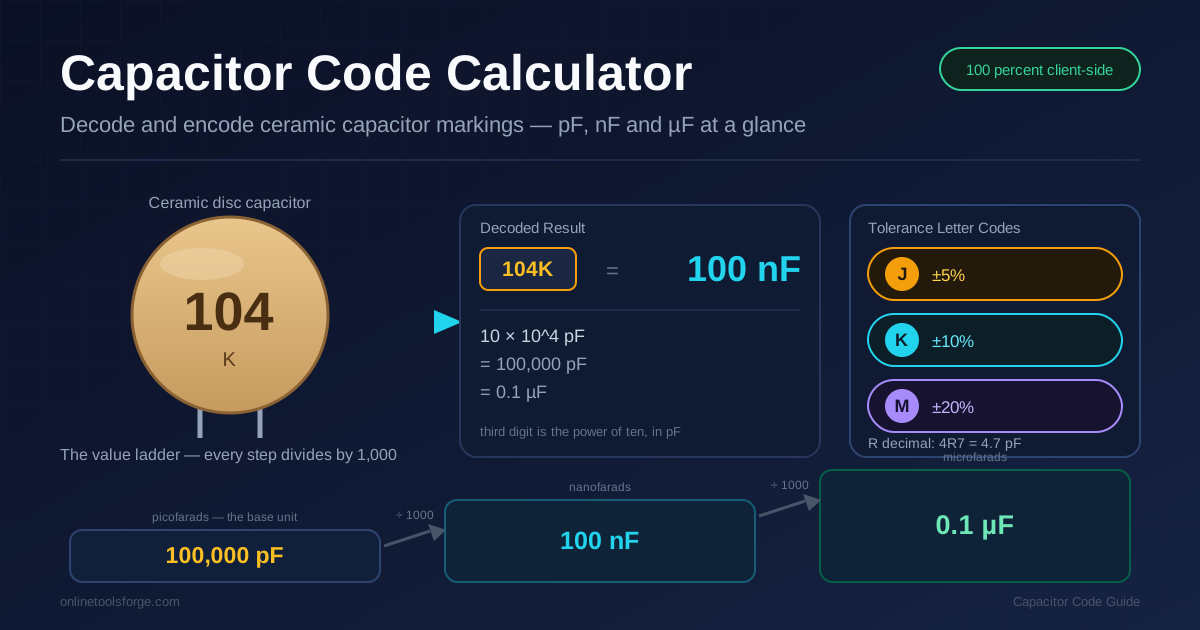
Table of Contents
Capacitor Code Calculator: Decode 3-Digit Markings to pF, nF, and µF
Ceramic capacitors are tiny, and that smallness is exactly why their markings look so cryptic. There is room on the body for three digits — not for "0.1 µF" or "100 nanofarads." So manufacturers print a code instead: 104, 221, 4R7, sometimes trailed by a lone letter. The free capacitor code calculator turns those markings into real values the moment you type them.
The tool works in both directions. Decode 104 and read 100 nF; encode 0.47 µF and get the code back; enter 4R7 and see 4.7 pF with the tolerance letter decoded alongside.
Why Use Capacitor Code Calculator?
- No mental exponent math: 104 means 10 followed by four zeros in picofarads — quick in theory, error-prone late in a session.
- Both directions covered: decode markings into pF, nF, and µF, or encode a schematic value back into the code you should buy.
- Handles the awkward cases: two-digit codes, R decimal notation for sub-10 pF parts, and trailing tolerance letters all parse cleanly.
- Instant unit comparison: every result appears in pF, nF, and µF at once, whatever convention the schematic uses.
- Private and offline-friendly: everything runs client-side in your browser; no values are uploaded or stored.
Key Features
| Feature | What It Does |
|---|---|
| Decode mode | Turns 2- and 3-digit codes into pF, nF, and µF |
| Encode mode | Converts a capacitance value back into its printed code |
| R decimal notation | Reads 4R7 as 4.7 pF for small values |
| Tolerance letters | Decodes J, K, M, and other EIA tolerance classes |
| Client-side operation | Runs entirely in the browser; nothing leaves your device |
- Live updates: results refresh as you type, so comparing candidates takes seconds.
- Clear errors: invalid codes are flagged instead of silently misread.
How to Use
- Pick a direction. Open the capacitor code calculator and choose decode to turn a marking into a value, or encode to turn a value into a marking.
- Decode a marking. Type the code from the body — say 104. The tool reports 10 × 10^4 pF = 100,000 pF = 100 nF = 0.1 µF immediately.
- Include the tolerance letter. If the body reads 104K, enter all four characters and the K decodes as ±10 percent.
- Encode a schematic value. Enter 0.1 µF or 220 pF and the tool returns 104 or 221 — the exact markings to hunt for in the drawer or catalog.
- Check the special cases. Enter 4.7 pF to see the code 4R7, and confirm that a bare two-digit 22 means 22 pF.
First Two Digits Times Ten to the Third
The pF base system
Every three-digit code follows one rule: the first two digits form a number, and the third digit counts how many zeros follow — always in picofarads. Code 104 means 10 plus four zeros: 100,000 pF. Code 221 means 22 plus one zero: 220 pF. There is no hidden unit switch; the base unit is always the picofarad, which is why the smallest and the largest ceramic capacitors share the same grammar.
Worked examples
| Code | Math | Value |
|---|---|---|
| 104 | 10 × 10^4 pF | 100,000 pF = 100 nF = 0.1 µF |
| 221 | 22 × 10^1 pF | 220 pF |
| 4R7 | R marks the decimal point | 4.7 pF |
| 22 | Two digits, no multiplier | 22 pF |
Values below 10 pF cannot use the multiplier grammar cleanly, so manufacturers replace the decimal point with the letter R — a convention borrowed from resistor notation. That is why 4R7 is 4.7 pF and 0R1 is 0.1 pF.
The pF to nF to µF ladder
Schematics and shop listings mix units freely, so the ladder matters as much as the code. Each step down — pF to nF to µF — divides by 1,000; moving back up multiplies by 1,000. The marking 104 sits at one point under three names: 100,000 pF, 100 nF, and 0.1 µF. When a schematic says 0.1 and a drawer says 104, the calculator confirms they match.
Tolerance letters
The letter that sometimes follows the code is the EIA tolerance class: J means ±5 percent, K means ±10 percent, and M means ±20 percent. Tolerance never changes the nominal value — a 104K and a 104M are both 100 nF — but it bounds how far the real part may wander. Timing and filter circuits want J parts; decoupling is content with M.
Voltage markings
Small ceramic discs usually omit the voltage rating, and silence is normal — the code covers capacitance only. When a voltage does appear, it is printed apart from the code (50, 100, or 1kV) and gives the DC working voltage, not a capacitance figure. Never assume an unmarked disc suits high-voltage work; check the datasheet first.
Practical Use Cases
Sorting the junk bin
Every hobbyist owns a jar of unlabeled capacitors. Decode each marking once, write 100 nF on the bag, and the jar becomes a usable inventory. Encode mode answers the reverse question when a schematic demands a specific code.
Verifying replacements
Repair work rarely offers the exact part. When the schematic calls for 0.22 µF and the drawer holds a 224, a quick decode confirms the match — and its tolerance — before the iron heats up.
Breadboard builds
Prototypes get rebuilt often, and re-reading tiny markings every time invites mistakes. Decode the codes once at the start of a session, keep the pF, nF, and µF values beside the board, and swap-ins become lookups instead of fresh math.
Kit assembly
Kits often list values one way (0.1 µF) while bagging parts another (104). Decoding every bag against the bill of materials takes minutes and catches the swapped-bag error that otherwise appears as a circuit that refuses to run.
Best Practices
- Measure suspicious parts with a meter. Codes describe intent, not condition; a cracked disc can be marked 104 and measure open.
- Respect voltage ratings even when capacitance matches. A 100 nF part rated 16 V does not substitute for one running at 100 V.
- Keep decoded values on storage labels. Write 100 nF beside 104 on the bag; future-you will thank you.
- Prefer C0G/NP0 for timing and filters. Tight tolerance beats price there; let class-2 ceramics handle decoupling.
- Convert before you order. If a listing says 0.1 with no unit, run it through the ladder first.
Decode Your First Capacitor Today
Grab the nearest ceramic capacitor, read its three digits, and open the capacitor code calculator. Enter the code, read the value in all three units, and note the tolerance letter. Ten seconds later the marking is no longer a mystery, and your parts jar is one step from organized.
Related Tools You Might Like:
- 555 Timer Calculator — pair freshly decoded capacitors with the right resistor values for astable and monostable circuits.
- LED Resistor Calculator — size the current-limiting resistors for the LED projects sharing that same junk bin.
- Resistor Color Code Calculator — decode the color bands on the resistors sitting in the drawer next to those capacitors.
Happy decoding!
Frequently Asked Questions
Q: What does the code 104 mean on a ceramic capacitor?
A: It means 10 × 10^4 picofarads: 100,000 pF, which is 100 nF, which is 0.1 µF. The first two digits are the significant figures; the third counts the zeros.
Q: What does the K in a marking like 104K mean?
A: It is an EIA tolerance class. J is ±5 percent, K is ±10 percent, and M is ±20 percent. Accuracy changes; the nominal value does not.
Q: Why do some small capacitors use codes like 4R7?
A: Below 10 pF the multiplier grammar gets awkward, so the letter R stands in for the decimal point: 4R7 is 4.7 pF and 0R1 is 0.1 pF.
Q: Does the calculator send my values anywhere?
A: No. Decoding and encoding run client-side in your browser. Nothing is uploaded, stored, or shared, and the page keeps working offline once loaded.