Battery Life Calculator: From Label mAh to Realistic Runtime Estimates
Estimate true device runtime from battery capacity, voltage, and average current draw with derating, reserve margin, and duty-cycle scenarios using the free Battery Life Calculator.
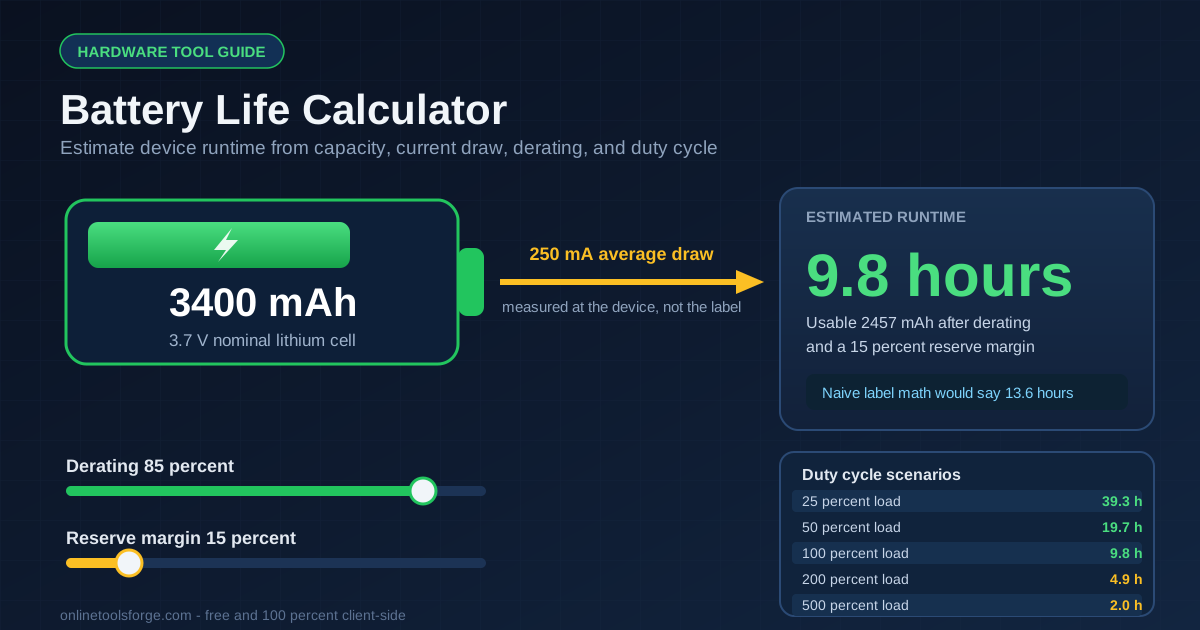
Table of Contents
Battery Life Calculator: From Label mAh to Realistic Runtime Estimates
Every hardware builder knows this moment. The label says 3000 mAh, the circuit draws a modest current, and the device is dead within a day. The naive math promised three days. The gap has three names: derating, duty cycle, and marketing.
The Battery Life Calculator closes that gap. Instead of a one-line division, you enter capacity, voltage, and average current draw, then apply a derating factor and reserve margin. A scenario table shows how runtime shifts when the load doubles, halves, or spikes.
This guide explains why the naive formula lies, how to use the calculator properly, and how to reason about mAh, Wh, and duty cycle like an engineer.
Why Use Battery Life Calculator?
- Marketing capacity is not usable capacity. Age, temperature, and discharge rate all eat into a 3400 mAh rating. The derating control models that loss explicitly.
- Duty cycle beats headline current. Almost no device draws a constant current. The scenario table shows runtime at 25 to 500 percent of your load, so bursty behavior stops being a surprise.
- mAh versus Wh confusion ends here. Comparing a 20000 mAh power bank with a 50 Wh laptop pack by mAh alone is meaningless; the calculator handles both units and uses voltage correctly.
- Reserve margin prevents hard failures. Draining a lithium cell to 0 percent triggers cutoffs and data loss. The reserve slider keeps a deliberate buffer in every plan.
- Presets make comparisons instant. AA, AAA, 9V, CR2032, 18650, phone, power bank, and laptop packs are one click away.
- It is private, instant, and free. Everything runs 100 percent client-side in your browser. No sign-up, no upload, just numbers you can act on.
Key Features
| Feature | What it does |
|---|---|
| Capacity input (mAh or Wh) | Enter the rating the way your datasheet states it, with a mode switch |
| Voltage and average current draw | Converts between charge and energy correctly using nominal voltage |
| Derating factor | Scales capacity down for real losses: aging, temperature, discharge rate |
| Reserve margin | Holds back a percentage of capacity you never plan to consume |
| Load scenario table | Shows runtime at 0.25x to 5x your average load for duty-cycle planning |
| Instant, client-side results | Recalculates on every keystroke with nothing sent to a server |
- Reports usable energy in Wh after derating and reserve — the number that actually powers your regulator.
- Translates raw hours into days, so a 38-hour estimate does not silently become "a couple of days."
How to Use
- Choose your capacity mode. Switch between mAh (what cell labels show) and Wh (what laptop labels show). Enter the rated capacity, or click a preset such as the 3400 mAh 18650.
- Enter the nominal voltage. Use 3.7 V for a lithium cell, 1.5 V for alkaline, 3 V for a CR2032. Voltage matters when capacity is in mAh and you care about energy.
- Enter the average current draw in mA. This is the value your multimeter gave you across a full duty cycle, not the datasheet's peak.
- Set derating and reserve. A common start is 80-85 percent derating for lithium chemistry and a 10-20 percent reserve. Cold or high-drain designs justify more.
- Read the results and stress-test them. Check the headline runtime, then scan the scenario table to see what a lighter or heavier load does.
mAh, Wh, and the Duty-Cycle Truth
In ideal math, runtime is capacity divided by current: a 3000 mAh cell feeding 250 mA lasts 12 hours. The formula is correct and nearly useless — the ignored details do the damage.
mAh versus Wh: voltage matters when comparing packs. Milliamp-hours measure charge; watt-hours measure energy, and energy is what your circuit consumes. A 20000 mAh power bank at 3.7 V stores 74 Wh, but only a fraction reaches a 5 V output after conversion losses. So compare packs in Wh; the calculator does this using the voltage you enter.
Derating models everything the label ignores. Real capacity shrinks with cycle aging, elevated discharge rates (a Peukert-style effect that hits high-drain loads hardest), and cold — a lithium cell at -10 degrees Celsius delivers 20-30 percent less. Regulator efficiency and self-discharge compound the loss, so 20-30 percent derating on lithium is standard practice.
Reserve margin exists because 0 percent is a cliff. Protection circuits cut off, LDO regulators drop out early, and a brown-out during a flash write corrupts data. Consuming only 80-90 percent of capacity turns a hard failure into predictable maintenance.
Duty cycle is where most estimates go wrong. Every device has two currents: sleep in microamps and active in milliamps. The 0.25x to 5x scenario rows show how sensitive runtime is to that average — if your radio transmits twice as often as planned, "two years" becomes "one year."
A worked example: the IoT sensor node. Suppose a node sleeps at 50 microamps and wakes once per minute to transmit for 100 ms at 50 mA. The active contribution is 50 mA times 0.1/60 — about 83 microamps — giving an average draw near 133 microamps. Naive math: 3000 mAh divided by 0.133 mA is 22,500 hours, or 2.5 years. Derate to 70 percent with a 10 percent reserve and usable capacity drops to 1890 mAh: realistic runtime, about 1.6 years — the difference between a deployment plan and a field of dead sensors.
Practical Use Cases
IoT Sensor Deployment Planning
Battery replacement dominates the maintenance cost of a sensor fleet. Before committing a node to a rooftop or greenhouse, run its measured currents through the calculator with conservative derating and a winter-sized reserve. If the answer sits too close to your service interval, fix the firmware first — longer sleep, lower transmit power.
Portable and Wearable Project Sizing
For a handheld gadget, runtime competes with weight and cost. With common-cell presets one click away, you can compare four pack options in under a minute and pick the smallest one that meets your spec with margin.
Backup Power Estimation
A router or Raspberry Pi on a UPS battery is a duty-cycle problem too. Enter the measured average draw and the battery's true usable capacity (derate lead-acid to roughly 50 percent), and the result tells you whether a blackout lasts through the night — or through dinner.
Product Spec Sanity Checks
Before printing "up to 48 hours battery life" on a box, run your own numbers. If the derated estimate says 31 hours, you found the problem before your customers did. The same check verifies vendor claims: a power bank promising eight phone charges can be tested against its Wh rating in seconds.
Best Practices
- Measure real current draw, never trust the datasheet alone. A USB power meter across a full duty cycle beats any headline number.
- Apply 20-30 percent derating for lithium cells. Aging, temperature, and rate effects mean a healthy cell rarely delivers its label capacity in the field.
- Plan for cold weather explicitly. Add 10-20 percent more loss for winter and size the reserve for the coldest week of the year.
- Compare packs in Wh, not mAh. When options differ in chemistry or cell count, enter each with its own voltage.
- Model duty cycle honestly. Average sleep and active currents realistically, including forgotten wakeups and that status LED you left on.
- Keep 10-20 percent reserve and treat it as untouchable — it absorbs estimate errors you have not discovered yet.
Run the Numbers Before You Commit
Battery mistakes are cheap to fix in a spreadsheet and expensive in the field. Open the Battery Life Calculator, enter your capacity, voltage, and measured draw, apply an honest derating and reserve, and let the scenario table stress-test your assumptions.
Related Tools You Might Like:
- LED Resistor Calculator — size current-limiting resistors for the LEDs your battery powers.
- Voltage Drop Calculator — confirm the voltage arriving at your circuit is what it needs.
- 555 Timer Calculator — compute the timing components behind your duty-cycle pulses.
Happy calculating!
Frequently Asked Questions
Q: How do I calculate battery life from mAh?
A: Divide capacity in mAh by average current in mA for ideal hours — a 3000 mAh cell at 250 mA gives 12 hours. Then apply 80-85 percent derating (typical for lithium) and a 10-20 percent reserve. The calculator applies both steps automatically.
Q: How much derating should I apply to a lithium battery estimate?
A: Start with 20-30 percent for lithium-ion or lithium-polymer cells; increase it for high discharge rates, cold temperatures, or multi-year service life. Winter or high-drain designs can justify a combined derating plus reserve of 40-50 percent.
Q: Why does my device die faster than the calculated runtime?
A: Usually the average current is higher than assumed (forgotten wakeups, status LEDs, inefficient regulators), the battery is cold or aged, and the cutoff stops delivering usable power before 0 percent.
Q: Does the calculator send my data anywhere?
A: No. It runs entirely in your browser, 100 percent client-side. Nothing you enter leaves your device, and the tool is free with no sign-up.